Technipol polyester and polyamide hot melts by Sipol for filters, footwear, heat-shrink tubing, electronics and road marking. Melting and softening points from 64 to 192 °C, solvent-free, with bio-based and biodegradable grades.
Technipol hot melts are thermoplastic copolyesters and copolyamides made by Sipol S.p.A. in Mortara, Italy. They melt to a liquid, wet the substrate and set as they cool and crystallize, with no solvent, no cure and no mixing. Across the range, melting and softening points run from 64 °C to 192 °C.
Sipol polymerizes every grade itself, so each one is built for a single job: pleat beads in an engine air filter, rod cement on a toe lasting machine, the liner inside heat-shrink tubing, a low-pressure molded connector, a road-marking binder. P.A.T. Products supplies the full Technipol range across the United States, Canada and Mexico, with Sipol's technical team behind every qualification.
Copolyester or copolyamide
Technipol copolyesters (CoPES)
White to transparent, density 1.11 to 1.29 g/cm³, with melting points from 154 °C to 185 °C on the adhesive grades. The filter grades stretch past 500 percent before they break, so the bond rides out vibration, and every one of them can be foamed. Food-contact carrier grades sit in the same family.
Technipol PA copolyamides (CoPA)
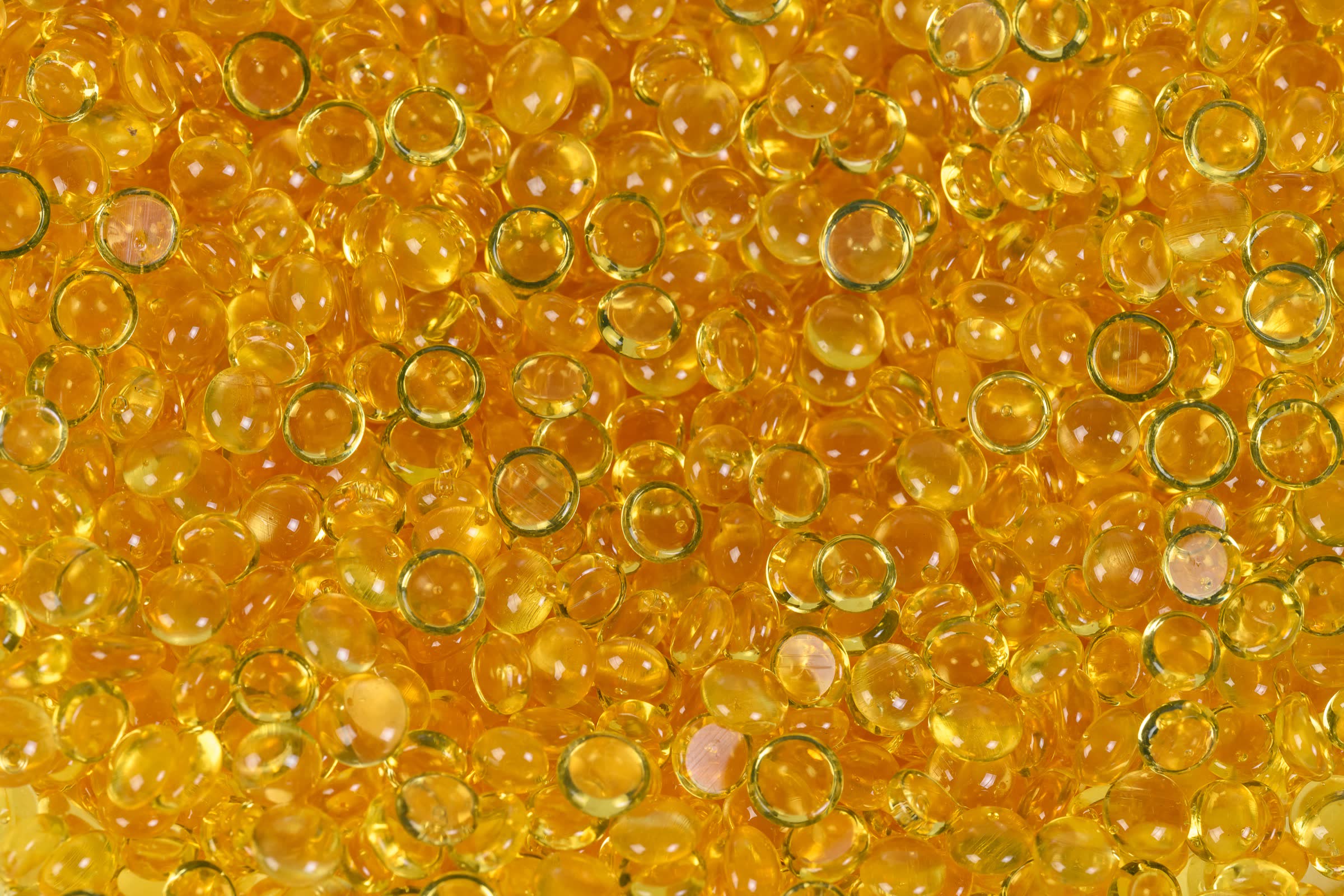
Amber, density 0.98 g/cm³, softening points from 110 °C to 192 °C and Brookfield viscosities as low as 0.7 Pa·s. Many grades take 60 to more than 80 percent of their raw materials from renewable, non-edible sources. Copolyamides cover the widest range of jobs: filters, footwear, heat-shrink tubing, electronics and road marking.
Technipol Bio hot melts
Technipol Bio 707 and 709 are fully biodegradable copolyester hot melts that melt at 64 °C. They bond substrates that cannot take a hot glue line: toe puffs and counters in footwear, and heat-sensitive textiles.
How the choice usually falls
Service temperature sets the floor for the melting or softening point. The application method sets the viscosity. The substrate and the medium the bond must survive, whether hot oil, diesel, a washing cycle or a polyethylene jacket, settle the chemistry.
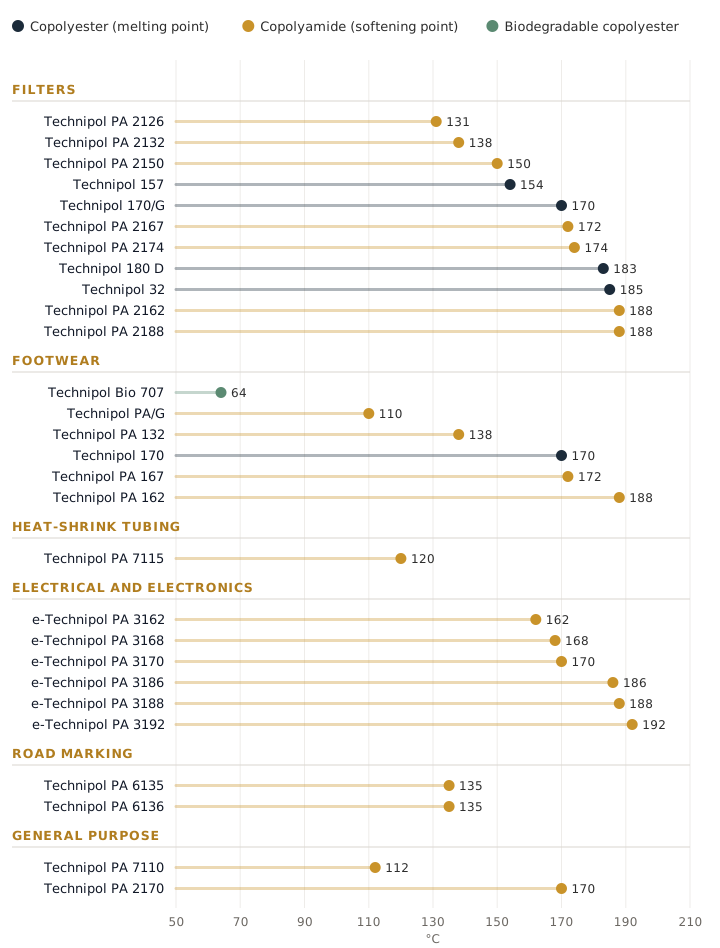
Melting and softening points across the range
Melting point (copolyesters, ISO 11357-3) or softening point (copolyamides, Sipol method MI 13) for each Technipol hot-melt grade, from Sipol's technical data sheets. Values are typical, not specification limits.
Grades by application
Every grade links to its own page with the full data sheet values, the versions it comes in and Sipol's processing guidance.
Pleat beads, edge seals and first-and-last pleat joints in engine air, oil and diesel elements, plus metal-free end caps on oil cartridges. Copolyester and copolyamide grades, applied by extruder, tank unit or spray.
Technipol Bio copolyesters for compostable compounds and masterbatches. Five grades carry TÜV Austria OK Compost Industrial, Home and Soil certification.
Technipol hot melts come as granules for melters, extruders and tank units, as extruded rod for lasting machines, and as powder on selected grades. The footwear rods are 3.9 mm and 4.2 mm in diameter, wound on reels. Granules ship in 25 kg bags with an aluminum moisture barrier, 500 kg octabins with a polyethylene liner, or 500 kg and 1000 kg big bags.
Filter grades run on extruders and tank units, and the low-viscosity Technipol 157 also sprays. The e-Technipol PA grades run in melters and low-pressure molding equipment. Each grade page gives the viscosity and, where Sipol states one, the application temperature: that is where a line trial starts.
Documentation and compliance
Sipol is certified to ISO 9001, ISO 14001 and ISO 45001 and has held an EcoVadis rating since 2016. Technipol grades are supported with REACH and RoHS statements, IMDS entries for the automotive filter grades, food-contact declarations on the carrier grades, renewable-content figures on the copolyamides, a tin-free declaration on the Technipol 170 rod cement, and TÜV Austria OK Compost certificates on Technipol Bio 1120, 1124, 1129, 1160 and 1164.
Tell us what your qualification needs and we will pull the documents for the grade.
A copolyester hot melt is a thermoplastic polyester built from more than one diacid or diol, so it melts at a controlled temperature and sets by crystallizing as it cools. Technipol copolyester hot melts from Sipol melt between 154 °C and 185 °C on the adhesive grades, bond without solvent, and stay flexible: the filter grades exceed 500 percent elongation at break. They are also written as CoPES, co-polyester or polyester hot melts.
How does a copolyamide hot melt differ from a copolyester hot melt?
Technipol PA copolyamide hot melts are amber, lighter (0.98 g/cm³ against 1.11 to 1.29 for the copolyesters) and generally lower in melt viscosity, down to 0.7 Pa·s on e-Technipol PA 3168. They soften between 110 °C and 192 °C, bond well to leather, wood, metals and polar plastics, and many carry 60 to more than 80 percent renewable raw materials. The copolyesters are the tougher, more elastic choice and the one used in food-contact carrier grades.
Which hot melt bonds polyethylene and polypropylene?
Technipol PA 7115. Sipol's data sheet states very high adhesion to non-polar substrates such as polyethylene and polypropylene, and resistance to the crosslinking of polyethylene and the expansion and shrinking steps that follow, which is why it is used as the adhesive liner in heat-shrink tubing and sleeves. It softens at 120 °C with a Brookfield viscosity of 100 Pa·s at 160 °C.
What forms do Technipol hot melts come in?
Granules for melters, extruders and tank units; extruded rod at 3.9 mm and 4.2 mm diameter for automatic lasting machines; and powder on selected grades such as Technipol 200 P and Technipol Bio 1160/P. Granules ship in 25 kg aluminum-barrier bags, 500 kg lined octabins or big bags up to 1000 kg.
Are there bio-based or compostable hot melts in the range?
Yes, two kinds. Many Technipol PA copolyamides take 60 to more than 80 percent of their raw materials from renewable, non-edible sources; PA 2150, 2162, 2167, 2174 and 7110 are each above 80 percent. Technipol Bio 707 and 709 are fully biodegradable copolyester hot melts with a 64 °C melting point, used for toe puffs, counters and heat-sensitive textiles.
We use a copolyester hot melt from another maker. Can P.A.T. Products second-source it?
Yes. P.A.T. Products supplies Sipol's Technipol copolyester and copolyamide hot melts across the United States, Canada and Mexico and will match the specification of the grade you use now. If you run Griltex from EMS-Griltech or Schaetti Fix from Fixatti, send the data sheet, or the melting point, viscosity, form and application, and we will name the Technipol grade to trial and arrange a sample. P.A.T. Products does not sell those brands, which are the registered trademarks of their respective owners. Cross-references are available on request.
Evonik is leaving the polyester business. Where can we source a copolyester hot melt?
Evonik announced on June 18, 2026 that it will discontinue its global polyester business in 2027 (Evonik press release), and its DYNAPOL page says it can no longer process new customer inquiries for those products. P.A.T. Products supplies Sipol's Technipol copolyester hot melts in North America as a second source for buyers of Evonik polyester resins. Send the data sheet of the Evonik grade you use and we will match the specification to a Technipol grade and arrange a trial sample. P.A.T. Products does not sell Evonik products.
Specifying a hot melt?
Tell us the substrate, the application method and the temperature the bond has to survive. We will match a Technipol grade and arrange a sample with Sipol's technical team behind it.