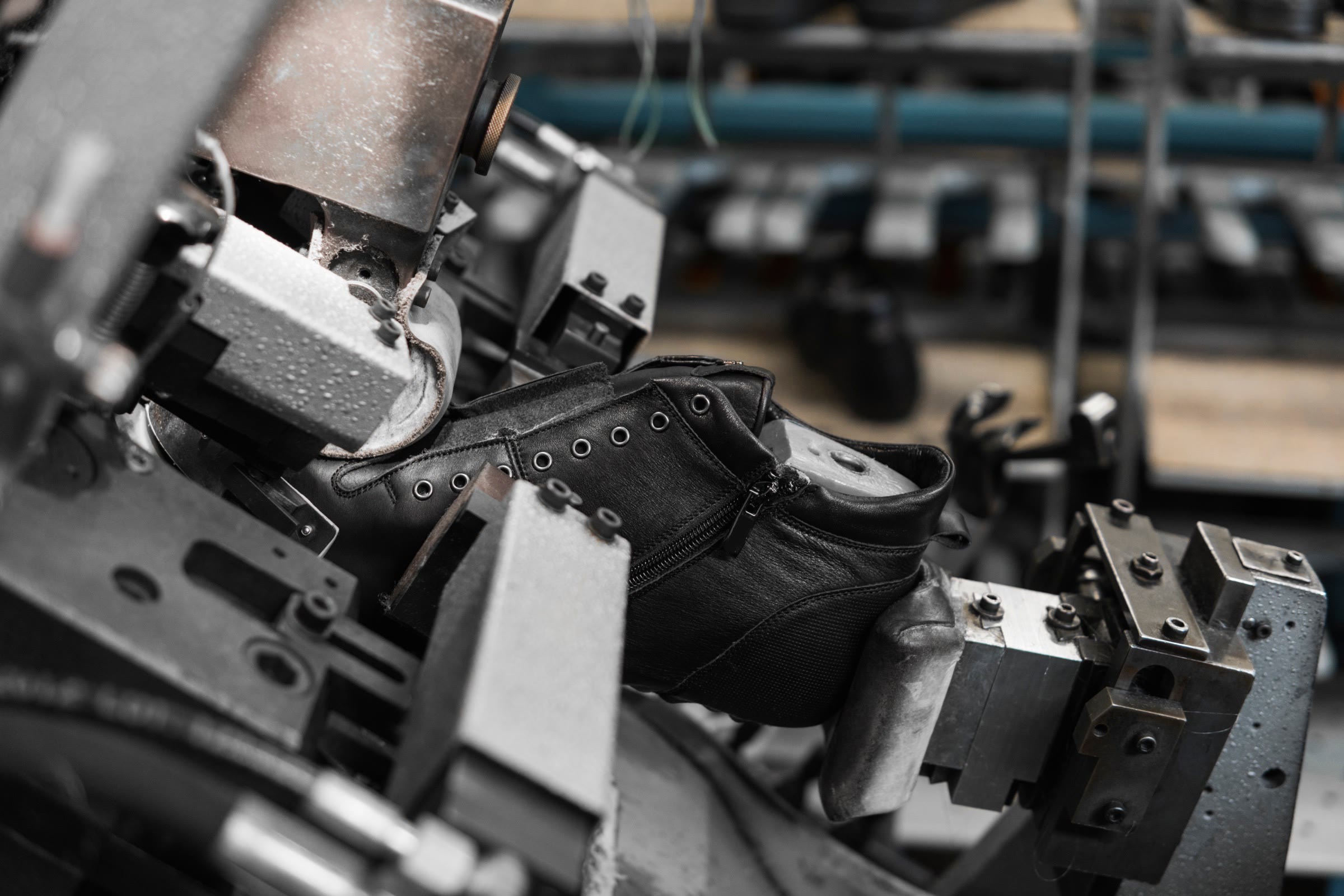
Technipol PA 132
Amber copolyamide hot melt for the shoe industry, 138 °C softening point and 6.5 Pa·s at 190 °C. Flexible, with good wetting on leather, wood and cardboard.
Amber copolyamide hot melt for the shoe industry, 138 °C softening point and 6.5 Pa·s at 190 °C. Flexible, with good wetting on leather, wood and cardboard.
Technipol PA 132 is an amber copolyamide hot-melt adhesive with a softening point of 138 °C and a Brookfield viscosity of 6.5 Pa·s at 190 °C. Sipol developed it principally for the shoe industry.
Sipol credits it with good flexibility and wettability, and with adhesion to leather, wood and cardboard.
The data sheet gives both an extrusion and a melter profile, so PA 132 runs from an extruder or a tank unit. The melter puts the hose and nozzle at 200 to 210 °C.
Around 60 percent of its raw materials come from renewable, non-edible resources, according to Sipol.
It is also written as copolyamide hot melt adhesive, co-polyamide hot melt, polyamide hot melt adhesive, thermoplastic polyamide adhesive, and CoPA.
| Property | Typical value |
|---|---|
| Softening point | 138 °C (Sipol method MI 13) |
| Brookfield viscosity | 6.5 Pa·s at 190 °C (Sipol method MI 12, Brookfield CAP 2000+ cone and plate) |
| Density | 0.98 g/cm³ (ISO 1183) |
| Renewable raw materials | Around 60 percent, from non-edible renewable resources (Sipol data sheet) |
| Color | Amber |
| Form | Granules |
Typical values from the manufacturer's technical data sheet. They describe the product, they are not a specification. We will send the current TDS and the batch documentation your qualification needs.
Tell us the part or the process, the property you are targeting, and the volume you expect. We will confirm the grade, send the documentation, and get a sample of the candidate grade to you.
The industry Sipol principally developed PA 132 for.
Sipol lists adhesion to leather with good flexibility.
Both named on the data sheet as substrates PA 132 bonds.
Sipol publishes a temperature profile for each method.
Sipol's suggested extrusion profile: under the hopper 50 to 80 °C, feeding zone 100 to 130 °C, compression zone 150 to 170 °C, metering zone 170 to 190 °C, die or hose 170 to 190 °C, nozzle 180 to 200 °C.
Sipol's suggested melter profile: pre-heating grid 165 to 175 °C, tank 190 to 200 °C, hose 200 to 210 °C, nozzle 200 to 210 °C.
Both profiles are starting points. Equipment and line speed move the final settings.
Package sizes: 25 kg bags with an aluminum film moisture barrier, 500 kg cardboard octabins with an inner PE liner, and 500 kg big bags..
Storage: Stable for 24 months unopened in the original packaging, kept in a cool, dry place and protected from light. Material held at around 5 to 10 °C or below should stand at 15 to 20 °C for at least 24 hours before use.
Read the safety data sheet before handling.
Technipol PA 132 softens at 138 °C and measures 6.5 Pa·s at 190 °C. Sipol's melter profile runs the pre-heating grid at 165 to 175 °C, the tank at 190 to 200 °C and the hose and nozzle at 200 to 210 °C. On an extruder the profile climbs from 50 to 80 °C under the hopper to 180 to 200 °C at the nozzle. Both are starting points for a line trial.
Technipol PA 132 is a granular grade that softens at 138 °C and runs from a melter or extruder. The rod cements Sipol makes for automatic lasting machines, Technipol PA 167 and Technipol PA 162, soften at 172 °C and 188 °C, with an indicative application temperature of 220 to 240 °C on the PA 167 and PA 162-4.2 data sheets. For thermofolding machines Sipol names Technipol PA/G, which softens at 110 °C.
The two data sheets give the same typical values for Technipol PA 132 and Technipol PA 2132, a 138 °C softening point, 6.5 Pa·s at 190 °C, around 60 percent renewable raw materials and the same machine profiles. Sipol positions PA 132 for the shoe industry and PA 2132 for the automotive filter industry. Order by the grade named for your application.
Yes. We send the Technical Data Sheet (TDS) and Safety Data Sheet (SDS) on request, in the manufacturer's current revision. Use Request TDS or SDS above and tell us what your qualification review needs.
Rod cement for automatic lasting machines, 172 °C softening point.
Footwear grade for thermofolding machines, 110 °C softening point.
Same typical values, positioned for the automotive filter industry.
The Technipol and Technipol PA range by softening point and use.
Lasting rod, folding and shoe-assembly hot melts and how to choose between them.