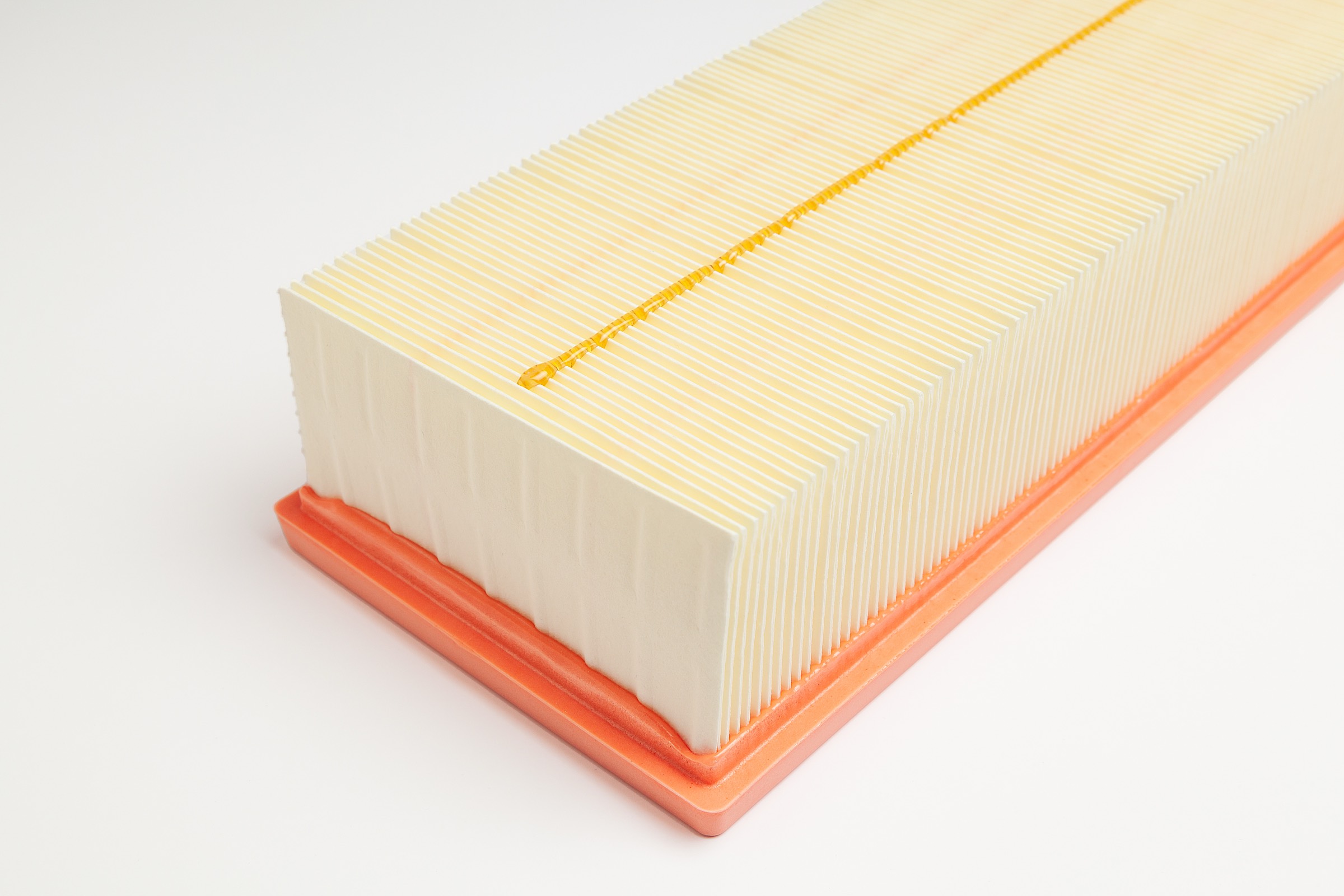
The thin bead running along the pleats of an engine air filter is hot-melt adhesive. Filter manufacturing treats adhesive as a structural material, selected against temperature, fluid, and vibration requirements the way a housing resin would be. Two chemistry families divide the work.
What the adhesive does in a filter element
- Pleat spacing and stabilization. Airflow wants to bunch pleats together; bunched pleats lose filtration area and raise pressure drop. The adhesive bead holds every pleat at its designed spacing for the life of the element.
- Edge and seam sealing. A filter is only as good as its worst bypass path. The adhesive seals media edges and the seam where the element closes, so everything that passes goes through the media.
- Closing the element. The first and last pleats are joined by adhesive, turning a pleated sheet into a sealed cylinder or panel.
- End caps, in cartridge designs. In modern metal-free oil filter elements the adhesive goes further and forms the end caps themselves, a design shift covered in metal-free oil filter elements.
- Damping. An engine filter lives on a vibrating machine. Adhesive elasticity, with elongation often above 500%, is what keeps bonds alive through years of vibration.
The service conditions that shape the choice
Each filter type carries its own qualification profile, and the adhesive has to pass the same tests as the element.
- Engine air filters see heat, fuel vapors, and airflow that runs to hundreds of cubic meters per hour. The bond must hold pleat geometry across the full environmental range of the intake tract.
- Engine oil filters live in hot oil, typically 140 to 155°C at 4 to 6 bar, with ISO 4548-6 as the reference for burst and differential-pressure performance. This is the hardest duty in the family.
- Diesel fuel filters demand chemical resistance across changing diesel formulations, ageing at 90°C for 168 hours, plus pressure and vibration. Wound-media designs also need the adhesive to hold coiled paper in place through manufacture and service.
Copolyester vs copolyamide
Filter hot melts come in two purpose-polymerized families, and both serve all three filter types; the grade tables overlap deliberately so lines can standardize.
- Copolyesters are the flexible, tough workhorses: high elongation for vibration resistance, melting points running roughly 154 to 185°C across the range, applied by extruder or tank unit. Their distinctive capability is foaming: every copolyester filter grade can be foamed, cutting adhesive consumption and weight at equal bond performance.
- Copolyamides bring the temperature ladder, softening points from roughly 131 up to 215°C, and strong resistance to hot oil and fuel. Grades built on non-edible agricultural feedstocks reach bio-based content up to 80%, which flows into the finished filter's environmental declaration.
The decision starts from the qualification tests and the line: what temperature and medium must the bond survive, and what equipment applies it. For formulators working on the adhesive itself rather than applying it, the plasticizer side of hot-melt behavior is covered in plasticizers in hot-melt and PVAc adhesives.
Application method matters as much as chemistry
Three delivery systems dominate filter plants, and the grade's melt viscosity must match:
- Extruder lays precise beads at production speed, the standard for pleat-spacing lines.
- Tank unit melts and pumps adhesive for seam work and end bonding.
- Spray requires genuinely low melt viscosity and suits wound diesel elements, where a low-melt, low-viscosity grade can be delivered by extruder, tank, or spray as the design demands.
A grade that runs beautifully on one delivery system can be unusable on another at identical bond performance, so state the equipment when asking for a recommendation.
The compliance gate
Automotive filter programs require material declarations before the first trial: IMDS entries, GADSL screening, REACH and RoHS status. Ask for the declaration package alongside the TDS, not after qualification. The Technipol filter adhesive range we supply carries this documentation.
Request a SampleQualifying a grade: what to send
Five things get a filter adhesive recommendation right on the first pass: the filter type and media, the qualification tests it must pass (with temperatures and pressures), the application equipment, the line speed, and any declaration requirements. From that, a short list of grades follows, then samples for a line trial with the manufacturer's technical team available for the setup questions. We supply the Technipol copolyester and copolyamide filter range to North American filter manufacturers on exactly that model.
Frequently asked
What does the adhesive do in a pleated filter element?
Three structural jobs: holding pleat spacing so the media does not bunch under flow, sealing edges and seams against bypass, and joining the first and last pleats to close the element. Its elasticity also damps vibration for the life of the part.
How do you choose between copolyester and copolyamide?
By service temperature, medium, and application method. Copolyesters are flexible, tough, and foamable; copolyamides reach softening points around 215°C with strong hot-oil and fuel resistance and bio-based content up to 80%. The qualification tests pick the grade.
How are filter hot melts applied on the line?
By extruder, heated tank unit, or, for low-viscosity grades, spray. The grade's melt viscosity has to match the delivery system, which is why the equipment belongs in every grade inquiry.
Why foam a filter adhesive?
Foaming puts gas into the melt, so the same bead volume uses less adhesive and weighs less at equal bond performance. On high-volume air filter lines the material saving is significant.
Running a filter line?
Send us the filter type, the tests, and the application equipment. We will propose a Technipol grade and arrange samples with the manufacturer's filter specialists behind the trial.
View filter adhesives