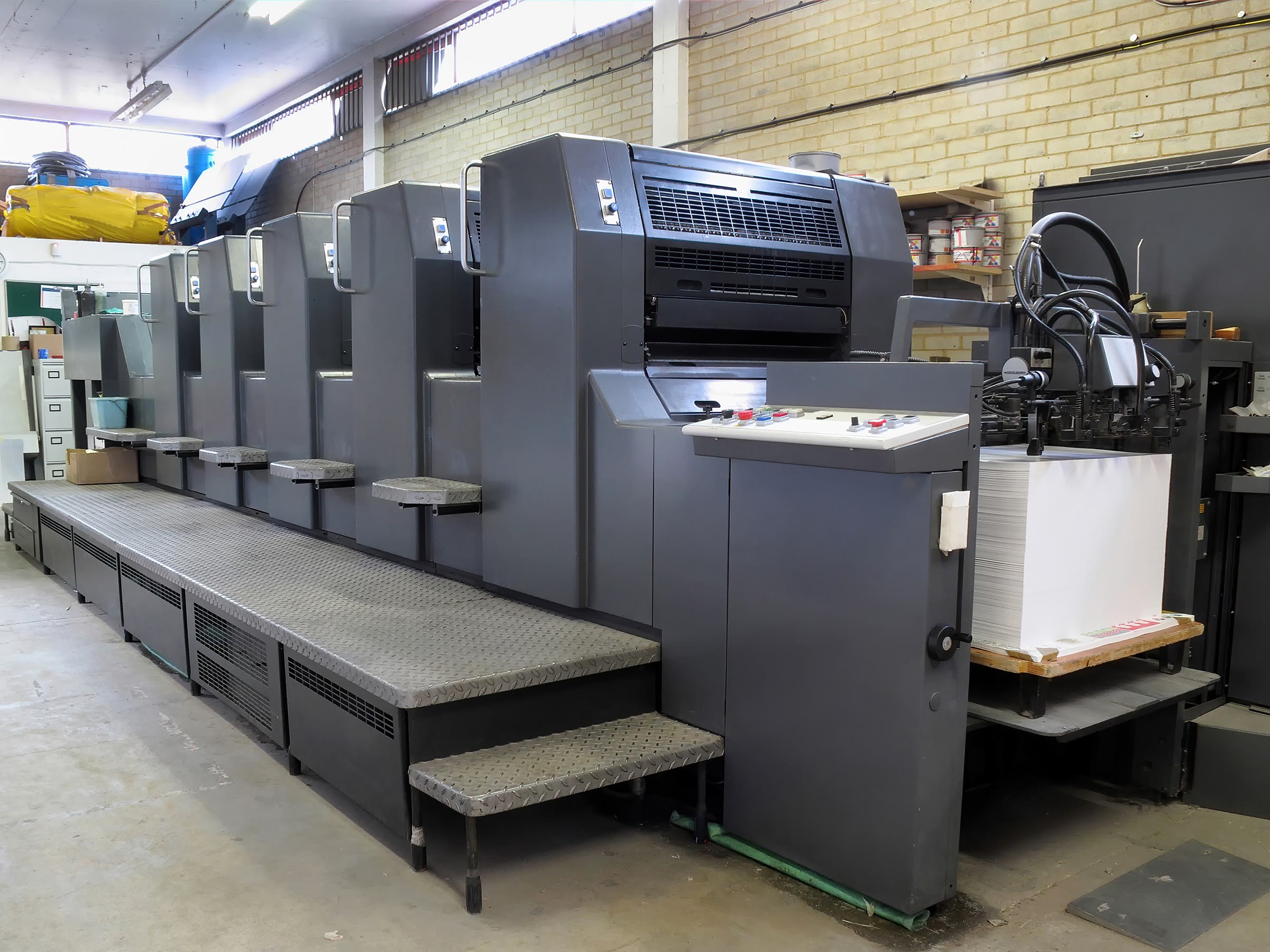
Four inputs into the same tank
P.A.T. Products has supplied raw materials into lithographic fountain solutions and pressroom chemistry for more than a decade. We sell to the formulators who blend the chemistry, not the finished concentrate to a printer.
A conventional fountain concentrate is built from a desensitizing gum, an acid and its buffer, a corrosion inhibitor, wetting agents and solvents, and a preservative. Four of those inputs come from us.
| Raw material | Identity | What it does in the pressroom |
|---|
| Gum arabic Types 4880 and 4915 | Acacia gum, CAS 9000-01-5, E 414, purified agglomerated spray-dried powder | Desensitizes the non-image areas of the plate so they hold water and reject ink. Also the active component of plate gums, finishers and etches |
| N-octyl pyrrolidone (NOP) | N-octyl-2-pyrrolidone, CAS 2687-94-7, colorless liquid, 99.0% min | Wetting agent and isopropanol replacement. Lowers the surface tension of the dampening solution so it spreads in a thin even film |
| Sodium Benzotriazole 40% | CAS 15217-42-2, aqueous liquid, 39.5 to 41.0% | Films the copper and brass in the wetted parts of a recirculating dampening system |
| Citric acid, anhydrous | CAS 77-92-9, fine granular, 30 to 80 mesh | Sets and holds the acid pH a conventional concentrate works at |
Gum arabic, the desensitizing component
Lithography puts image and non-image areas on one surface at the same level and separates them chemically. Gum arabic adsorbs onto the grained aluminum oxide of the open areas and holds a water film there, which is what makes those areas reject ink.
Type 4880 is the grade to open on and Type 4915 is the second. Both are purified spray-dried powders in agglomerated form, specified as fast soluble in cold water, so nothing has to be ground before the make-up tank. Country of origin is Germany. The grade table, the specification values, and the make-up figures are on gum arabic for lithographic fountain solutions.
N-octyl pyrrolidone, the wetting agent
A dampening solution has to spread across the plate in a thin even film, and water on its own will not do it. Isopropanol was the standard answer for decades. It is also a flammable liquid that evaporates out of an open recirculating system, which is why VOC regulation and the plant safety case both push against it.
NOP is the replacement we supply. It is a linear N-alkyl-2-pyrrolidone, CAS 2687-94-7, carrying a hydrophilic pyrrolidone ring and a hydrophobic alkyl chain, so it wets and dissolves at the same time. Closed-cup flash point is 129 °C and it boils at 303 °C, so it stays in the tank rather than leaving through the top of it, and it is low foaming in a system that recirculates all day. Lithographic fountain solutions are the first application on its data sheet. The full specification is on N-octyl pyrrolidone (NOP).
Sodium benzotriazole, the corrosion inhibitor
A fountain solution is acidic water circulating continuously through metal, and it carries more than one corrosion problem. Magnesium nitrate is the classic inhibitor on the plate side. Benzotriazole and its sodium salt do the other half of the job: they form a protective film on copper, brass and other yellow metals, which is what the wetted hardware in a recirculation and dampening system is frequently made of.
Sodium Benzotriazole 40% (CAS 15217-42-2) is the water-soluble sodium salt supplied as an aqueous liquid at 39.5 to 41.0 percent. It meters straight into a water-based concentrate with no dissolving step. The solid benzotriazole grade, 99% fine granular, suits a formulator who prefers to make up their own concentrate. Both, plus the tolyltriazole equivalents, are on corrosion inhibitors.
Citric acid, the pH lever
The acid in a conventional concentrate sets the pH the system runs at and buffers it against the drift that comes from paper, ink and make-up water. Published formulations use citric acid, phosphoric acid, gluconic and lactic acid, usually with a phosphate or citrate salt alongside, working to a target somewhere between pH 3.5 and 5.5. Gum arabic is most effective under acidic conditions, so the acid and the gum are chosen together.
We supply citric acid anhydrous as fine granular, 30 to 80 mesh, CAS 77-92-9. It is a commodity-scale input into the same concentrate as the gum, so it is worth pricing on the same order.
Where these materials end up
Fountain solution concentrates
Conventional acid systems for sheetfed and web offset, gum-containing and alcohol-free alike.
Plate gums and finishers
End-of-run treatments that hold the desensitized surface through plate storage.
Plate etches and cleaners
Corrective chemistry for open areas that have started taking ink.
Blanket and roller washes
Gum-containing rinse steps that return a plate to a desensitized state after solvent.
Buying from us
Every item ships with a product specification, a Safety Data Sheet, and a Certificate of Analysis for the lot. Country of origin on the gum reads Germany.
Send the grades you buy today with the annual volumes and pack sizes, and we will come back with availability, documentation, and samples. If you work from a competitive specification rather than a type number, send the specification and we will say which grade matches it and where it does not.
Frequently asked questions
What raw materials go into a lithographic fountain solution?
A conventional concentrate is built from a desensitizing gum, an acid and its buffer, a corrosion inhibitor, wetting agents and solvents, and a preservative. P.A.T. Products supplies four of those inputs: gum arabic for desensitizing, N-octyl pyrrolidone as the wetting agent and isopropanol replacement, sodium benzotriazole 40% solution for the copper and brass a circulating solution touches, and citric acid for pH.
Do you sell finished fountain solution?
No. We supply raw materials to the companies that blend pressroom chemistry, not a finished concentrate to a printer. If you blend your own fountain solution, plate gum, or plate etch, that is the conversation we are set up for.
Why is a corrosion inhibitor in a fountain solution at all?
A fountain solution is acidic water that circulates continuously through metal hardware. Benzotriazole chemistry forms a protective film on copper and brass, which is what the wetted parts of a recirculation and dampening system are often made of. The sodium salt is supplied as a water-soluble liquid so it meters straight into a water-based concentrate.
Which gum arabic grade do pressroom formulators start on?
Type 4880, with Type 4915 as the second grade. Both are purified spray-dried gum arabic powders in agglomerated form, specified as fast soluble in cold water, so there is no grinding step ahead of the make-up tank. Country of origin is Germany.