What the topcoat has to do
A topcoat lacquer on a PVC-coated fabric carries four jobs at once: resist weather and UV, slow the migration of plasticizer out of the PVC, keep the surface soil-resistant and easy to clean, and stay suitable for welding so the fabricator can seam the finished goods. The base material underneath is usually a PVC-coated polyester fabric. The same category covers PVC and TPO roof membranes and swimming pool liners. The migration mechanism and what a barrier topcoat can and cannot do about it are covered in plasticizer migration in PVC-coated fabric.
The PVC coating supplies the strength and the barrier. The lacquer decides how the surface behaves and how long the assembly lasts outdoors, which is why it is specified by finish, service life, and welding method, not by film chemistry alone.
P.A.T. Products supplies the ROWA Lack range across North America. ROWA Lack has made lacquer systems since 1969 and is part of ROWA GROUP, with headquarters in Pinneberg and production in Seevetal, Germany. The plant is certified to ISO 50001:2018 for energy management, and the systems are marketed as SVHC-free.
We are exhibiting at the Advanced Textiles Expo, booth 428, November 3 to 5, 2026 in Orlando, with the lacquer manufacturer on the stand. Bring a piece of your substrate and we will coat it.
Three topcoat chemistries
Acrylic (ROWAKRYL). The volume topcoat for truck covers, awnings, halls and tents, banners, and backlit, frontlit and side-curtain print media. The range also covers PVC roofing membranes, PVC synthetic leather, PVC tablecloths, book covers, and pool liners, in matt, semi-gloss, and gloss. Solids run from about 13 to 46 percent. Two-component acrylic grades form the base of the anti-graffiti and easy-clean systems.
Polyurethane (ROWATHAL). The finish for PVC synthetic leather and automotive interior foils, where mar resistance, a matt surface, hand feel, and anti-squeak behavior are the specification. Solids sit between about 18 and 22 percent, with waterborne grades in the range.
PVDF fluoropolymer (ROWAFLON). Specified where outdoor life and soil resistance drive the decision: architectural and tensile membrane, halls and tents, premium pool liners, and automotive foils that need resistance to heat yellowing. Supplied as UV protection primers and as matching topcoats, solids from about 11 to 22 percent.
Transfer-coating topcoats (ROWANYL). Gloss topcoats for PVC synthetic leather applied to release paper and transferred to the substrate, at about 20 to 28 percent solids, in solventborne and waterborne form.
Grade codes carry a W when the grade is waterborne. The G and M prefixes are lacquer codes and do not indicate chemistry; the family name does that.
The selection sequence, with solids ranges, one-component versus two-component crosslinking, and what welding does to the choice, is set out in choosing a topcoat lacquer for PVC-coated fabric.
Send us your substrate and we will coat it
Send a piece of your fabric or film and we will have the candidate grade applied to it and returned to you, so you judge gloss, hand, and appearance on your own material rather than on a generic panel.
Request a Sample
Crosslinkers and surface additives
ROWASET covers the components that go in alongside the binder: crosslinkers, slip additives, lubricants, surface modifiers, wetting and leveling agents, UV absorbers, defoamers, thickeners, and stabilizers. A two-component system needs the matching crosslinker to reach its stated chemical and scratch resistance, so the catalyst is specified with the lacquer.
Where the substrate needs surface preparation before the lacquer, Tramaco's TRAPUR polyurethane primers cover PVC, TPO and TPE film and plastic parts. Tramaco and ROWA Lack are sister companies in the ROWA Group, so the primer and the topcoat come through one supplier relationship.
UV protection for architectural membrane
A UV protection primer under a membrane topcoat filters more than 80 percent of the UV in sunlight while keeping transparency in the visible range above 70 percent. That matters because UV degrades the PVC boundary layer underneath the lacquer, which can break the bond between the lacquer and the PVC surface even while the topcoat film itself is still intact.
Single-layer PVDF systems deliver outdoor durability, UV resistance, low soiling, and good cleaning behavior. Two-layer systems add the primer beneath the topcoat, using titanium dioxide or zinc oxide as the light protection agent depending on grade, with one zinc oxide grade formulated for very high transparency where the appearance of the membrane matters.
The failure mechanism and the choice between the two absorbers are set out in UV protection primers for PVC architectural membrane.
Anti-graffiti and easy-clean finishes
Waterborne two-component anti-graffiti lacquers for artificial leather run at a pot life of more than eight hours, applied by anilox roller or doctor blade and dried at 140 C for one minute. The systems are transparent and come in matt, more matt, and gloss versions, each catalyzed with a matching crosslinker.
Published performance is high scratch resistance, good resistance to solvents and chemicals, low soiling, and cleaning behavior that removes dried permanent marker or ballpoint from a coated artificial leather surface with a dry cloth. Spray paint is removed without residue in many cases, which is a qualified claim, not an absolute one, and worth testing against the marking media your own end use actually sees.
The pot life, the application window, and what the catalyst changes are covered in waterborne 2K anti-graffiti lacquers for vinyl and synthetic leather.
Trials on your own substrate
We coat trial panels on customer material. Send a piece of the fabric or film you actually run, tell us the finish you are after, and we will have the candidate grade or grades applied to it and sent back to you. You then judge gloss level, hand, and appearance against your own standard, on your own substrate, before anyone commits to a line trial.
Coating your own material settles the questions that matter earliest: how the gloss reads over your base color, how the surface feels, whether the finish sits the way you want on your embossing or grain. What it cannot settle is line behavior, so a line trial still follows on a stocked or sampled quantity.
Applications
Truck covers and tarpaulins
Acrylic topcoats for curtain-side covers, awnings, and materials for halls and tents, balancing weathering, soil release, plasticizer barrier, and weldability.
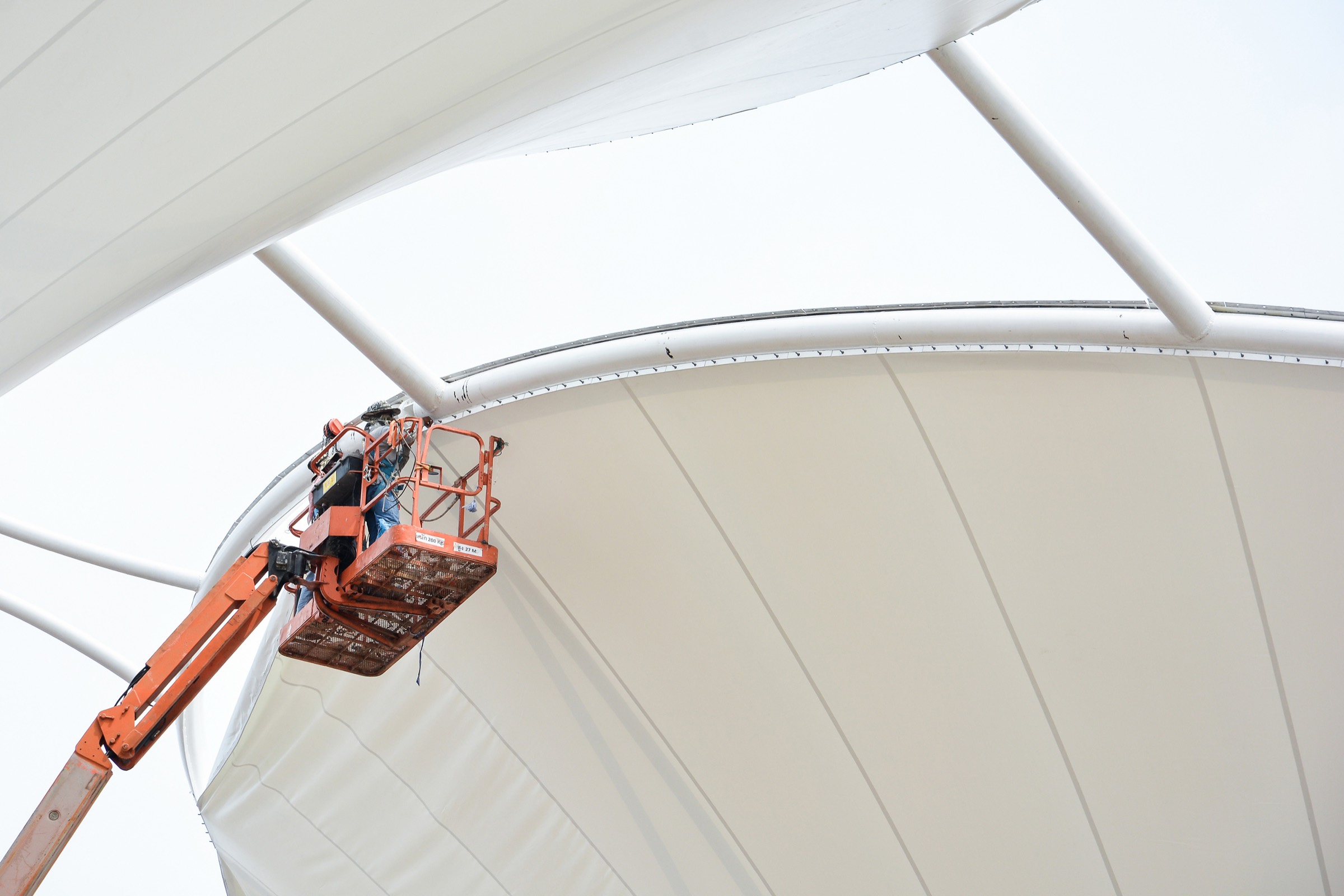
Architectural and tensile membrane
PVDF primers and topcoats for tensile structures, halls, and tents, as single-layer or two-layer UV protection systems.
Synthetic leather
Polyurethane matt topcoats with mar resistance and hand feel, and gloss transfer-coating topcoats applied on release paper, for bags, apparel, footwear, furniture upholstery, transit seating, and medical surfaces.
Print media
Acrylic topcoats optimized for printability on backlit, frontlit, and side-curtain PVC-coated fabrics, holding ink adhesion through storage and keeping print profiles consistent across base materials.
Automotive interior foils
Finishes for PVC, ABS, and TPO dashboard and door-panel foils and for coated synthetic leather, covering mar resistance, matt appearance, anti-squeak behavior, and resistance to heat yellowing.
Roofing membrane and pool liner
Waterborne acrylic topcoats for PVC roofing membrane, and gloss and silk-matt lacquers for pool liners exposed to chlorinated or salt water plus daily UV, with a PVDF option for weather resistance and a plasticizer barrier effect.
Furniture and decoration foils
Surface finishes for the rigid and semi-rigid PVC and TPO foils used in furniture and interior decoration.
Anti-graffiti and easy-clean
Two-component acrylic systems with matching crosslinker for PVC and PU surfaces in public spaces, in matt and gloss.
Waterborne and solventborne
Waterborne grades run across all three chemistries and are identified by a W in the grade code. ROWA Lack has been converting the range from solvent to water and markets low-emission alternatives alongside the established solventborne grades.
A waterborne grade and its solventborne counterpart are not drop-in substitutes on a coating line. Drying, wetting, line speed, blocking behavior, and adhesion all shift, so the change is planned as a line trial, not a substitution. We can supply both versions for the same nominal finish so the comparison runs on your own equipment.
Moving a line from solvent to water?
We can put the waterborne and solventborne versions of the same finish in front of you together, so the trial answers the process question and the performance question at the same time.
Talk to an Expert
Stock, documentation, and North American supply
We stock the grades our customers run and ship them from North America, in working lot sizes for coaters and converters. P.A.T. Products handles the import, the documentation, and the small-lot logistics across the United States, Canada, and Mexico.
These are finished, substrate-validated lacquer systems, not raw binders, so the range also covers finishes worked up against a specific fabric. For a grade that is new to you, or a tailored finish, we quote lead time and minimum quantity with the sample.
Technical Data Sheets and Safety Data Sheets are available for every grade, and a Certificate of Analysis ships with each lot. If you are qualifying a second source, tell us the finish you run now and what it has to pass, and we can work the match with ROWA Lack's technical team.
Tarpaulins
Architectural membrane
Synthetic leather
Print media
Automotive foils
Pool liner
SVHC-free
Waterborne
Product families
Five families cover the range PAT supplies. Each page carries the grades ROWA publishes, what each one is built for, the solids envelope, and the processing window from ROWA's own data sheets.
| Family | Chemistry | Solids | Where it fits |
|---|
| ROWAKRYL | Acrylic, solvent and waterborne | 13.4 to 45.8 percent | The volume topcoat. Truck covers, awnings, halls and tents, roofing membrane, print media, synthetic leather, pool liner. 22 published grades |
| ROWAFLON | PVDF, solvent and waterborne | 11.0 to 22.0 percent | Architectural membrane UV primers and topcoats, halls and tents, premium pool liner, heat-yellowing-resistant automotive foil. 12 grades |
| ROWATHAL | Polyurethane, isocyanate crosslinkable | 17.6 to 22.0 percent | Automotive interior foil and PVC synthetic leather. Matt, mar resistant, deep drawable, one anti-squeak grade. 4 grades, 2 waterborne |
| ROWANYL | Not published by the manufacturer | 20.4 to 28.0 percent | Gloss topcoats for PVC synthetic leather applied on release paper by transfer coating. 3 grades |
| ROWASET | Crosslinkers and surface additives | Set by the lacquer | The catalysts every two-component system needs, plus slip, wetting, leveling, defoaming and UV additives |
The full line, including the families PAT does not currently supply, sits on the ROWA Lack brand page and on the ROWA Lack partner page.
Frequently asked questions
What does a topcoat lacquer do on a PVC-coated fabric?
It carries four jobs at once. It resists weather and UV, it slows the migration of plasticizer out of the PVC, it keeps the surface soil-resistant and easy to clean, and in most cases it has to stay weldable so the fabricator can seam the finished goods. The PVC coating supplies the strength and the barrier; the lacquer decides how the surface behaves and how long it lasts outdoors.
How do acrylic, polyurethane, and PVDF topcoats compare?
Acrylic topcoats are the volume choice for truck covers, awnings, halls and tents, banners and print media, and they form the base of two-component anti-graffiti systems. Polyurethane topcoats go on synthetic leather and automotive interior foils where mar resistance, matt finish, hand feel, and anti-squeak behavior matter. PVDF fluoropolymer topcoats go where outdoor life and soil resistance are the specification, which is architectural and tensile membrane, halls and tents, and premium pool liners. Service life, welding method, and whether the line runs solvent or water usually decide the choice before performance does.
Can a lacquered PVC fabric still be high-frequency welded?
In most of these applications the lacquer system has to be suitable for welding, and grades are formulated for it. Weldability varies by grade and by film weight, so it is confirmed on your own substrate and your own welding parameters during the trial. Tell us the welding method and the seam requirement at the sample stage.
How does a UV protection primer work on architectural membrane?
UV degrades the PVC boundary layer underneath the lacquer, which can break the bond between the lacquer and the PVC surface even while the topcoat film itself is still intact. A two-layer system answers that: a UV protection primer that reflects or absorbs the radiation, then a topcoat over it. Published performance for the ROWAFLON primers is more than 80 percent of the UV in sunlight filtered, with transparency in the visible range still above 70 percent. The absorber is titanium dioxide or zinc oxide depending on the grade, and one zinc oxide grade is formulated for very high transparency.
Are waterborne versions available?
Yes. Waterborne grades run across the acrylic, polyurethane, and PVDF families and are marked with a W in the grade code. Solids content sits roughly between 11 and 46 percent depending on family and grade. Waterborne and solventborne versions of the same nominal finish are not drop-in substitutes for each other on a coating line, so plan a line trial.
Do you stock these lacquers, and can you trial one on my substrate?
Yes to both. These are made-to-order systems supplied from the German plant, so plan a first order against a trial and not against a shortage. We also coat trial panels: send a piece of your fabric or film and we will have the candidate grade applied to it and returned, so you judge gloss, hand, and appearance on your own material rather than on a generic panel. For a grade that is new to you, or a finish tailored to your substrate, we quote lead time and minimum quantity alongside the sample.