Technipol 32
Copolyester hot melt for automotive air and oil filters. Melting point 185 °C, Vicat 114 °C, 34 Pa·s at 210 °C, elongation above 500%, applied by extruder.
Copolyester hot melt for automotive air and oil filters. Melting point 185 °C, Vicat 114 °C, 34 Pa·s at 210 °C, elongation above 500%, applied by extruder.
Technipol 32 is a copolyester hot-melt adhesive with a melting point of 185 °C and elongation at break above 500%, designed by Sipol for the production of air and oil filters in the automotive industry. Sipol credits it with high chemical resistance to mineral oil and diesel vapors, and with thermal resistance compatible with the paper curing temperatures of a filter line.
Flexibility is the property the grade is built around. Sipol states that it keeps the filter element intact through every production step, and its filter range lists Technipol 32 as the very flexible extrusion grade, suitable for all kinds of filter paper.
Melt viscosity is 34 Pa·s at 210 °C and the melt flow index 43 g/10 min at 210 °C under 0.325 kg. Sipol recommends extruders for this grade. The Vicat softening point of 114 °C sits about 70 °C below the melting point, which is the temperature at which the cooled bead begins to yield under load.
Sipol states that its Technipol copolyester filter grades can be foamed. A foamed bead fills the same volume with less adhesive.
Technipol 232 is the development of Technipol 32 aimed at the circular economy, and Sipol lists it as an experimental grade. Half of the monomers used to make it come either from renewable sources, derivatives of non-edible vegetable oils, or from selected and treated post-consumer waste. Its data sheet gives a renewable carbon content of 29% calculated according to ASTM D6866, a post-consumer waste content of 21%, a melting point of 183 °C and 37 Pa·s at 210 °C, with the same extrusion profile.
It is also written as copolyester hot melt adhesive, co-polyester hot melt, polyester hot melt adhesive, thermoplastic copolyester adhesive, and CoPES.
| Property | Typical value |
|---|---|
| Density | 1.11 g/cm³ (ISO 1183) |
| Melting temperature | 185 °C (ISO 11357-3) |
| Vicat softening temperature | 114 °C, 1 N, 50 °C/h (ISO 306) |
| Elongation at break | Above 500% (ISO 527) |
| Brookfield viscosity | 34 Pa·s at 210 °C (Brookfield CAP 2000+ cone/plate, Sipol method MI 12) |
| MFI | 43 g/10 min at 210 °C, 0.325 kg (ISO 1133) |
| Application method | Extruder |
| Form | Granules |
| Versions | Technipol 32; Technipol 232, experimental, 29% renewable carbon (ASTM D6866) and 21% post-consumer waste content, melting point 183 °C, 37 Pa·s at 210 °C |
Typical values from the manufacturer's technical data sheet. They describe the product, they are not a specification. We will send the current TDS and the batch documentation your qualification needs.
Tell us the part or the process, the property you are targeting, and the volume you expect. We will confirm the grade, send the documentation, and get a sample of the candidate grade to you.
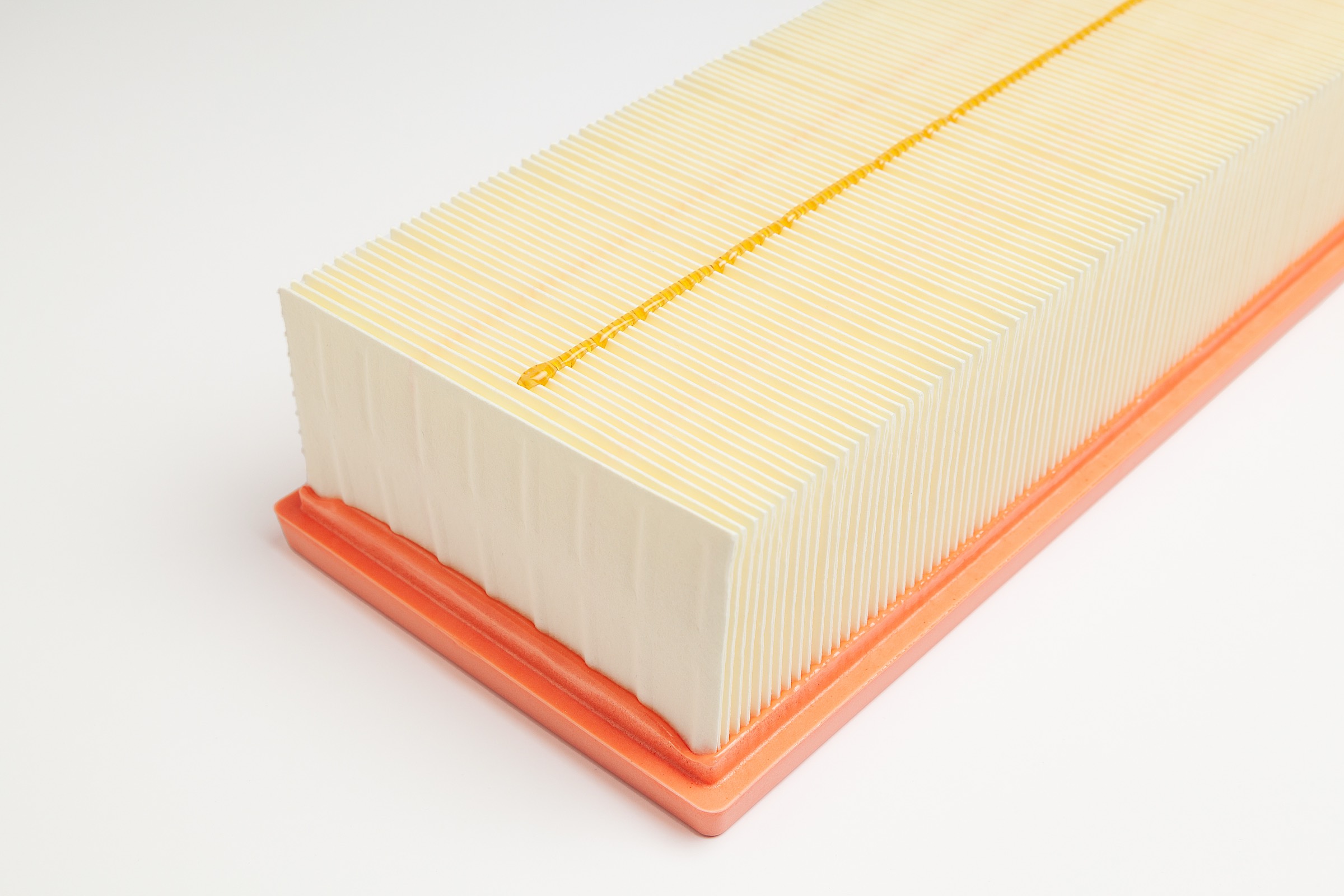
Pleat and edge bonding in automotive air filter elements, one of the two uses Sipol designed the grade for.
The second designed use, where the bond meets mineral oil and diesel vapors.
Sipol lists it as suitable for all kinds of filter paper, with thermal resistance compatible with paper curing.
Sipol states its Technipol copolyester filter grades can be foamed.
Sipol recommends extruders for applying Technipol 32. The suggested profile runs 100 to 120 °C under the hopper, 140 to 160 °C in the feeding zone, 180 to 210 °C in the compression zone, 220 to 240 °C in the metering zone, and 240 to 250 °C at the extrusion die or hose and at the nozzle.
Material stored at around 5 to 10 °C or below should be held at 15 to 20 °C for at least 24 hours before it goes into the hopper.
Package sizes: 25 kg bags with an aluminum film barrier against moisture, 500 kg cardboard octabins with an inner PE liner, and 500 kg and 1000 kg big bags..
Storage: Stable for 12 months unopened in the original packaging, kept in a cool, dry place and protected from light. Material stored at around 5 to 10 °C or below should be held at 15 to 20 °C for at least 24 hours before use.
Read the safety data sheet before handling.
Technipol 32 melts at 185 °C, and Sipol's suggested extrusion profile takes it to 240 to 250 °C at the die or hose and the nozzle, with the metering zone at 220 to 240 °C and the feeding zone at 140 to 160 °C. At 210 °C its Brookfield viscosity is 34 Pa·s. Sipol recommends an extruder for this grade, and the data sheet gives an extrusion profile only.
Both are Sipol copolyester hot melts for automotive air and oil filters, both melt in the 183 to 185 °C range and both run on the same extrusion profile. Technipol 32 flows more easily, at 34 Pa·s at 210 °C and 43 g/10 min, against 47 Pa·s and 27 g/10 min for 180 D. Technipol 180 D softens later, with a Vicat point of 140 °C against 114 °C here, and Sipol rates its thermal resistance high where it rates 32 good.
Technipol 232 is an experimental development of Technipol 32 in which half of the monomers come from renewable sources or from treated post-consumer waste. Its data sheet gives 29% renewable carbon by ASTM D6866 and 21% post-consumer waste content. It melts at 183 °C, runs at 37 Pa·s at 210 °C and uses the same extrusion profile as Technipol 32, so a line can trial it without resetting temperatures.
Yes. Sipol's filter literature states that its Technipol copolyester filter grades can be foamed, and Technipol 32 is one of the grades it lists for engine air and oil filters. Foaming puts gas into the melt, so a bead of the same volume carries less adhesive. Elongation at break above 500% is the property the grade is chosen for, so confirm flexibility on the foamed bead in the line trial.
Yes. We send the Technical Data Sheet (TDS), Safety Data Sheet (SDS), and IMDS data on request, in the manufacturer's current revision. Use Request TDS or SDS above and tell us what your qualification review needs.
Air and oil filter grade with a higher Vicat point, 140 °C, on the same extrusion profile.
Oil and diesel filter grade melting at 170 °C, applied by extruder or melter.
Low-melting diesel filter grade at 154 °C, for extruder, melter or spray.
The full Technipol range, by chemistry and application.
Copolyester and copolyamide grades for air, oil and diesel filters.
How service temperature, medium and application method pick the grade.