What TPC-ET is
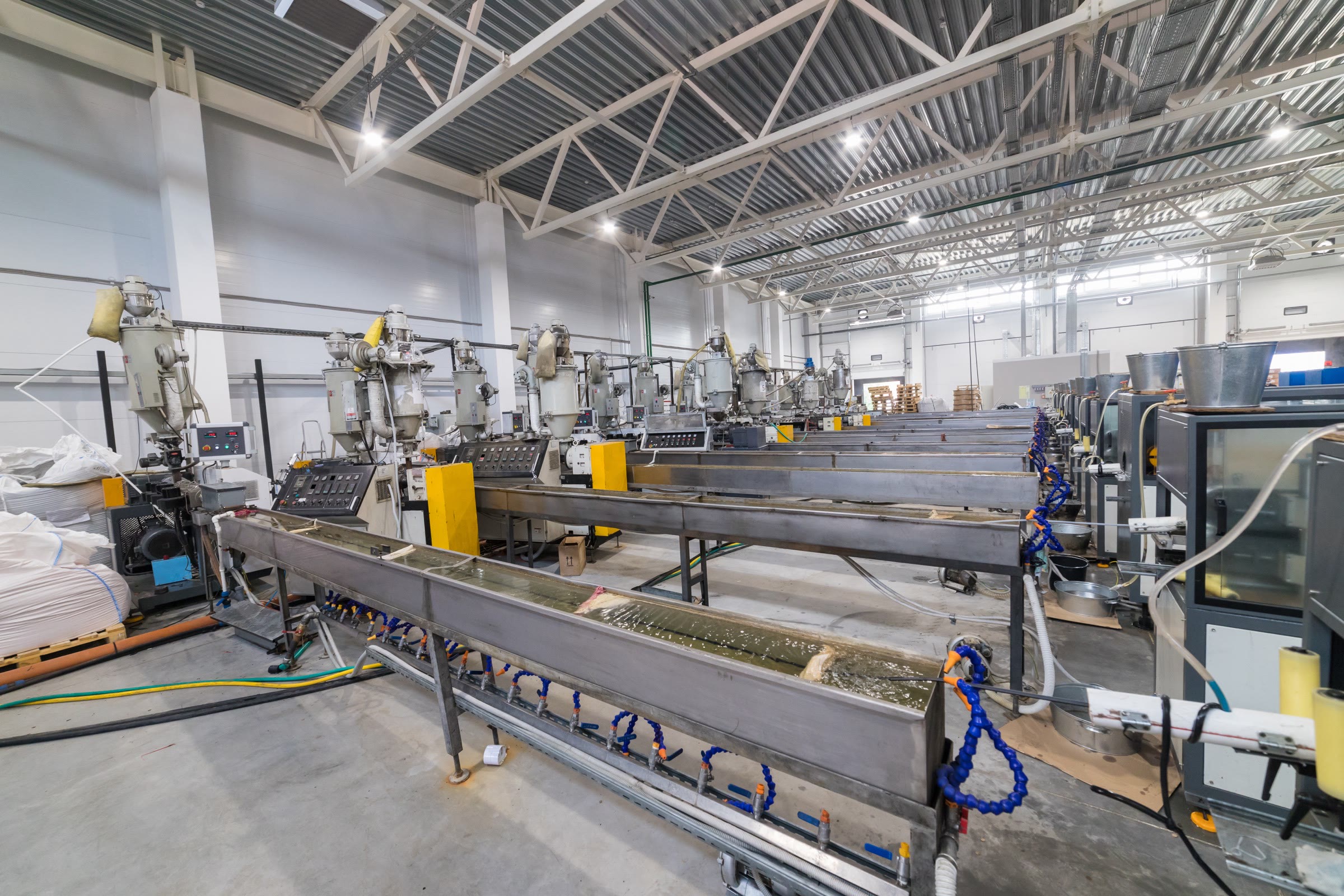
TPC-ET is a thermoplastic copolyester elastomer. The same material is written TEEE and COPE, and all three name one thing: a block copolymer with hard crystalline polyester segments and soft polyether segments. The hard segments carry strength, dimensional stability and high-temperature performance. The soft segments carry flexibility, elastic recovery and toughness when it is cold. It processes on thermoplastic equipment and behaves like a rubber in service.
P.A.T. Products supplies the Sipolprene range in North America. Sipol S.p.A. produces it at Mortara in Italy on four polymerization lines with a combined copolyester capacity of 10,000 metric tons a year.
Working a TPC-ET spec?
Send the hardness, the melting point and how the part is made. We will name the grade, send the data sheet, and ship material to test.
Request a Sample
When a copolyester elastomer beats a TPU
Temperature is the usual reason. A TPC-ET carries a maximum service temperature near 185 degrees C, against roughly 110 degrees C for a typical thermoplastic polyurethane, and it holds compression set and creep resistance as the temperature climbs. A part that fails hot, not cold, is the signal to look at this family.
Chemical exposure is the second reason, and hydrolysis the third. Where a polyester TPU would need watching against hot water, humidity or aggressive fluids, a copolyester elastomer usually has more room before the property loss shows up in the part.
What you give up is cost per pound and some of the abrasion resistance that makes TPU the right answer for wear parts. Neither family replaces the other across the board. What is TPC-ET defines the family against ISO 18064 and works through the comparison with TPU property by property.
Where it does not fit
Not hydraulics. Copolyester elastomer is the wrong material for oleo-dynamic and hydraulic service. Thermoplastic polyurethane is the correct family for hydraulic hose and hydraulic seals, and that is a different page.
Not the softest end. The range starts at Shore D 28. Below that, a TPU or another elastomer family is the better fit.
Not blow molding, today. The range covers melt flow indices from roughly 10 to 35 grams per 10 minutes. Very high viscosity grades below MFI 10 are not part of it.
Where it fits
Hose and tube
High viscosity grades made for extrusion, with melt strength held through the die instead of built by solid-state post-condensation.
Wire and cable jacketing
Automotive cable to ISO 6722 temperature class B, and class C depending on the cable system.
Belting and monofilament
Conveyor and drive belting, and monofilament extrusion where heat and oil exposure rule out a softer family.
Molded parts on a cycle
Fast-crystallizing grades that shorten injection cycle time, which is where the cost argument gets made.
Breathable membrane and laminate
A monolithic structure that moves water vapor while blocking liquid water, for protective apparel and nonwoven lamination.
Modifier and compounding
Including a PVC modifier grade, and use as an adhesion modifier toward polar substrates in compounded systems. For carrying a color or additive concentrate in PET, see the Technipol masterbatch carriers.
Grades in this line
Sixteen standard grades. Hardness and melting point are the two numbers that start a selection, so they lead the table. Values are typical figures from Sipol's published data; ask for the current data sheet on any grade and we will send the revision that is live today.
| Grade | Shore D | Melting point | Character |
|---|
| Sipolprene 25170 | 28 | 173 C | Elastomeric, the soft end of the range |
| Sipolprene 25185 | 29 | 184 C | Elastomeric, higher melting point |
| Sipolprene 35180 | 35 | 177 C | Elastomeric |
| Sipolprene 35195 | 36 | 195 C | Elastomeric, higher melting point |
| Sipolprene 46185 | 45 | 186 C | Plastomeric |
| Sipolprene 48200 | 48 | 198 C | Plastomeric |
| Sipolprene 55200 | 53 | 198 C | Plastomeric, the volume grade of the range |
| Sipolprene 54205 | 54 | 204 C | Plastomeric |
| Sipolprene 58210 | 58 | 211 C | Plastomeric |
| Sipolprene 63210 | 62 | 211 C | Plastomeric |
| Sipolprene 68217 | 68 | 217 C | Plastomeric, stiff |
| Sipolprene 72220 | 72 | 218 C | Plastomeric, the stiff end of the range |
| Sipolprene 35150 | 37 | 150 C | PVC modifier |
| Sipolprene 40171 | 38 | 170 C | Fast cycle, injection molding |
| Sipolprene 45211 | 45 | 209 C | Fast cycle, injection molding |
| Sipolprene 55211 | 54 | 213 C | Fast cycle, injection molding |
Standard grades are also available heat stabilized, UV stabilized, in black, in a low viscosity cut for injection molding and compounding, and in a high viscosity cut for hose, film and cable. Tell us the process before the grade is fixed, because the viscosity choice is usually decided by the line, not the part.
Not sure which hardness to start from?
Tell us what the part does, how hot it runs and what it touches. We will narrow it to one or two grades and send both if it is close.
Request a Sample
Supply and documentation
P.A.T. Products represents Sipol in North America and quotes the Sipolprene range into the United States, Canada and Mexico. This is a line we are actively building here, so tell us the volume you are planning as well as the grade and we will come back with lead time and the supply route that fits it.
Technical Data Sheets and Safety Data Sheets are available on every grade. Tell us what your qualification process needs and we will pull the documents.
Frequently asked questions
What is TPC-ET?
TPC-ET is a thermoplastic copolyester elastomer, also written TEEE or COPE. It is a block copolymer: hard crystalline polyester segments give strength, dimensional stability and high-temperature performance, and soft polyether segments give flexibility, elastic recovery and toughness at low temperature. It processes like a thermoplastic and behaves like a rubber, and it holds those properties at temperatures where a thermoplastic polyurethane starts to give them up.
Can P.A.T. Products cross-reference a copolyester elastomer grade from another supplier?
Sipolprene is a thermoplastic copolyester elastomer, the same material class as Hytrel and Arnitel, which are the registered trademarks of their respective owners, and it is specified into the same applications. We do not publish a grade-to-grade mapping, because hardness and melting point alone do not decide whether a substitution works in a real part. Send us the grade you run now with its hardness, melting point and processing route, and we will name the closest Sipolprene grade and ship material to test. Cross-references are available on request.
Can I use TPC-ET for hydraulic hose?
No. Copolyester elastomer is the wrong material for oleo-dynamic and hydraulic service. Thermoplastic polyurethane is the correct family for hydraulic hose and for hydraulic seals. Ask us about the TPU line instead.
How does TPC-ET compare with TPU on temperature?
A copolyester elastomer carries a maximum service temperature near 185 degrees C against roughly 110 degrees C for a typical thermoplastic polyurethane, and it holds compression set and creep resistance better as the temperature rises. If your part is failing hot rather than failing cold, that is the signal to look at TPC-ET.
Is a biobased or breathable grade available?
Both. A sustainable grade family carries up to 50 percent biobased monomers for buyers working to a materials mandate, and a breathable grade family uses a monolithic structure that transports water vapor while blocking liquid water, with water absorption up to 30 percent at 23 degrees C over 24 hours. Tell us which requirement you are working to and we will send the data sheet.