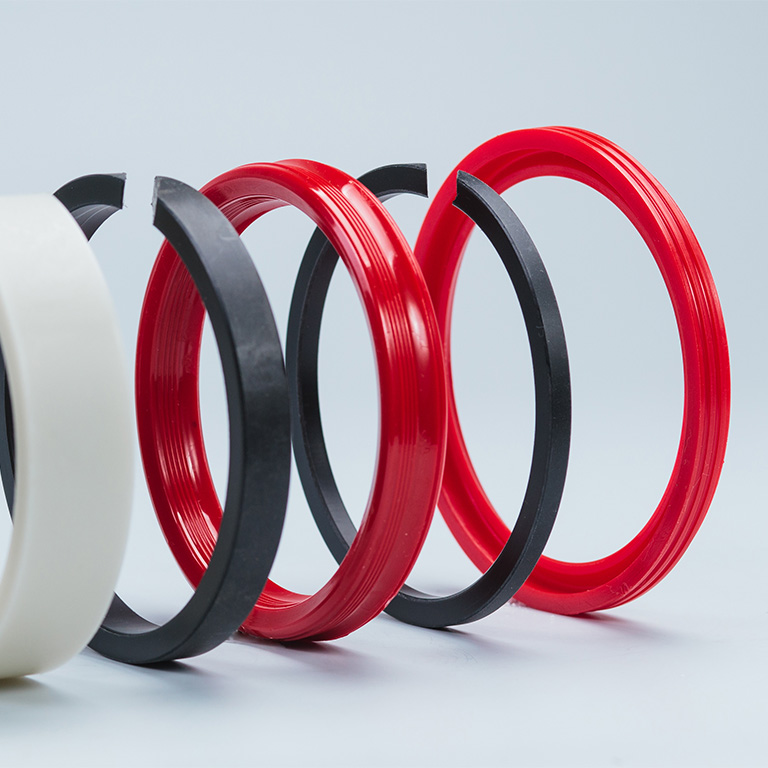
TPU for hydraulic and pneumatic seals
Rod and piston seals, back-up rings, wipers, and gaskets. Laripur grades selected by fluid, temperature, and pressure, from North American stock.
Rod and piston seals, back-up rings, wipers, and gaskets. Laripur grades selected by fluid, temperature, and pressure, from North American stock.
Thermoplastic polyurethane combines high abrasion and extrusion resistance with good compression-set recovery, which is the combination dynamic seals need: hold the seal geometry under pressure, survive thousands of stroke cycles, and recover after load.
Because it is thermoplastic, Laripur TPU is injection molded or machined from extruded stock with consistent, repeatable properties and no curing step.
The most important seal decision is the soft-segment chemistry, because it sets how the seal survives its fluid and environment over years of service.
Polyester or caprolactone TPU. Best abrasion, extrusion resistance, and resistance to oils and fuels. The default for standard hydraulic and pneumatic service.
Polyether TPU. Far better hydrolysis resistance, so the seal does not soften and fail after long exposure to water-based fluids or humidity.
Polyether TPU. Keeps flexibility and sealing force at low temperatures where polyester grades stiffen.
The trade-offs behind this table are covered in polyester vs polyether TPU.
Dynamic seals for hydraulic cylinders, where abrasion resistance and extrusion resistance under pressure drive service life.
Harder grades that support an O-ring and prevent it from extruding into the clearance gap at high pressure.
Rod wipers that keep contamination out of the cylinder while flexing over the rod surface.
Gaskets and static seals where chemical resistance and compression set matter more than dynamic wear.
Most TPU seals fall between Shore A 90 and Shore D 55. Harder grades resist extrusion at high pressure; softer grades conform and seal on imperfect surfaces at lower pressure. Laripur covers the full range, so the same supplier can serve a family of seal designs.
Tell us the fluid, the operating temperature and pressure, and the seal type, and we will recommend a grade and send a sample. Cross-references from other TPU seal grades are available on request.
These are the Laripur grades COIM names for sealing on their own data sheets. Two of them publish compression set, the property a seal is judged on.
| Grade | Chemistry | Hardness | What COIM lists it for |
|---|---|---|---|
| Laripur E 107-93A | Polycaprolactone ester | 93 A | Heavy duty hydraulic seals. VICAT 347 degrees F, compression set at three conditions |
| Laripur 2203-93A | PTMG polyether | 92 A | High performance seals of wide applicability, pneumatic in particular. Compression set at two conditions |
| Laripur 2102-85AE | Polycaprolactone ester | 84 A | Seals, bellows, watch belts and technical items |
| Laripur 7560 | PTMG polyether | 77 A | Seals and technical items, with hydrolysis resistance |
Harder grades are available where a seal has to resist extrusion at high pressure. See the full COIM catalog or the TPU line overview.
Send us the fluid, the temperature, the pressure and the seal type. We will name the grade, send the compression set data where COIM publishes it, and ship a sample.
Request a SampleTechnical Data Sheets and Safety Data Sheets are available for every grade, with food-contact statements (FDA 21 CFR 177.2600) for select grades on request. We hold inventory in North American warehouses and ship across the US, Canada, and Mexico, with samples usually out the same business day.
It depends on the fluid and temperature. For mineral-oil and fuel hydraulics, polyester or caprolactone TPU gives the best abrasion, extrusion, and oil resistance. For water-based fluids, water-glycol, or humid and immersed service, polyether TPU resists hydrolysis far better and is the safer long-term choice. For cold service, polyether also holds flexibility at lower temperatures.
Most dynamic seals fall in the Shore A 90 to Shore D 55 range. Higher hardness improves extrusion resistance under pressure; lower hardness improves sealing on imperfect surfaces and low-pressure conformability. Back-up rings typically use the harder end of the range.
Thermoplastic polyurethane is injection molded or machined from extruded stock with consistent, repeatable properties and no curing step. It offers high abrasion and extrusion resistance and good compression-set recovery, and it can be reprocessed. For high-volume precision seals it often gives better dimensional consistency than cast systems.