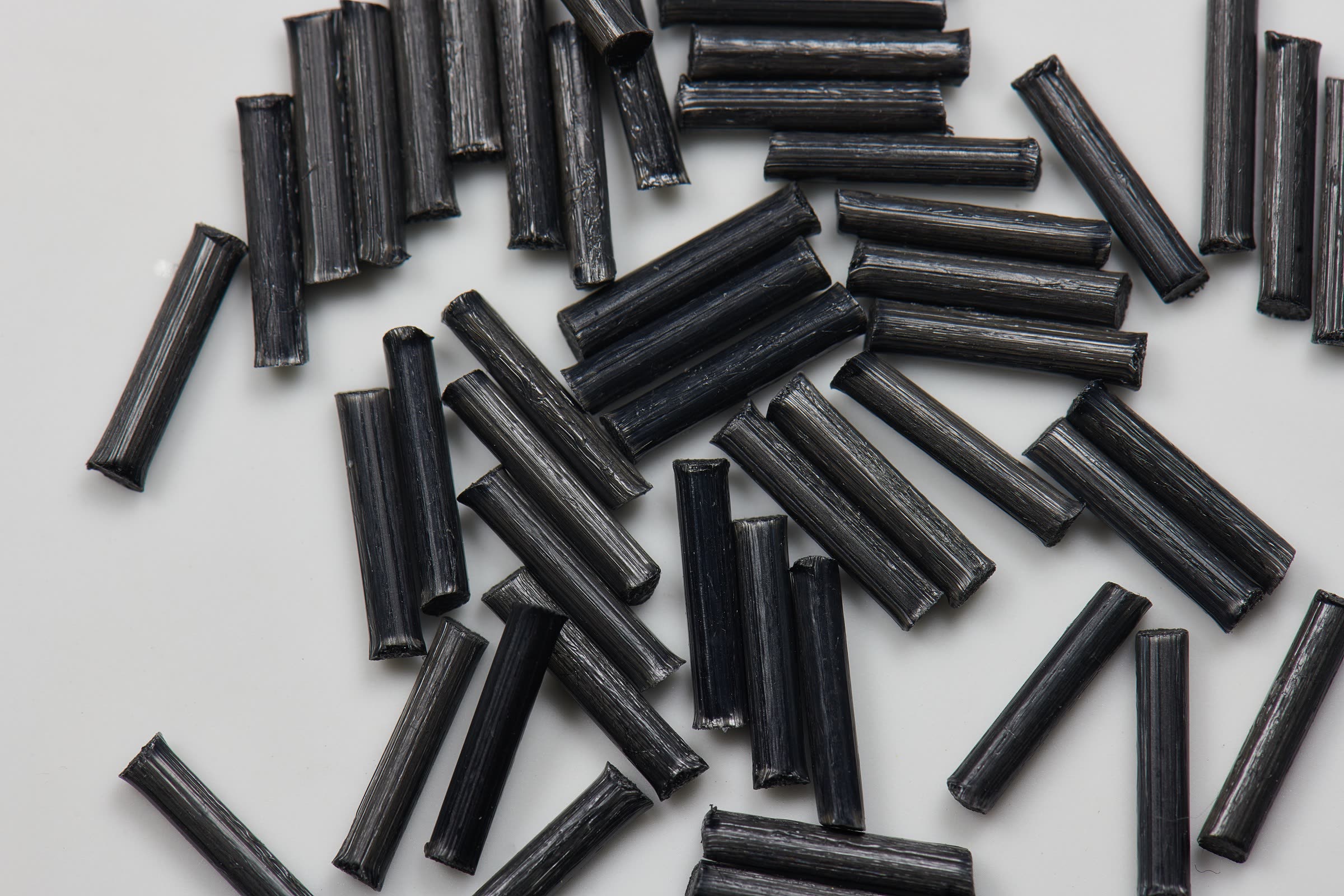
Sipolprene 25150
Shore D 24 ether ester TPC-ET with a 150 °C melting point, developed for blending with PVC into plasticizer-free soft compounds. Injection molding and extrusion.
Shore D 24 ether ester TPC-ET with a 150 °C melting point, developed for blending with PVC into plasticizer-free soft compounds. Injection molding and extrusion.
Sipolprene 25150 is an ether ester thermoplastic elastomer (TPC-ET) at a nominal Shore D 24, with a melting temperature of 150 °C and a low modulus. Sipol developed it with a low melting temperature so it can be mixed with PVC to make soft compounds free from plasticizers.
The 150 °C melting point is the property Sipol designed in for PVC blending, and it sets the processing window. The suggested barrel profile runs from 140 °C at the rear zone to 180 °C at the nozzle, and the extrusion profile tops out at 170 to 180 °C at the die.
As a part material it is very soft. Flexural modulus is 17 MPa, elongation at break 780 percent and stress at break 20 MPa, with no break in notched Izod at 23 °C.
Compression set rises from 24 percent at 23 °C to 71 percent at 70 °C, so check it against the service temperature of any part that has to hold a seal. Water absorption is 0.9 percent after 24 hours of immersion.
Sipol publishes one data sheet for 25150, and it lists no black, UV-stabilized or heat-stabilized versions.
It is also written as TPC-ET, thermoplastic copolyester elastomer, TPEE, TEEE, COPE, copolyester elastomer, thermoplastic polyester elastomer, and ether ester elastomer.
| Property | Typical value |
|---|---|
| Melting temperature | 150 °C (ISO 11357-3) |
| Crystallization temperature | 122 °C (ISO 11357-3) |
| Melt flow index (MFI) | 19 g/10 min at 200 °C, 2.16 kg (ISO 1133) |
| Melt volume rate (MVR) | 17 cm³/10 min at 200 °C, 2.16 kg (ISO 1133) |
| Shore D hardness | 24 instantaneous, 20 after 15 s (ISO 868) |
| Stress at break | 20 MPa (ISO 527) |
| Elongation at break | 780 percent (ISO 527) |
| Flexural modulus | 17 MPa (ISO 178) |
| Notched Izod impact, 23 °C | No break (ISO 180) |
| Abrasion resistance | 59 mm³ at 5 N vertical load (ISO 4649) |
| Compression set, 23 °C | 24 percent (ISO 815:1991) |
| Compression set, 70 °C | 71 percent (ISO 815:1991) |
| Density | 1.08 g/cm³ (ISO 1183) |
| Water absorption | 0.9 percent, 24 h immersion at 23 °C (Sipol method MI 08) |
| Versions | One version; no dry blend variants listed on the TDS |
Typical values from the manufacturer's technical data sheet. They describe the product, they are not a specification. We will send the current TDS and the batch documentation your qualification needs.
Tell us the part or the process, the property you are targeting, and the volume you expect. We will confirm the grade, send the documentation, and get a sample of the candidate grade to you.
Sipol developed the grade with a low melting temperature so it can be mixed with PVC without plasticizers.
The 150 °C melting point and 19 g/10 min melt flow at 200 °C suit a melt blend with PVC.
Shore D 24 with a 17 MPa flexural modulus, molded at 160 to 180 °C barrel temperatures.
The TDS gives an extrusion profile of 140 to 160 °C at the feed and 170 to 180 °C at the die.
Dry before processing at 90 °C for 2 to 3 hours in a dehumidifying dryer, to a processing moisture content of 0.15 percent.
Suggested injection molding profile for a 150 °C melting grade: rear zone 140 °C, center zone 160 °C, front zone 170 °C and nozzle 180 °C, with the mold at 20 to 30 °C.
Suggested extrusion profile: feeding zone 140 to 160 °C, compression zone 160 to 170 °C, metering zone 170 to 180 °C and head or die 170 to 180 °C.
Package sizes: 25 kg bags with an aluminum film moisture barrier, 500 kg cardboard octabins with an inner PE liner, and 500 kg and 1000 kg big bags..
Storage: Stable for 12 months unopened in the original packaging, kept cool and dry and protected from light. Material held at around 5 to 10 °C or below should sit at 15 to 20 °C for at least 24 hours before use.
Read the safety data sheet before handling.
Sipolprene 25150 was developed with a low melting temperature, 150 °C, so it can be mixed with PVC to make soft compounds free from plasticizers. It is a Shore D 24 ether ester TPC-ET, and Sipol rates its melt behavior as suitable for injection molding and extrusion as well, so the same grade can be run on its own as a very soft part material.
Sipolprene 25150 melts at 150 °C. Sipol suggests an injection barrel profile of 140 °C at the rear zone, 160 °C center, 170 °C front and 180 °C at the nozzle, with the mold at 20 to 30 °C. For extrusion the profile runs 140 to 160 °C at the feed and 170 to 180 °C at the die. Dry it at 90 °C for 2 to 3 hours first, to 0.15 percent moisture.
Sipolprene 25150 and Sipolprene 35150 share the 150 °C melting point and the PVC-blending purpose stated on each data sheet. 25150 is the softer of the two at Shore D 24 and 17 MPa flexural modulus, against Shore D 37 and 50 MPa for 35150. 35150 carries an EU 10/2011 food contact statement and a black dry blend version; the 25150 data sheet lists neither.
The Sipolprene 25150 data sheet carries no food contact statement, so we do not describe it as compliant. If the compound is going into a food-contact use, Sipolprene 35150 is the PVC-blending grade whose data sheet states compliance with European EU 10/2011, at a 150 °C melting point and Shore D 37.
Yes. We send the Technical Data Sheet (TDS) and Safety Data Sheet (SDS) on request, in the manufacturer's current revision. Use Request TDS or SDS above and tell us what your qualification review needs.
The other PVC-blending grade at 150 °C, harder at Shore D 37 and with an EU 10/2011 statement.
Soft Shore D 28 TPC-ET with a 173 °C melting point and FDA and EU 10/2011 statements.
Shore D 29 with a 184 °C melting point, for parts that run warmer.
The Sipolprene range from soft to hard, and where copolyester elastomer fits against TPU.
What the TPC-ET name means and how the family differs from TPU.
How to match a copolyester elastomer specification by hardness, melt flow and version.