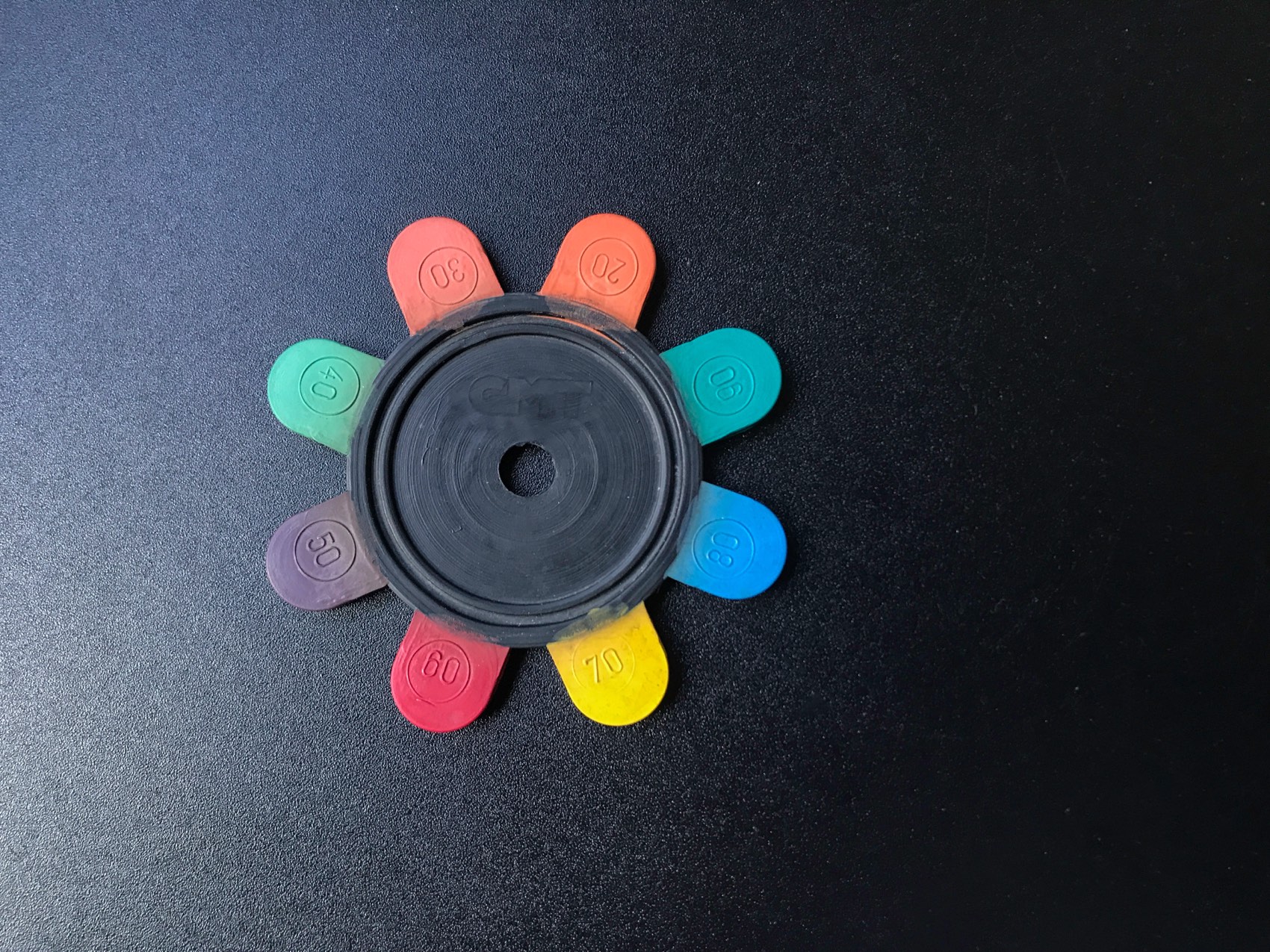
Thermoplastic urethane combines elasticity, transparency, and resistance to oil, grease, abrasion, and a wide range of chemicals. It is a family of materials defined largely by hardness, measured on the Shore scale.
What is a durometer?
Durometer is the unit of hardness on the Shore scale. For TPU, hardness is reported on Shore A for softer, more elastomeric grades, and Shore D for harder, more rigid grades. The transition point is roughly Shore A 95 / Shore D 40.
Hardness in TPU is determined primarily by the ratio of hard segments to soft segments in the polymer chain. Hard segments provide rigidity and wear resistance. Soft segments provide flexibility and resilience. Adjusting this ratio (and choosing between polyester and polyether chemistry) sets each grade's hardness and performance profile.
The durometer spectrum
Shore A 60–85 (very soft): highly flexible. Used in over-molded soft-touch grips, films, wearable technology interfaces, and medical device components requiring compliance.
Shore A 85–95 (soft to medium): flexible with better tear resistance. The range of most cast urethane wheels, flexible tubing, and bellows. Good abrasion resistance.
Shore A 95 to Shore D 50 (medium): the workhorse range for industrial applications. Seals, hydraulic components, hose, conveyor belts, and drive belts. Balances flexibility with mechanical strength.
Shore D 50–75 (hard): rigid but not brittle. High wear resistance, dimensional stability, and load capacity. Used in structural components, high-load wheels, cable jacketing, and applications requiring creep resistance.
Polyester vs. polyether chemistry
Polyester-based TPU offers better oil and grease resistance, higher mechanical properties, and better abrasion resistance, preferred for most industrial applications. Polyether-based TPU offers better hydrolysis resistance and low-temperature flexibility, preferred in wet environments and cold-climate outdoor use.
The Laripur range from COIM
PAT supplies the Laripur line of TPU from COIM, covering Shore A 66 through Shore D 77 in polyester, PTMG polyether, and polycaprolactone ester chemistries, from a single source with over 35 years of North American distribution history. See the TPU product page for the full overview, or read polyester vs polyether TPU for the chemistry trade-offs.
The Laripur range by hardness
Every Laripur grade PAT stocks, ordered softest to hardest, with the soft-segment chemistry alongside it. Hardness and tensile strength are the typical values from COIM's own technical data sheet, and each grade links to its full specification.
| Grade | Hardness | Soft segment | Tensile strength |
|---|---|---|---|
| Laripur 6518 | 66 A | Plasticized polyester, transparent | 4500 psi |
| Laripur 7025 | 70 A | Polyester | 6200 psi |
| Laripur 7560 | 77 A | PTMG polyether | 6000 psi |
| Laripur 8125 | 83 A | Polyester | 60.5 N/mm2 |
| Laripur 8225 | 83 A | Polyester | 8500 psi |
| Laripur 8025 | 84 A | Polyester | 7900 psi |
| Laripur 2102-85AE | 84 A | Polycaprolactone ester | 9300 psi |
| Laripur 8860EG | 86 A | PTMG polyether | 6380 psi |
| Laripur 9060 | 88 A | PTMG polyether | 7000 psi |
| Laripur 9025 | 90 A | Polyester | 8600 psi |
| Laripur 2103-90AE | 90 A | PTMG polyether | 8000 psi |
| Laripur 2203-93A | 92 A | PTMG polyether | 8000 psi |
| Laripur E 107-93A | 93 A | Polycaprolactone ester | 8200 psi |
| Laripur 4525EG | 46 D | Polyester | 8800 psi |
| Laripur 5260 | 50 D | PTMG polyether | 8000 psi |
| Laripur 5225 | 51 D | Polyester | 9000 psi |
| Laripur 5725 | 56 D | Polyester | 9500 psi |
| Laripur 5760 | 56 D | PTMG polyether | 9000 psi |
| Laripur 5925 | 59 D | Polyester | 9800 psi |
| Laripur 6325 | 62 D | Polyester | 10000 psi |
| Laripur 6560 | 65 D | PTMG polyether | 9600 psi |
| Laripur 72D25 | 67 D | Polyester | 10300 psi |
| Laripur 71D60 | 70 D | PTMG polyether | 77.2 N/mm2 |
| Laripur 7711 | 77 D | Not stated by COIM | 10000 psi |
Two grades at the same durometer in different chemistries behave differently in wet, cold, or oily service, so read the hardness column and the chemistry column together. Browse the full COIM catalog for the specification, processing profile, and packaging on each grade, or see the TPU buyer's guide for the selection sequence.
Not sure which Laripur grade fits your application?
Our TPU team can help you select the right hardness, chemistry, and processing grade. Contact us to discuss your application or request samples.
Talk to Our TPU Team