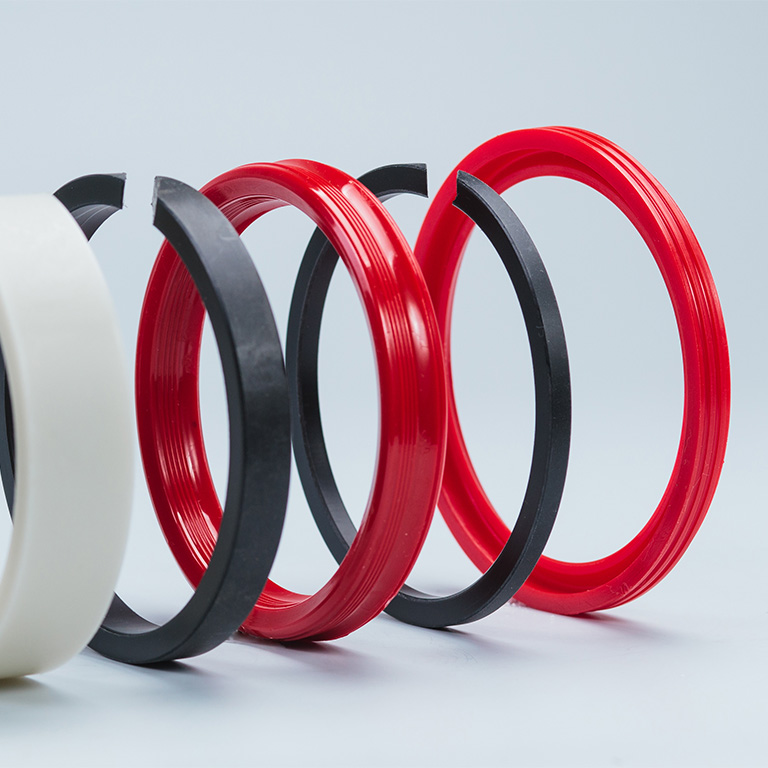
Thermoplastic polyurethane is one of the most capable sealing materials in the hydraulic and pneumatic toolbox. It holds seal geometry under pressure, survives long stroke counts, and recovers after load. But TPU is a family, not a single material, and the grade that thrives in an oil cylinder can fail in a water-glycol one.
What makes TPU good at sealing
Three properties carry a seal, and TPU is strong on all three:
- Abrasion resistance keeps the dynamic sealing surface intact over thousands of strokes.
- Extrusion resistance, driven by modulus, keeps the seal from being forced into the clearance gap at pressure.
- Compression-set recovery lets the seal spring back after load instead of taking a permanent dent and leaking.
Because it is thermoplastic, TPU is injection molded or machined from extruded stock with repeatable properties and no curing step, which is why precision seal makers favor it at volume.
The extrusion gap, and why modulus matters
At high pressure, soft seal material wants to flow into the clearance gap between the rod and the bore, where it shears off and fails. The defense is modulus: a harder, higher-modulus material resists being pushed into the gap. This is the whole reason back-up rings exist. A hard TPU back-up ring sits behind a softer primary seal and blocks the gap so the primary seal can do its job at pressure it could not survive alone.
Compression set: the seal's memory
Compression set measures how much a material stays deformed after a load is removed. A seal with high compression set loses its sealing force over time and starts to weep. TPU has good recovery, but compression set climbs with temperature, so a grade that performs at room temperature should be checked at the seal's real operating temperature.
Match the chemistry to the fluid
This is the decision that most often determines seal life:
| Service | TPU chemistry |
|---|---|
| Mineral oil, fuel, standard hydraulics | Polyester or caprolactone |
| Water, water-glycol, humid or immersed | Polyether |
| Cold or sub-zero | Polyether |
The classic failure to avoid
A polyester seal in a water-based or humid system can soften and lose strength over months as the ester bonds hydrolyze. If the fluid is water-glycol or the cylinder lives outdoors, specify a polyether grade from the start. The full chemistry comparison is in polyester vs polyether TPU.
Request a SampleSeal types
- Rod and piston seals: dynamic seals where abrasion and extrusion resistance set service life.
- Back-up rings: hard grades that block the extrusion gap behind an O-ring or primary seal.
- Wipers and scrapers: keep contamination out of the cylinder while flexing over the rod.
- Static seals and gaskets: where chemical resistance and compression set matter more than dynamic wear.
Frequently asked
Which TPU type is best for hydraulic seals?
For mineral-oil and fuel hydraulics, polyester or caprolactone TPU gives the best abrasion, extrusion, and oil resistance. For water-based fluids, water-glycol, or humid and immersed service, polyether resists hydrolysis far better. For cold service, polyether keeps flexibility at lower temperatures.
What is extrusion resistance in a seal?
Extrusion is when seal material is forced into the clearance gap between moving parts under high pressure, where it shears off and fails. A higher-modulus, harder TPU resists extrusion better, which is why back-up rings use the harder end of the range.
Why use TPU instead of cast polyurethane or rubber?
TPU is injection molded or machined from extruded stock with consistent, repeatable properties and no curing step. It offers high abrasion and extrusion resistance and good compression-set recovery, and for high-volume precision seals it often gives better dimensional consistency than cast systems.
Sourcing seal-grade TPU
P.A.T. Products distributes COIM Laripur TPU across the full hardness range and all three soft-segment chemistries, from North American stock. Tell us the fluid, temperature, pressure, and seal type, and we will recommend a grade, send a sample, and provide a cross-reference if you are qualifying against another material.
| Grade | Soft segment | Hardness | Service it suits |
|---|---|---|---|
| Laripur E 107-93A | Polycaprolactone ester | 93 A | Heavy duty hydraulic seals in mineral oil and fuel. VICAT 347 degrees F, compression set published at three conditions |
| Laripur 2203-93A | PTMG polyether | 92 A | Water, water-glycol and humid service. High performance seals of wide applicability, pneumatic in particular |
| Laripur 2102-85AE | Polycaprolactone ester | 84 A | The softer ester option. Seals, bellows and wipers in oil-based service |
| Laripur 7560 | PTMG polyether | 77 A | The softer polyether option. Very good hydrolysis and microbial resistance for wet and buried service |
Harder grades are available where a seal has to hold a clearance gap at high pressure. The hardest in the range is Laripur 7711 at Shore 77 D, a high-modulus engineering grade COIM lists for rigid mouldings and high-tear parts. Browse the full COIM catalog for the rest of the range.
See TPU for seals