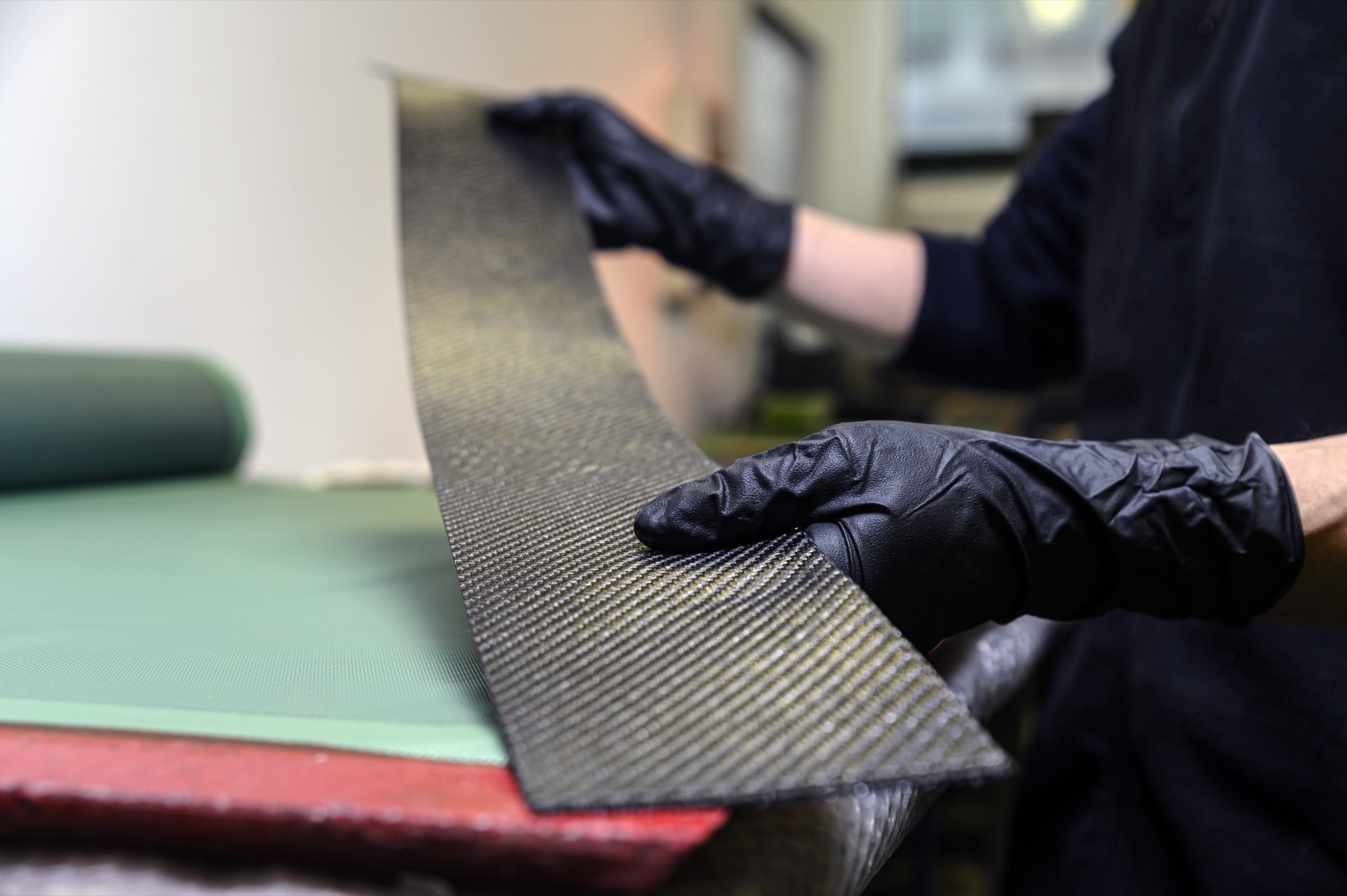
COIM publishes twenty-nine polyurethane dispersions for carbon fiber sizing, each with dried film mechanical data, the 100 percent modulus, maximum load, and elongation at break. The range runs from a soft 0.5 MPa film at 880 percent elongation to a stiff 21 MPa one at 230 percent, with polycarbonate, polyester, and polyether backbones across the family.
The range is published for nylon, polycarbonate, and polyurethane matrices, where an epoxy film former is the wrong chemistry for the melt. Film stiffness changes cutting behavior, fuzz, and blade wear on chopping and converting lines.
Most of the range is anionic, published with high strand and tow integrity that still wets and disperses easily during application, and with electrostatic dissipation, which bleeds off the static that makes loose carbon filament fly, cling, and bridge. The anionic grades accept anionic or non-ionic bath additives.
Six grades carry a current technical data sheet and their own page. FILCO 547 and FILCO 8000 are the non-ionic polyester-polyurethanes, 547 with published film data at 2 MPa and 8000 published for a soft coating with excellent strand integrity. FILCO D2496, D2596, D2594 and D2476 are anionic, stepping up from 8 to 20 MPa on polyester, polyether and polycarbonate backbones, all published for virgin or recycled carbon fiber. FILCO 8000 is published for glass, carbon, basalt and mineral fiber on its data sheet and is not in the brochure table below.
Seventeen grades are published hydrazine-free. FILCO D2594 and D2596 are published for continuous and chopped carbon fiber, virgin or recycled. FILCO 8815 is the reactive option, crosslinking during downstream processing, with a published heat resistance of 572 degrees F at 5 percent mass loss. FILCO 7810 carries the highest solids in the family at 60 percent.
It is also written as PU sizing for carbon fiber, polyurethane carbon fiber sizing, carbon fiber sizing for polyamide, anionic polyurethane dispersion, waterborne PU film former, and recycled carbon fiber sizing.
Typical properties
| Property | Typical value |
|---|
| Chemistry | Polyurethane dispersions on polycarbonate, polyester, and polyether backbones |
| Carrier | Water based, most grades anionic, several non-ionic |
| Solids content | 27.5 to 60 percent depending on grade |
| Dried film 100 percent modulus | 0.5 to 21 MPa where published |
| Elongation at break | 50 to 880 percent depending on grade |
| Compatible matrices | PA, PC, PU, ABS |
| Published grades | 29 |
| Fibers | Carbon, with D2594 and D2596 published for virgin or recycled fiber |
Typical values from the manufacturer's technical data sheet. They describe the product, they are not a specification. We will send the current TDS and the batch documentation your qualification needs.
Need this in your system?
Tell us the binder system, the property you are targeting, and the volume you
expect. We will confirm the grade, send the documentation, and get a sample of the candidate grade to you.
Recommended grades
| Grade | Dispersion type | Solids | 100 percent modulus | Max load | Elongation at break | Notes |
|---|
| FILCO TD2328 | Anionic | 39.5 percent | 0.5 MPa | 5 MPa | 880 percent | The softest film in the range |
| FILCO D2446 | Anionic | 39.5 percent | 2.5 MPa | 18 MPa | 800 percent | Hydrazine-free |
| FILCO D2618 | Anionic | 45.5 percent | 1.5 MPa | 11 MPa | 770 percent | Hydrazine-free |
| FILCO D2208 | Anionic | 33.5 percent | 2.5 MPa | 25 MPa | 740 percent | Hydrazine-free |
| FILCO D2426 | Anionic | 30 percent | 3 MPa | 29 MPa | 740 percent | Hydrazine-free |
| FILCO D2422 | Anionic | 30.5 percent | 3 MPa | 26 MPa | 725 percent | Hydrazine-free |
| FILCO TD2307 | Anionic | 34 percent | 3.5 MPa | 26 MPa | 710 percent | Development grade |
| FILCO D2474 | Anionic | 30 percent | 2 MPa | 16 MPa | 675 percent | Hydrazine-free |
| FILCO 547 | Non-ionic | 45 percent | 2 MPa | 32 MPa | 650 percent | Hydrazine-free, polyester backbone, soft hand, good abrasion resistance, own page |
| FILCO TD2349 | Non-ionic | 30.5 percent | 3 MPa | 35 MPa | 600 percent | Development grade |
| FILCO 7810 | Non-ionic and anionic | 60 percent | 3 MPa | 37 MPa | 550 percent | Hydrazine-free, the highest solids in the family |
| FILCO 8815 | Non-ionic | 51 percent | 3.5 MPa | 26 MPa | 500 percent | Hydrazine-free, reactive, 572 degrees F at 5 percent mass loss |
| FILCO D2270 | Anionic | 35 percent | 10 MPa | 37 MPa | 450 percent | Hydrazine-free, also published as a liquid binder for non-wovens |
| FILCO TD2322 | Anionic | 30.5 percent | 5.5 MPa | 29 MPa | 410 percent | Development grade |
| FILCO TD2331 | Anionic | 30.5 percent | 5 MPa | 17 MPa | 375 percent | Development grade, polycarbonate backbone |
| FILCO D2596 | Anionic | 32 percent | 9 MPa | 31 MPa | 320 percent | Hydrazine-free, virgin or recycled carbon fiber, moderate stiffness, own page |
| FILCO TD2313 | Anionic | 35.5 percent | 9.5 MPa | 26 MPa | 300 percent | Development grade |
| FILCO D2284 | Anionic | 38 percent | 10.5 MPa | 23 MPa | 300 percent | Hydrazine-free |
| FILCO D2496 | Anionic | 33.5 percent | 8 MPa | 19 MPa | 300 percent | Hydrazine-free, polyester backbone, virgin or recycled fiber, moderate stiffness, own page |
| FILCO TD2352 | Anionic | 38.5 percent | 17 MPa | 49 MPa | 300 percent | Development grade, the highest max load in the range |
| FILCO TD2334 | Anionic | 30 percent | 11 MPa | 26 MPa | 275 percent | Development grade |
| FILCO D2460 | Anionic | 27.5 percent | 13 MPa | 28 MPa | 250 percent | Hydrazine-free |
| FILCO TD2343 | Anionic | 31.5 percent | 21 MPa | 45 MPa | 230 percent | Development grade, the stiffest film in the range |
| FILCO TD2325 | Anionic | 30.5 percent | 13 MPa | 26 MPa | 230 percent | Development grade |
| FILCO D2594 | Anionic | 31 percent | 12 MPa | 24 MPa | 220 percent | Hydrazine-free, virgin or recycled carbon fiber, high tow integrity, own page |
| FILCO D2476 | Anionic | 35 percent | 20 MPa | 35 MPa | 200 percent | Hydrazine-free, polycarbonate backbone, outstanding abrasion resistance, virgin or recycled fiber, own page |
| FILCO D2368 | Anionic | 35 percent | 12 MPa | 16 MPa | 180 percent | Hydrazine-free |
| FILCO TD2340 | Anionic | 30 percent | Not published | 86 MPa | 50 percent | Development grade, very high load, very low elongation |
| FILCO 7601 | Non-ionic | 38 percent | Not published | Not published | Not published | 586 degrees F at 5 percent mass loss |
Values are the manufacturer's published typical figures. Ask for the current
technical data sheet on any grade and we will send it with the matching safety
data sheet.
Applications
Chopped carbon fiber for polyamide
PU film formers matched to the nylon melt, with the stiffness the chopping line needs stated per grade.
Converting and chopping lines
The anionic grades add electrostatic dissipation against fuzz and fly.
Recycled carbon fiber
FILCO D2594 and D2596 are published for continuous and chopped carbon fiber, virgin or recycled.
Restricted substance requirements
Hydrazine-free grades are published across the range.
Downstream crosslinking
FILCO 8815, the reactive grade, crosslinks during downstream processing instead of staying thermoplastic.
It is specified where the formulation needs dried film stiffness published on every grade, 0.5 to 21 MPa at 100 percent modulus, anionic grades with electrostatic dissipation for chopping and converting lines, hydrazine-free grades published across the range, virgin and recycled carbon fiber covered by the same published grades, and a reactive option in FILCO 8815 where the film should crosslink downstream.
Handling and dispersion
Applied at the fiber line or in a re-sizing bath. The anionic grades are published with high shear stability and accept anionic or non-ionic bath additives.
Selection runs matrix first, then stiffness. A soft, extensible film keeps tow flexible and yields at a cutting edge, a stiff film holds a compact bundle that presents once and shears once.
Grades carrying a TD prefix are development codes in COIM's current published carbon range, sampled the same way as the named grades, with COIM's technical team in the selection.
Packaging, storage, and regulatory status
Package sizes: Made to order in the pack size the line needs. Tell us the volume and we will confirm..
Storage: Store in closed containers away from direct sun. The polyurethane grades with published data sheets hold 12 months from production, and freezing destroys a waterborne dispersion permanently. Confirm the shelf life on the current data sheet for your grade.
Read the safety data sheet before handling. Hydrazine-free grades are marked in the table. We supply the current SDS with every grade in the manufacturer's current revision.
Frequently asked questions
Which grade should a polyamide compounder start with?
Start from the stiffness the line needs. FILCO 547 is the soft non-ionic polyester-polyurethane at 650 percent elongation, D2596 sits at moderate stiffness at 9 MPa modulus, and D2594 at high stiffness at 12 MPa with high tow integrity. Tell us the matrix, the cutter, and the failure mode you are working on and we will recommend a starting grade.
Why are most of these grades anionic?
The anionic dispersions are published with high shear stability for the size bath and with electrostatic dissipation. Loose carbon filament charges and flies on chopping and converting lines, and the anionic film former bleeds that charge off.
What does hydrazine-free mean here?
Some waterborne polyurethane chemistries carry residual hydrazine from chain extension. The grades COIM marks hydrazine-free are published as such for formulations with restricted substance requirements. Tell us the list you have to meet and we will confirm a grade against it.
Can these grades re-size recycled carbon fiber?
Yes. FILCO D2594 and D2596 are published for continuous and chopped carbon fiber, virgin or recycled. Reclaimed fiber comes out of pyrolysis bare, and the re-size follows the same selection logic as a virgin line, matrix first and then stiffness.
What are the TD grade codes?
Development codes in COIM's current published carbon range. They carry the same published dried film data as the named grades and are sampled the same way, with COIM's technical team in the selection.
Can I get the TDS and SDS for FILCO polyurethane film formers for carbon fiber?
Yes. We send the Technical Data Sheet (TDS) and Safety Data Sheet (SDS) on request, in the manufacturer's current revision. Use Request TDS or SDS above and tell us what your qualification review needs.
Related products
Non-ionic polyester-polyurethane, the soft reference at 2 MPa and 650 percent elongation.
Non-ionic polyester-polyurethane published for a soft coating with excellent strand integrity.
Anionic polyester-polyurethane, moderate stiffness at 8 MPa.
Anionic polyether-polyurethane, moderate stiffness at 9 MPa.
Anionic polyether-polyurethane, high stiffness at 12 MPa.
Anionic polycarbonate-polyurethane, the stiffest with a current data sheet at 20 MPa.
The epoxy and UPE table, thirteen grades with published heat resistance, including FILCO 8902 for PPS and PEEK.
The wider non-reactive polyurethane family across glass and basalt.
The reactive blocked-isocyanate family, where the film crosslinks downstream.
Where this grade fits
What a film former does in a sizing, and how the chemistries divide.
What the film former does to cutting force, fuzz and blade wear on a converting line.
The selection logic, matrix first, then hand, then heat.
What pyrolysis strips and what the re-size has to restore.