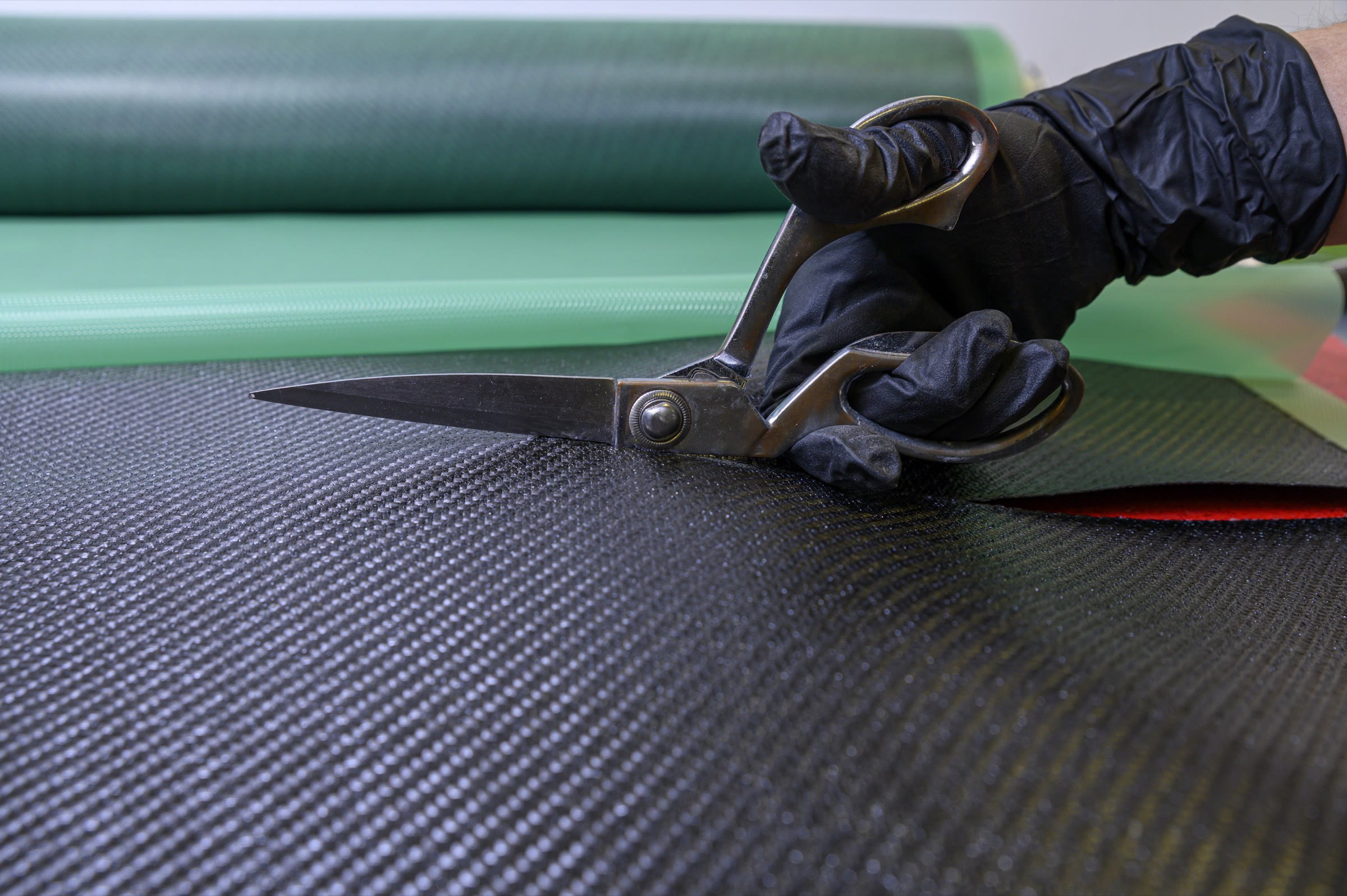
Chopping blade life on a carbon fiber line is partly a sizing property. Carbon is abrasive, so blades wear on any cutter, but how fast they wear depends on how the tow presents to the edge, and the film former in the size controls that. A consolidated tow shears in one clean cut. A fuzzy, splayed, or statically charged tow forces re-cuts, sheds loose filament into the mechanism, and runs abrasive debris across the edge on every pass. Lines running the same fiber on the same cutter see different blade counts under different sizings.
What the blade actually meets
A chopping blade never touches bare carbon first. It lands on the sized surface of a bundle, and the cut that follows is set by three film properties: how stiffly the bundle resists deflection, how the film yields or fractures at the edge, and how much loose filament the handling upstream has already generated. All three trace back to the film former, which is why sizing selection belongs on the short list of levers when blade life runs short, next to blade steel, geometry, and throughput.
Stiffness is now a published number
COIM publishes dried-film mechanical data for the hand of its carbon fiber polyurethane grades: twenty-nine dispersions spanning 0.5 to 21 MPa at 100 percent modulus and 50 to 880 percent elongation at break. A soft non-ionic polyester-polyurethane, FILCO 547, sits at 2 MPa and 650 percent. The anionic grades step up from there: D2496, a polyester-polyurethane, at 8 MPa and 300 percent, D2596, a polyether-polyurethane, at 9 MPa and 320 percent, D2594, the stiff polyether, at 12 MPa and 220 percent, and D2476, a polycarbonate-polyurethane, at 20 MPa and 200 percent with COIM's strongest published abrasion resistance.
Which end helps depends on the failure mode. A line fighting fuzz and splaying usually wants the stiffer film: a compact, well-consolidated bundle presents once and shears once. A line seeing high cutting force or a brittle, dusty cut can move the other way, toward a softer, more extensible film that yields at the edge instead of shattering.
Fighting short blade life on a chopping line?
Tell us the fiber, the cutter, the sizing chemistry you run now, and the compound the chop feeds. We will recommend a starting film former and support a counted chop trial.
Request a SampleStatic is the second lever
Loose carbon filament is conductive, light, and quick to charge. Once static builds, fly follows: filament that clings to guides and housings, bridges in hoppers, and drifts back into the cut zone. Four of the FILCO carbon fiber polyurethane grades with current data sheets, D2496, D2596, D2594 and D2476, are anionic dispersions published with enhanced electrostatic dissipation, which bleeds charge instead of letting it accumulate. The same grades are published with high strand and tow integrity, which limits how much loose filament gets generated in the first place.
Non-ionic film formers remain the classic default in carbon sizing baths, and the non-ionic grades in the range serve exactly that role. The anionic grades are published for carbon fiber, virgin or recycled, with high shear stability and compatibility with anionic or non-ionic bath additives, and D2496 and D2476 are published for glass, basalt and mineral fiber as well.
The matrix still comes first
Chopped fiber ends up in a compound, and the film former has to couple to that melt, so matrix compatibility is still the first gate, before hand and before static. The polyurethane grades serve polyamide, polycarbonate, ABS, and polyurethane matrices. For compounds processed at PPS and PEEK temperatures the line carries FILCO 8902, a modified epoxy at 57 percent solids whose dried film loses only 5 percent of its mass at 725 degrees F and needs no curing after drying. The epoxy ladder, thirteen grades with a published heat-resistance number on each, is on the FILCO carbon fiber film formers page, and the full polyurethane roster with the stiffness data per grade is on the polyurethane film formers page.
Running a chop trial that proves anything
A data sheet cannot promise a blade count, because the cutter, the blade spec, and the wear endpoint differ line to line. What a trial can do is settle the question on your own equipment. Change one variable, the sizing. Hold the fiber, the cutter, the blade lot, and the throughput constant. Count cuts per blade to a defined endpoint, whether that is a wear measurement or a cut-quality limit, and log fuzz and chop length distribution alongside.
We supply sample quantities sized for exactly that kind of trial, and where the question needs the manufacturer, COIM's technical team joins the grade selection directly. If the fiber is reclaimed rather than virgin, the same selection applies with one extra step, covered in re-sizing recycled and converted carbon fiber. The full selection sequence, matrix first, then hand, then downstream heat, is in choosing a film former for carbon fiber sizing.
Frequently asked
Why does blade life vary with the sizing on carbon fiber?
The film former is the material the blade actually meets, and it sets how the tow presents to the edge. A well-consolidated tow shears in one cut. A fuzzy or splayed tow forces re-cuts, and every extra pass runs abrasive carbon debris across the edge. Stiffness, lubricity, and static behavior all feed that outcome, so two sizings on the same fiber can wear blades at different rates.
Is a softer or a stiffer film former better for chopping?
It depends on the failure mode. Against fuzz and splaying, a stiffer film with a higher dried-film modulus holds a compact bundle that shears cleanly. Against high cutting force or a brittle, dusty cut, a softer, more extensible film changes how the tow yields at the edge. The FILCO polyurethane range publishes the numbers, 0.5 to 21 MPa at 100 percent modulus and 50 to 880 percent elongation.
What does an anionic sizing do for fuzz and fly?
Loose carbon filament charges easily, then flies, clings, and bridges. Anionic polyurethane dispersions are published with enhanced electrostatic dissipation, which bleeds the charge off. That works on fuzz and fly from a second direction, alongside the film stiffness that controls how much loose filament gets generated in the first place.
How should a chop trial be run so the result means something?
Change one variable, the sizing, and count cuts per blade to a defined wear or quality endpoint. Hold the fiber, the cutter, the blade lot, and the throughput constant, and log fuzz and length distribution alongside the blade count. A controlled count on your own cutter settles it.
Does the matrix still decide the sizing for chopped fiber?
Yes, before hand and before static. Polyurethane dispersions serve polyamide, polycarbonate, ABS, and polyurethane matrices. For compounds processed at PPS and PEEK temperatures there is a modified epoxy whose dried film loses only 5 percent of its mass at 725 degrees F. Matrix first, then the hand the chopping line needs.
Chopping or converting carbon fiber?
Send the fiber, the cutter, the current sizing, and the destination compound. We will recommend a film former, ship a trial quantity, and back the count with technical support.
View the FILCO carbon fiber grades