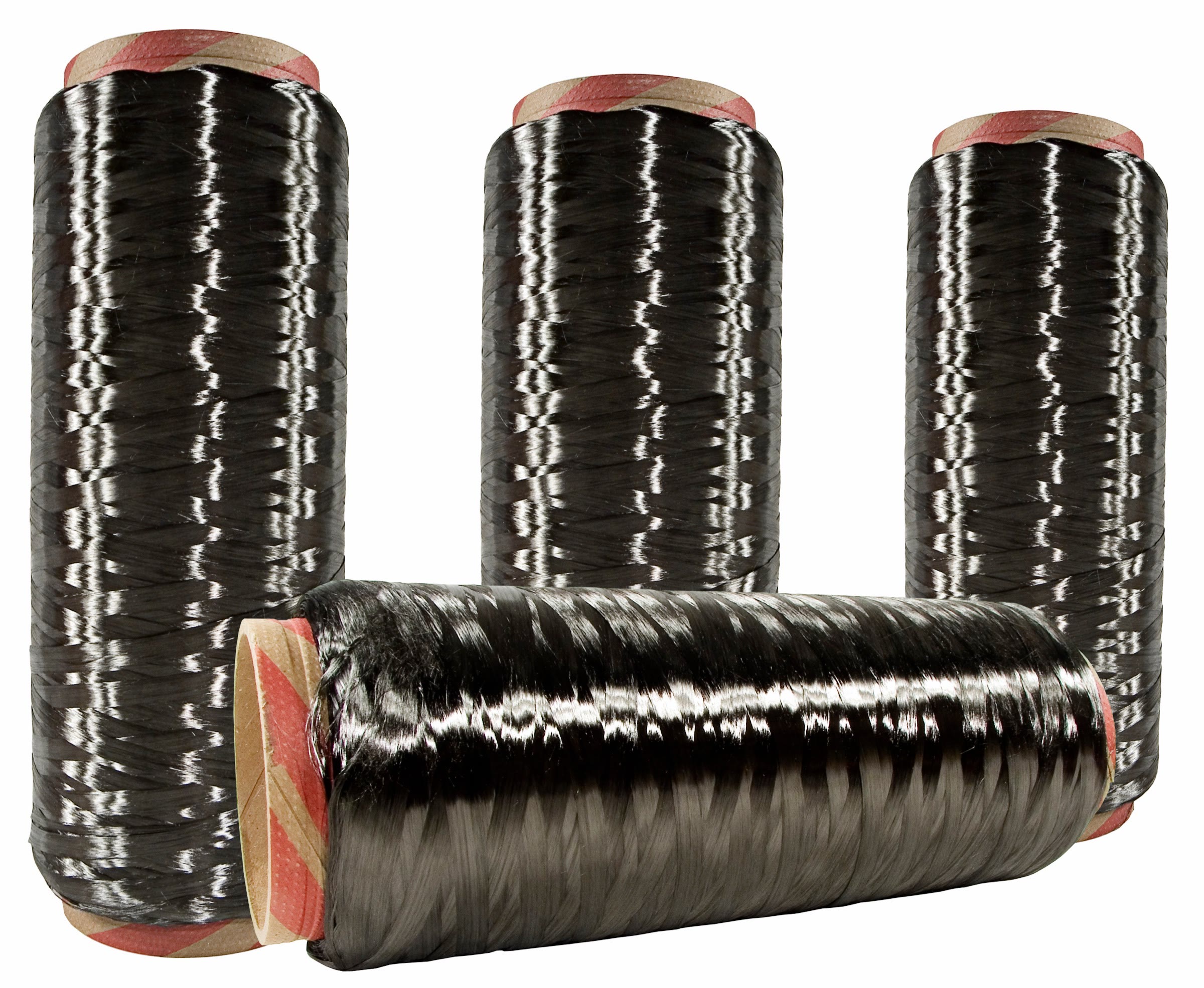
COIM publishes thirteen epoxy and unsaturated-polyester film formers for carbon fiber sizing, laddered from very soft to very stiff, each with its solids, glass transition temperature, epoxy equivalent weight, and a heat-resistance number, the temperature at which the dried film has lost 5 percent of its mass. A companion range of polyurethane dispersions for polyamide and engineering-thermoplastic matrices has its own page, with dried film stiffness published per grade.
The very soft grades, FILCO 303i, 349, 309 and 348HP, keep continuous fiber flexible for spooling and textile handling. The middle of the ladder carries the higher-temperature chemistries for continuous or chopped fiber, FILCO 345 epoxy novolac, 74005 epoxy cresol novolac, and the modified epoxy 362, alongside the UPE grades 8901 and 354N. At the stiff end, FILCO 394, 322 and 8902 hold a compact, stable bundle for chopping and dosing.
FILCO 8902 tops the ladder. It is a special epoxy in non-ionic water dispersion at 57 percent solids, epoxy equivalent weight 2950, whose dried film loses only 5 percent of its mass at 725 degrees F (385 degrees C), needs no curing after drying, and is cross-linkable. It is the grade for chopped strands and tows going into PPS and PEEK, where a standard epoxy sizing degrades, and it also serves PBT, PET, ABS, PC, epoxy and unsaturated polyester, on glass, carbon, basalt and mineral fibers.
The whole table is non-ionic, which keeps the emulsions stable against the treated carbon surface, and the matrix coverage spans epoxy, unsaturated polyester, vinyl ester, phenolic, PPS, aramid and polyurethane. In COIM's published unidirectional CFRP comparison, FILCO-sized carbon fiber raised laminate tensile strength 65 percent and elongation 69 percent against unsized fiber, and a mismatched sizing lowered both.
FILCO 362, 354N, 394, 322 and 8902 contain a co-solvent, and COIM offers solvent-free versions on request.
It is also written as carbon fiber sizing, carbon fiber sizing, carbon fiber film former, PEEK compatible sizing, PPS compatible sizing, epoxy sizing for carbon fiber, and carbon fiber sizing agent.
Typical properties
| Property | Typical value |
|---|
| Chemistry | Epoxy, modified epoxy, epoxy novolac, epoxy cresol novolac, UPE |
| Carrier | Water based, non-ionic |
| Solids content | 39 to 63 percent depending on grade |
| Tg range | 5 to 100 degrees F |
| Epoxy equivalent weight | 200 to 2950 g/eq where applicable |
| Heat resistance, 5 percent mass loss | 496 to 725 degrees F depending on grade |
| Compatible matrices | Epoxy, UPE, vinyl ester, phenolic, PPS, aramid, PU, and PEEK on FILCO 8902 |
| Published grades | 13, plus the polyurethane range on its own page |
| Fibers | Carbon, virgin or recycled. Several grades also glass, basalt, mineral |
Typical values from the manufacturer's technical data sheet. They describe the product, they are not a specification. We will send the current TDS and the batch documentation your qualification needs.
Need this in your system?
Tell us the binder system, the property you are targeting, and the volume you
expect. We will confirm the grade, send the documentation, and get a sample of the candidate grade to you.
Recommended grades
| Grade | Chemistry | Solids | Tg | EEW | 5 percent mass loss | Main features |
|---|
| FILCO 303i | Epoxy | 51 percent | 5 degrees F | 200 g/eq | 568 degrees F | Very soft, suitable for continuous fiber |
| FILCO 349 | Epoxy | 61 percent | 5 degrees F | 240 g/eq | 570 degrees F | Very soft, high solid, for continuous fiber |
| FILCO 309 | Epoxy | 54 percent | 5 degrees F | 270 g/eq | 579 degrees F | Very soft, for continuous fiber |
| FILCO 348HP | Epoxy | 63 percent | 10 degrees F | 270 g/eq | 585 degrees F | Very soft, for continuous fiber |
| FILCO 345 | Epoxy novolac | 55 percent | 23 degrees F | 200 g/eq | 608 degrees F | Soft, high temperature applications, for continuous fiber |
| FILCO 8901 | UPE | 48 percent | 37 degrees F | Not applicable | 496 degrees F | Soft, for continuous fiber |
| FILCO 7900 | Epoxy | 46 percent | 50 degrees F | 2000 g/eq | 579 degrees F | Medium-soft, for continuous or chopped fiber |
| FILCO 362 | Modified epoxy | 39 percent | 50 degrees F | 530 g/eq | 610 degrees F | Medium-soft, high temperature applications, for continuous or chopped fiber |
| FILCO 74005 | Epoxy cresol novolac | 45 percent | 55 degrees F | 280 g/eq | 653 degrees F | Medium-soft, high temperature applications, for continuous or chopped fiber |
| FILCO 354N | UPE | 47 percent | 55 degrees F | Not applicable | 680 degrees F | Medium-soft, high temperature applications, for continuous or chopped fiber |
| FILCO 394 | Modified epoxy | 55 percent | 86 degrees F | 1800 g/eq | 725 degrees F | Stiff, high temperature applications, suitable for chopped fiber |
| FILCO 322 | Modified epoxy | 55 percent | 86 degrees F | 530 g/eq | 644 degrees F | Stiff, high temperature applications, suitable for chopped fiber |
| FILCO 8902 | Epoxy | 57 percent | 100 degrees F | 2950 g/eq | 725 degrees F | Very stiff, for PPS and PEEK processing, cross-linkable, no curing needed after drying |
Values are the manufacturer's published typical figures. Ask for the current
technical data sheet on any grade and we will send it with the matching safety
data sheet.
Applications
PEEK and PPS compounds
FILCO 8902, the grade published for chopped strands and tows at PPS and PEEK melt temperatures.
Continuous fiber lines
The very soft end of the ladder, FILCO 303i through 348HP, keeps tow flexible for spooling and textile handling.
Chopped carbon fiber
The stiff end, FILCO 394, 322 and 8902, holds a compact bundle that chops and doses cleanly.
High temperature service
Every grade carries a published 5 percent mass loss temperature, 496 to 725 degrees F.
Recycled carbon fiber
The re-size follows the same ladder, and the polyurethane range is published for virgin or recycled fiber.
It is specified where the formulation needs a published heat-resistance number on every grade, 496 to 725 degrees F, a soft to very stiff ladder, Tg 5 to 100 degrees F, FILCO 8902 for PPS and PEEK processing, with no post-cure step, cOIM's published UD-CFRP data, 65 percent higher tensile and 69 percent higher elongation against unsized fiber, and solvent-free versions of the co-solvent grades on request.
Handling and dispersion
Applied at the fiber line or in a re-sizing bath as supplied or diluted. FILCO 8902 should be stirred before use to homogenize, and its dried film needs no curing step.
Selection runs matrix first, then the hand the line needs, then the temperature the size will see downstream. The three columns to read are Tg, which sets the hand, EEW, which sets solubility in the matrix, and the mass loss temperature, which sets the heat ceiling.
For polyamide compounds and for chopping lines managing blade life and fuzz, start from the polyurethane range instead, where dried film stiffness is published per grade.
Packaging, storage, and regulatory status
Package sizes: Made to order in the pack size the line needs. Tell us the volume and we will confirm..
Storage: Store in closed containers away from direct sun. FILCO 8902 holds 9 months from production, and freezing destroys a waterborne dispersion permanently. Confirm the shelf life on the current data sheet for your grade.
Read the safety data sheet before handling. We supply the current SDS with every grade in the manufacturer's current revision.
Frequently asked questions
Is there a carbon fiber sizing for PEEK or PPS processing?
Yes, FILCO 8902. It is a special epoxy in non-ionic water dispersion at 57 percent solids whose dried film loses only 5 percent of its mass at 725 degrees F, and it needs no curing after drying. COIM publishes it for chopped strands and tows going into PPS and PEEK among other matrices. Standard epoxy sizings degrade at those melt temperatures.
How do I read the soft to stiff ladder?
By the process. Soft, low Tg films keep continuous tow flexible for spooling, weaving and textile handling. Stiff, high Tg films hold a compact bundle that chops cleanly and doses evenly. The table runs FILCO 303i at Tg 5 degrees F up to FILCO 8902 at 100, and the feature column states where COIM positions each grade.
Which grade suits polyamide compounds and chopped carbon fiber?
The polyurethane range, which has its own page. Those grades are published for nylon, polycarbonate and polyurethane matrices with dried film stiffness stated per grade, from a soft 0.5 MPa film to a stiff 21 MPa one, and several are published for virgin or recycled carbon fiber.
Does a carbon fiber sizing have to be non-ionic?
No. The epoxy and UPE grades on this page are non-ionic, which keeps the emulsion stable against the treated carbon surface. Most of the companion polyurethane range is anionic by design, published with high shear stability, and the anionic character adds electrostatic dissipation that works against fuzz and fly on chopping lines.
What does the 5 percent mass loss temperature tell me?
It is a thermogravimetric number, the temperature at which the dried film has lost 5 percent of its weight, and COIM publishes it per grade as the comparable heat-resistance figure. Use it to rank grades against the temperature your process reaches, then confirm with a trial.
What difference does the sizing make to the finished composite?
In COIM's published unidirectional CFRP comparison, FILCO-sized carbon fiber raised laminate tensile strength 65 percent and elongation 69 percent against unsized fiber, and a mismatched sizing lowered both.
Can I get the TDS and SDS for FILCO carbon fiber film formers?
Yes. We send the Technical Data Sheet (TDS) and Safety Data Sheet (SDS) on request, in the manufacturer's current revision. Use Request TDS or SDS above and tell us what your qualification review needs.
Related products
The PPS and PEEK grade, on its own page with the full data sheet detail.
The polyamide side of the carbon range, 29 grades with dried film stiffness published per grade.
The novolac family across glass and carbon, functionality published per grade.
The binder side, which also serves carbon preforms, mats and non-wovens.
Where this grade fits
What a film former does in a sizing, and how the chemistries divide.
The selection logic, matrix first, then hand, then heat.
What the film former does to cutting force, fuzz and blade wear on a converting line.
What pyrolysis strips and what the re-size has to restore.