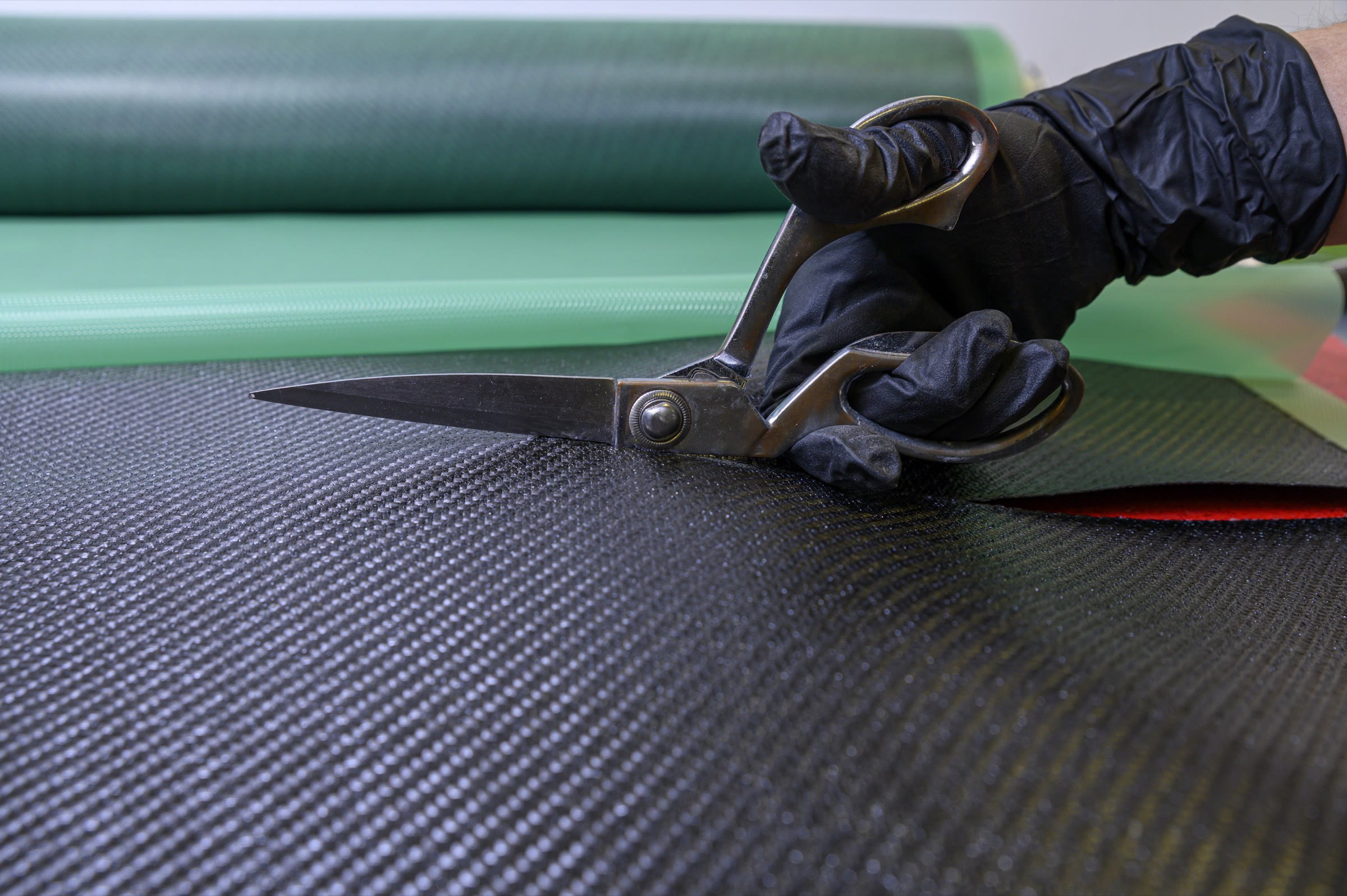
FILCO D2476 is an anionic polycarbonate-polyurethane waterborne dispersion used as a film former in sizings for continuous and chopped glass, basalt, mineral and carbon fiber, virgin or recycled. COIM publishes it at 35 percent solids and pH 7.5.
Its dried film is the stiff end of the family. At 20 MPa 100 percent modulus, 35 MPa tensile strength and 200 percent elongation at break on ASTM D1708, it holds a compact bundle that presents once to a cutting edge and shears once. COIM lists high stiffness, outstanding abrasion resistance and high strand and tow integrity that is still easy to disperse and wet during application.
The polycarbonate backbone is what sets it apart from the polyester and polyether grades in the same family. Polycarbonate polyols are the choice where abrasion resistance and hydrolytic stability both matter, which is why COIM's abrasion claim on this grade is the strongest in the range.
The anionic dispersion is published for enhanced electrostatic dissipation, bleeding off the charge that makes loose carbon filament fly, cling and bridge on chopping and converting lines. It carries high shear stability and accepts anionic or non-ionic bath additives. The matrix side is polycarbonate, nylon and polyurethane.
It is also written as FILCO FD2476, FD2476, D2476 sizing, anionic polyurethane dispersion, polycarbonate polyurethane film former, and high stiffness carbon fiber sizing.
Typical properties
| Property | Typical value |
|---|
| Appearance | Pale yellow liquid |
| Solid content | 35 percent |
| pH | 7.5 |
| 100 percent modulus | 20 MPa, ASTM D1708 |
| Tensile strength | 35 MPa, ASTM D1708 |
| Elongation at break | 200 percent, ASTM D1708 |
| Dispersion type | Anionic |
| Backbone | Polycarbonate-polyurethane |
| Fibers | Glass, basalt, mineral, carbon, virgin or recycled, continuous or chopped |
Typical values from the manufacturer's technical data sheet. They describe the product, they are not a specification. We will send the current TDS and the batch documentation your qualification needs.
Need this in your system?
Tell us the binder system, the property you are targeting, and the volume you
expect. We will confirm the grade, send the documentation, and get a sample of the candidate grade to you.
Applications
Chopped carbon fiber
The stiffest published film in the family holds a compact, well-consolidated bundle that cuts cleanly and feeds evenly.
Recycled carbon fiber
Published for virgin or recycled fiber. Reclaimed fiber comes out of pyrolysis bare and needs a film that restores bundle integrity and bulk density.
Polycarbonate compounds
The polycarbonate backbone couples to a polycarbonate matrix, alongside nylon and polyurethane.
Abrasion-loaded handling
Outstanding abrasion resistance, the strongest abrasion claim COIM publishes in the polyurethane range.
Lines fighting fuzz and fly
Anionic electrostatic dissipation plus high tow integrity work on loose filament from two directions.
It is specified where the formulation needs the stiffest published film in the family, 20 MPa at 100 percent modulus, outstanding abrasion resistance on a polycarbonate backbone, anionic, with enhanced electrostatic dissipation for chopping and converting lines, high strand and tow integrity that still wets and disperses easily during application, and published for virgin or recycled carbon fiber, and for glass, basalt and mineral.
Handling and dispersion
Applied at the fiber line or in a re-sizing bath. The anionic dispersion is published with high shear stability and is compatible with anionic or non-ionic additives. Confirm compatibility before adding a cationic component.
Selection runs matrix first, then stiffness. FILCO D2476 is the top of the polyurethane stiffness ladder with a current data sheet. Where the bundle is too stiff for the process, step down to D2594 at 12 MPa, D2596 at 9, D2496 at 8, or FILCO 547 at 2.
The film is thermoplastic and non-reactive. Where the process should crosslink the film, look at the reactive polyurethane family instead.
Packaging, storage, and regulatory status
Package sizes: Made to order in the pack size the line needs. Tell us the volume and we will confirm..
Storage: Store in closed containers away from direct sun at 41 to 86 degrees F. Maximum suggested storage is 12 months from production in the original package, after which the product must be rechecked. Freezing destroys the dispersion permanently.
Not classified as dangerous under Regulation EC 1272/2008 (CLP) and not regulated for transport. The safety data sheet notes the material can accumulate static charge during handling. Read the SDS before handling. We supply the current SDS with every shipment in the manufacturer's current revision.
Frequently asked questions
Why choose FILCO D2476 over the other anionic grades?
Stiffness and abrasion resistance. At 20 MPa 100 percent modulus it is the stiffest FILCO polyurethane with a current data sheet, and the polycarbonate backbone carries COIM's strongest abrasion claim in the range. Pick it where the bundle has to stay compact through hard handling.
What does the polycarbonate backbone change?
Polycarbonate polyols give a tougher, more abrasion-resistant film than the polyester and polyether grades, and better resistance to hydrolysis than a polyester. It is why COIM publishes outstanding abrasion resistance on this grade and only very good on its siblings.
Does it work on recycled carbon fiber?
Yes. COIM publishes it for continuous and chopped carbon fiber, virgin or recycled, alongside glass, basalt and mineral fiber.
What does anionic do for a chopping line?
The dispersion is published with enhanced electrostatic dissipation, which bleeds off the charge that makes loose carbon filament fly, cling and bridge. The high tow integrity limits how much loose filament forms in the first place.
Can I get a sample and the data sheet?
Yes. Tell us the fiber, the matrix, the cutter and the failure mode, and we will send the current technical data sheet with the matching safety data sheet and arrange sample material for the trial.
Can I get the TDS and SDS for FILCO D2476?
Yes. We send the Technical Data Sheet (TDS) and Safety Data Sheet (SDS) on request, in the manufacturer's current revision. Use Request TDS or SDS above and tell us what your qualification review needs.
Related products
The high-stiffness anionic polyether-polyurethane, 12 MPa at 220 percent elongation.
The moderately stiff anionic polyester-polyurethane, 8 MPa at 300 percent elongation.
The full published roster with film stiffness on every grade.
The very stiff modified epoxy for PPS and PEEK, where the matrix is not a polyurethane question.
Where this grade fits
What a film former does in a sizing, and how the chemistries divide.
What film stiffness does to cutting force, fuzz and blade wear on a converting line.
What pyrolysis strips and what the re-size has to restore.