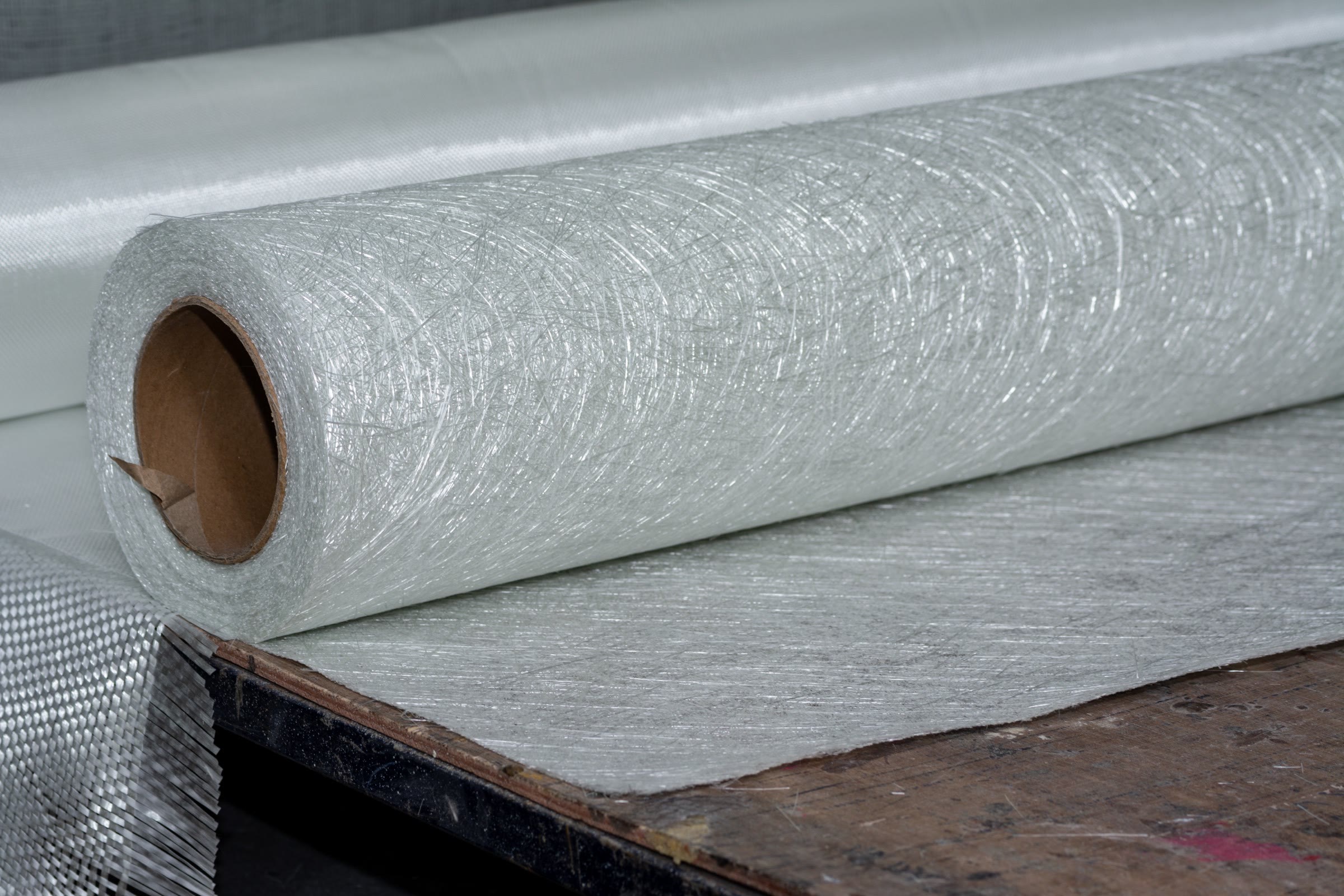
FILCO powder binders for chopped strand mat
Powder binders for chopped strand mat, on propoxylated bisphenol A from integrated production. Quick styrene solubility, light color, and a choice of particle size and melt index.
Powder binders for chopped strand mat, on propoxylated bisphenol A from integrated production. Quick styrene solubility, light color, and a choice of particle size and melt index.
Chopped strand mat is one of the nonwoven reinforcements, the bonded fiber webs that also include continuous filament mat, surfacing veil and preforms. It is a web of chopped glass held together by a powder binder that is sprinkled on and melted. The binder has to hold the mat through handling and cutting, then dissolve in styrene fast enough that the laminator does not have to fight it during wet-out.
COIM builds the 661, 663 and 665 range on propoxylated bisphenol A from integrated production, meaning the raw material is made in-house and not bought in. All three are published as quick to dissolve in styrene and light in color. Light color matters because a mat binder that yellows shows through a finished laminate.
The three variables are particle size, melt index and Tg. Particle size comes as MF and MG grades, MF being the finer distribution and MG the coarser. Melt index runs 10 on FILCO 663P, 18 on 661, 20 on 621 and 28 on 665, and it is what sets how the binder flows when the mat passes through the oven.
FILCO 621 is built on ethoxylated bisphenol A, not propoxylated, and COIM publishes it for superior mechanical properties. FILCO 663P carries the highest Tg in the family at 140 degrees F.
The same powder family serves carbon fiber. COIM's current carbon range publishes these polyester powders for preforms, chopped and continuous strand mat, and special non-wovens in carbon fiber, and adds FILCO 669 for increased stiffness and FILCO BIO 674, a non-bisphenolic grade whose biobased and recycled versions are available on request.
It is also written as CSM powder binder, chopped strand mat binder, styrene soluble powder binder, glass mat binder, nonwoven reinforcement binder, and powder binder for nonwovens.
| Property | Typical value |
|---|---|
| Chemistry | Propoxylated bisphenol A polyester, with FILCO 621 on ethoxylated bisphenol A |
| Form | Powder |
| Raw material | Integrated production of the propoxylated bisphenol A |
| Styrene solubility | Quick across the range |
| Color | Light |
| Melt index range | 10 to 28 g per 10 minutes depending on grade |
| Tg range | 115 to 140 degrees F |
| Particle size grades | MF for the finer distribution, MG for the coarser |
| Published grades | 4 base grades, 6 including the MF and MG variants |
| Matrix | Thermoset |
Typical values from the manufacturer's technical data sheet. They describe the product, they are not a specification. We will send the current TDS and the batch documentation your qualification needs.
Tell us the binder system, the property you are targeting, and the volume you expect. We will confirm the grade, send the documentation, and get a sample of the candidate grade to you.
| Grade | Chemistry | Particle size grade | Melt index | Tg | Main features |
|---|---|---|---|---|---|
| FILCO 661 MF | Propoxylated bisphenol A | MF, the finer distribution | 18 g per 10 minutes | 115 degrees F | Quick styrene solubility, light color |
| FILCO 661 MG | Propoxylated bisphenol A | MG, the coarser distribution | 18 g per 10 minutes | 115 degrees F | Quick styrene solubility, light color |
| FILCO 663P | Propoxylated bisphenol A | A single narrow fraction at 99 percent; confirm the mesh on the data sheet | 10 g per 10 minutes | 140 degrees F | The highest Tg and the lowest melt index in the family |
| FILCO 665 MF | Propoxylated bisphenol A | MF, the finer distribution | 28 g per 10 minutes | 115 degrees F | The highest melt index in the family |
| FILCO 665 MG | Propoxylated bisphenol A | MG, the coarser distribution | 28 g per 10 minutes | 115 degrees F | The highest melt index in the family |
| FILCO 621 | Ethoxylated bisphenol A | MG type distribution | 20 g per 10 minutes | 122 degrees F | Superior mechanical properties |
Values are the manufacturer's published typical figures. Ask for the current technical data sheet on any grade and we will send it with the matching safety data sheet.
The binder sprinkled onto the chopped web and melted to hold the mat together.
Where quick styrene solubility decides how easily the mat wets out under the roller.
Light color across the range, so the binder does not show through the finished part.
FILCO 621, on ethoxylated bisphenol A, published for superior mechanical properties.
Polyester powder binders serve preform work as well as mat.
Preforms, mats and special non-wovens in carbon fiber, per COIM's current carbon range, with FILCO BIO 674 as the non-bisphenolic option, biobased and recycled versions on request.
It is specified where the formulation needs quick solubility in styrene, so the mat wets out under the roller, light color, so the binder does not show in the laminate, particle size selectable as MF or MG on the 661 and 665 ranges, melt index from 10 to 28, which sets how the binder flows in the oven, and integrated production of the propoxylated bisphenol A raw material.
Applied as a powder to the chopped web and melted, so oven temperature and dwell are what turn the binder into a mat. Melt index is the property to match to that oven.
Particle size decides how evenly the powder distributes before it melts. MF for a finer, more even spread; MG where the coarser distribution suits the applicator.
FILCO 663P at melt index 10 and Tg 140 degrees F behaves differently in the oven from the rest of the family. Treat it as a separate selection, not a variant of 661.
Package sizes: Made to order in the pack size the line needs. Tell us the volume and we will confirm..
Storage: Store dry in the original sealed packaging, out of direct sun. A polyester powder binder picks up moisture and cakes, which shows up as uneven distribution on the mat line. Confirm the shelf life on the current data sheet for your grade.
Read the safety data sheet before handling. Powder handling carries its own dust precautions. We supply the current SDS with every grade.
Yes. Chopped strand mat is a dry-laid nonwoven reinforcement, and these powders are what bond the web. For continuous filament mat, FILCO 657 and 658 are the powder binders. For carbon fiber nonwovens and preforms the same family applies, adding FILCO 669 for stiffness and FILCO BIO 674, a non-bisphenolic grade. Tell us the fiber, the web weight and the oven profile and we will match the grade.
They are COIM's particle size grades. MF is the finer distribution and MG the coarser. Both are published for FILCO 661 and 665 at the same melt index and Tg, so the choice is about how the powder spreads on your applicator, not about the cured properties.
Match it to the oven. Melt index sets how far the binder flows once it melts, and the range here runs 10 on FILCO 663P, 18 on 661, 20 on 621 and 28 on 665. Tell us the oven temperature and the line speed and we will take the selection to COIM's technical group.
It is built on ethoxylated bisphenol A, not propoxylated, and COIM publishes it for superior mechanical properties. It is the one chemistry change in the family, so treat it as a deliberate selection and not a substitution.
Because it can show through a finished laminate. COIM publishes light color as a property of the whole range, which is what keeps the binder out of the appearance of the part.
Yes. COIM's current carbon fiber range publishes the polyester powder binders for preforms, chopped and continuous strand mat, and special non-wovens in carbon. It also lists FILCO 669 for increased stiffness and FILCO BIO 674, a non-bisphenolic grade whose biobased and recycled versions COIM makes available on request. Tell us the web and the resin and we will match the grade.
Yes. Tell us the mat weight, the oven profile and the resin system and we will send the current technical data sheet with the matching safety data sheet, and arrange sample material.
Yes. We send the Technical Data Sheet (TDS) and Safety Data Sheet (SDS) on request, in the manufacturer's current revision. Use Request TDS or SDS above and tell us what your qualification review needs.
The CFM side, with a film former and two catalyzed powder binders.
The sizing on the roving before it is chopped into mat.
The other thermoset molding route.
What a film former does in a sizing, and how the chemistries divide.
The selection logic, worked through on the carbon side.