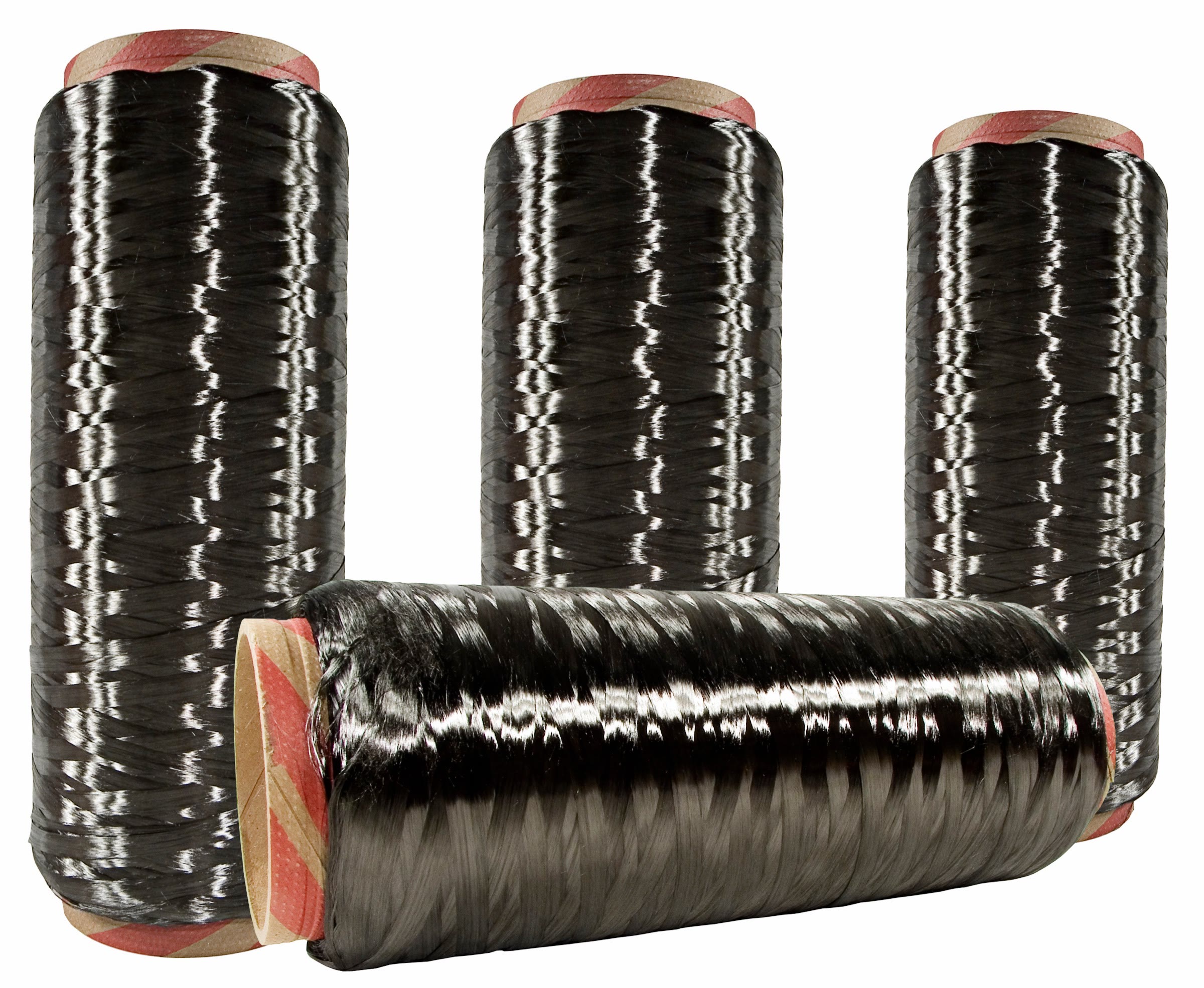
FILCO 547 is a waterborne non-ionic polyester-polyurethane dispersion used as a film former in sizings for continuous or chopped glass, carbon, basalt and mineral fibers. COIM publishes it at 45 percent solids, pH 6, with an average particle size of 600 nanometers.
Its dried film is the soft end of the range. At 2 MPa 100 percent modulus, 32 MPa tensile strength and 650 percent elongation at break, all on ASTM D1708, the sized tow stays flexible and yields at a cutting edge rather than fracturing. COIM lists low stiffness and good abrasion resistance as its characteristics.
The non-ionic dispersion gives superior stability where the size bath runs at a very acid or very basic pH, and COIM publishes good compatibility with typical sizing bath components. The matrix side is nylon, polycarbonate and polyurethane, where an epoxy film former is the wrong chemistry for the melt.
Where the line needs a stiffer bundle from the same polyurethane family, the anionic grades FILCO D2496, D2596, D2594 and D2476 step up in 100 percent modulus from 8 to 20 MPa, each with its own data sheet and page.
It is also written as FILCO F547, F547, 547 sizing, non-ionic polyurethane dispersion, polyester polyurethane film former, and soft carbon fiber sizing.
Typical properties
| Property | Typical value |
|---|
| Appearance | Milky liquid |
| Solid content | 45 percent |
| pH | 6 |
| Average particle size | 600 nm |
| 100 percent modulus | 2 MPa, ASTM D1708 |
| Tensile strength | 32 MPa, ASTM D1708 |
| Elongation at break | 650 percent, ASTM D1708 |
| Dispersion type | Non-ionic |
| Backbone | Polyester-polyurethane |
| Fibers | Glass, carbon, basalt, mineral, continuous or chopped |
Typical values from the manufacturer's technical data sheet. They describe the product, they are not a specification. We will send the current TDS and the batch documentation your qualification needs.
Need this in your system?
Tell us the binder system, the property you are targeting, and the volume you
expect. We will confirm the grade, send the documentation, and get a sample of the candidate grade to you.
Applications
Polyamide compounds
High compatibility with nylon, polycarbonate and polyurethane matrices, the thermoplastics where an epoxy sizing does not couple.
Continuous carbon fiber
A soft, extensible film keeps tow flexible for spooling, weaving and textile handling.
Chopped fiber where the cut runs brittle
A line seeing high cutting force or a dusty cut can move to this softer film, which yields at the edge instead of shattering.
Glass, basalt and mineral fiber
Published for the same fiber scope as the rest of the polyurethane family, so one grade can run across reinforcements.
Extreme pH size baths
Non-ionic stabilization holds where an anionic dispersion would not.
It is specified where the formulation needs the softest published film in the family, 2 MPa modulus at 650 percent elongation, non-ionic, stable in very acid or very basic size baths, good abrasion resistance on the sized filament, 45 percent solids, the highest of the polyurethane grades with a current data sheet, and hydrazine-free, as marked in COIM's published range.
Handling and dispersion
Applied at the fiber line or in a re-sizing bath. Confirm bath compatibility with the other components before changing a formulation, as with any film former.
Selection runs matrix first, then stiffness. FILCO 547 is the soft reference point on the polyurethane ladder. Move up to D2496 or D2596 for a moderately stiff bundle and to D2594 or D2476 for a compact, high-integrity one.
The film is thermoplastic and non-reactive. Where the process reaches a temperature that should crosslink the film, look at the reactive polyurethane family instead.
Packaging, storage, and regulatory status
Package sizes: Made to order in the pack size the line needs. Tell us the volume and we will confirm..
Storage: Store in closed containers away from direct sun at 41 to 86 degrees F. Maximum suggested storage is 12 months from production in the original package, after which the product must be rechecked. Freezing destroys the dispersion permanently.
Not classified as dangerous under Regulation EC 1272/2008 (CLP) and not regulated for transport. Read the safety data sheet before handling. We supply the current SDS with every shipment in the manufacturer's current revision.
Frequently asked questions
What is FILCO 547 used for?
As the film former in a sizing for continuous or chopped glass, carbon, basalt and mineral fiber headed into nylon, polycarbonate or polyurethane matrices. It is the soft grade of the family, chosen where the tow has to stay flexible or where a stiffer film cuts brittle.
How soft is the film?
COIM publishes 2 MPa at 100 percent modulus, 32 MPa tensile strength and 650 percent elongation at break on ASTM D1708. That is the lowest modulus of any FILCO polyurethane grade with a current data sheet.
Is FILCO 547 anionic or non-ionic?
Non-ionic. COIM publishes that for superior stability in very acid or very basic size baths and for compatibility with typical bath components. The anionic grades in the same family, D2496, D2596, D2594 and D2476, add electrostatic dissipation and are the stiffer options.
Does it work on carbon fiber?
Yes. The data sheet names continuous or chopped glass, carbon, basalt and mineral fibers, so one film former can be qualified across more than one reinforcement.
Can I get a sample and the data sheet?
Yes. Tell us the fiber, the matrix and the process, and we will send the current technical data sheet with the matching safety data sheet and arrange sample material for the trial.
Can I get the TDS and SDS for FILCO 547?
Yes. We send the Technical Data Sheet (TDS) and Safety Data Sheet (SDS) on request, in the manufacturer's current revision. Use Request TDS or SDS above and tell us what your qualification review needs.
Related products
The moderately stiff anionic polyester-polyurethane, 8 MPa modulus at 300 percent elongation.
The other non-ionic polyester-polyurethane, published for a soft coating with excellent strand integrity.
The full published roster with film stiffness on every grade.
The wider non-reactive non-ionic family across glass and basalt.
Where this grade fits
What a film former does in a sizing, and how the chemistries divide.
What film stiffness does to cutting force, fuzz and blade wear on a converting line.
The selection logic, matrix first, then hand, then heat.