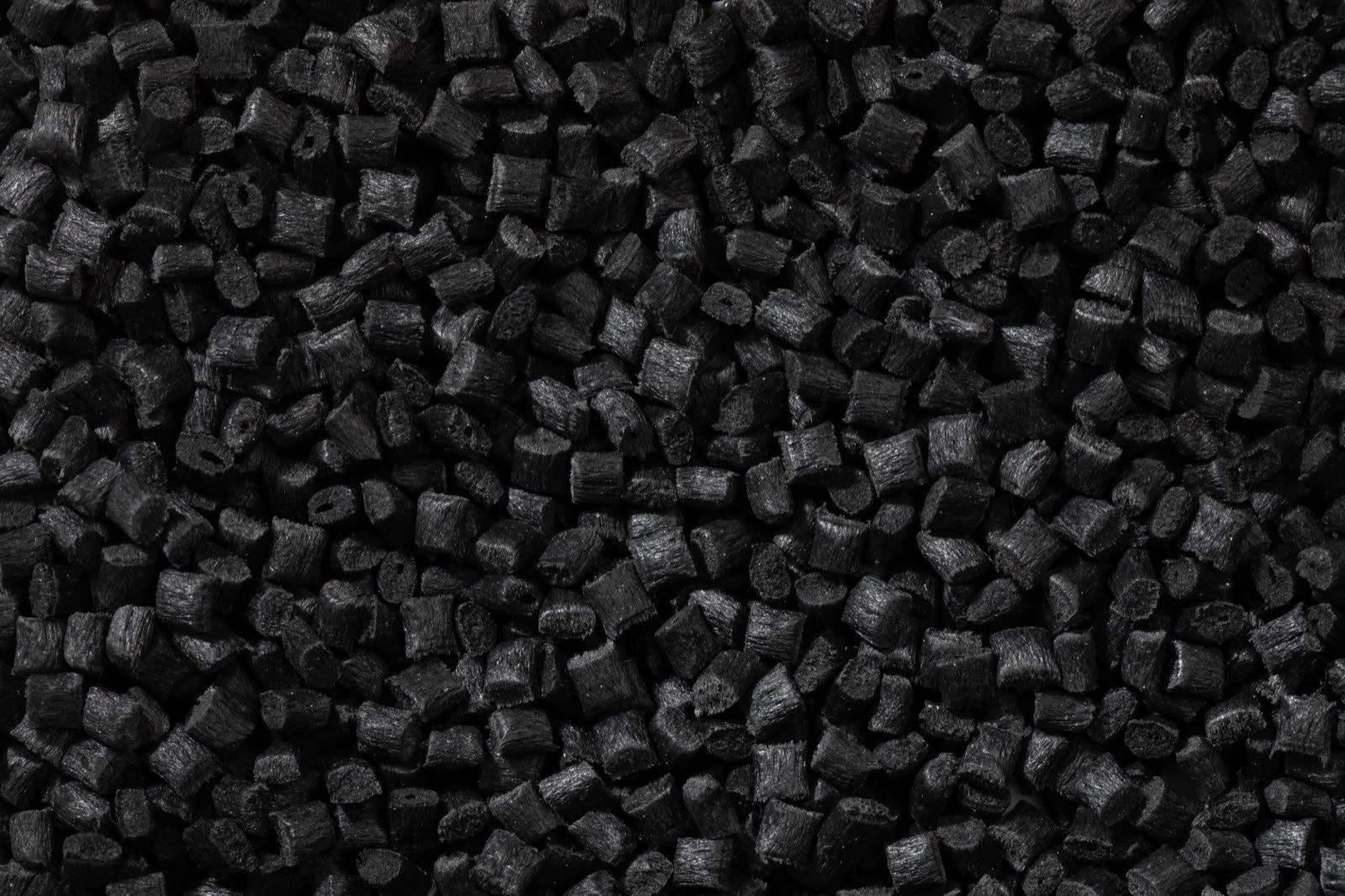
FILCO 8902
A special epoxy film former whose dried film holds 95 percent of its mass at 725 degrees F, built for chopped strands and tows going into PPS and PEEK. 57 percent solids, cross-linkable, and no curing needed after drying.
A special epoxy film former whose dried film holds 95 percent of its mass at 725 degrees F, built for chopped strands and tows going into PPS and PEEK. 57 percent solids, cross-linkable, and no curing needed after drying.
FILCO 8902 is a special epoxy resin in non-ionic water dispersion at 57 percent solids. Its dried film loses only 5 percent of its mass at 725 degrees F (385 degrees C), the highest heat-resistance figure in COIM's published carbon fiber range, and COIM publishes it for chopped strands and tows going into PPS and PEEK, where standard epoxy film formers degrade.
The film needs no curing after drying, and it is cross-linkable. Dried, it is tough, not tacky, clear, hard, and very slowly soluble in styrene. The dispersion carries outstanding hydrolysis resistance and high mechanical shear stability when diluted.
At a glass transition temperature of 100 degrees F, FILCO 8902 sits at the very stiff end of COIM's carbon fiber ladder, holding a compact, stable bundle that chops and doses cleanly. Its epoxy equivalent weight of 2950 puts it among the highest molecular weight epoxies in the line.
COIM publishes it for chopped strands and tows going into thermoplastics, PBT, PET, ABS, PC, PPS and PEEK, for epoxy and unsaturated polyester thermosets, and for SMC and BMC roving. The fiber scope covers glass, carbon, basalt and mineral fibers. The standard version contains a co-solvent, and COIM offers a solvent-free version on request.
It is also written as FILCO F8902, 8902 sizing, PEEK compatible film former, PPS compatible film former, high temperature carbon fiber sizing, and modified epoxy dispersion.
| Property | Typical value |
|---|---|
| Appearance | Milky liquid |
| Solid content | 57 percent |
| pH | 7 |
| Average particle size | 900 nm |
| Viscosity | Below 5000 mPa s |
| Epoxy equivalent weight | 2950 |
| Tg | 100 degrees F |
| Heat resistance | 5 percent mass loss at 725 degrees F |
| Dispersion type | Non-ionic |
| Fibers | Glass, carbon, basalt, mineral |
Typical values from the manufacturer's technical data sheet. They describe the product, they are not a specification. We will send the current TDS and the batch documentation your qualification needs.
Tell us the binder system, the property you are targeting, and the volume you expect. We will confirm the grade, send the documentation, and get a sample of the candidate grade to you.
The published grade for chopped strands and tows at melt temperatures where standard epoxy sizings degrade.
The very stiff film holds a compact bundle that chops cleanly and feeds evenly.
Also published for PBT, PET, ABS and PC.
The thermoset side, epoxy and unsaturated polyester included.
The same selection applies when reclaimed fiber is headed for a high temperature compound.
It is specified where the formulation needs the highest published heat resistance in the carbon range, 5 percent mass loss at 725 degrees F, no curing step after drying, one less stage on the line, cross-linkable, with outstanding hydrolysis resistance, high shear stability of the diluted emulsion in the size bath, and one grade across glass, carbon, basalt and mineral fiber.
Stir before use to homogenize, then apply at the fiber line or in a re-sizing bath as supplied or diluted. The dried film needs no curing step.
The film is not tacky once dry, so sized fiber winds, conveys and stores cleanly.
Where the compound is PBT, PET or PC rather than PPS or PEEK, also compare FILCO 7900 and 394, the other high molecular weight epoxies in the family.
Package sizes: Made to order in the pack size the line needs. Tell us the volume and we will confirm..
Storage: Store in closed containers away from direct sun at 41 to 95 degrees F. Maximum suggested storage is 9 months from production in the original package, after which the product must be rechecked. Freezing destroys the dispersion permanently.
Read the safety data sheet before handling. We supply the current SDS with every shipment in the manufacturer's current revision. A solvent-free version is available on request.
Heat resistance. Its dried film loses only 5 percent of its mass at 725 degrees F, the highest figure in COIM's published carbon fiber range, where a standard epoxy sizing degrades well below PPS and PEEK melt temperatures. It is published by name for chopped strands and tows going into those matrices.
No. The film needs no curing after drying, which removes a stage from the line, and it remains cross-linkable where downstream processing calls for it.
Very stiff, the top of COIM's carbon fiber hand ladder, with a Tg of 100 degrees F. The bundle stays compact through chopping and automated dosing. Where the line needs a softer hand, the ladder runs down to very soft grades on the carbon fiber film formers page.
No. COIM publishes it for glass, carbon, basalt and mineral fibers, so a plant running more than one reinforcement can qualify one film former across them.
Yes. Tell us the fiber, the matrix and the process temperatures, and we will send the current technical data sheet with the matching safety data sheet and arrange sample material for the trial.
Yes. We send the Technical Data Sheet (TDS) and Safety Data Sheet (SDS) on request, in the manufacturer's current revision. Use Request TDS or SDS above and tell us what your qualification review needs.
The full epoxy and UPE ladder, thirteen grades with published heat resistance.
The polyamide side of the carbon range, with film stiffness published per grade.
The novolac route to temperature resistance below the 8902 tier.
What a film former does in a sizing, and how the chemistries divide.
The selection logic, matrix first, then hand, then heat.
What the film former does to cutting force, fuzz and blade wear on a converting line.
What pyrolysis strips and what the re-size has to restore.