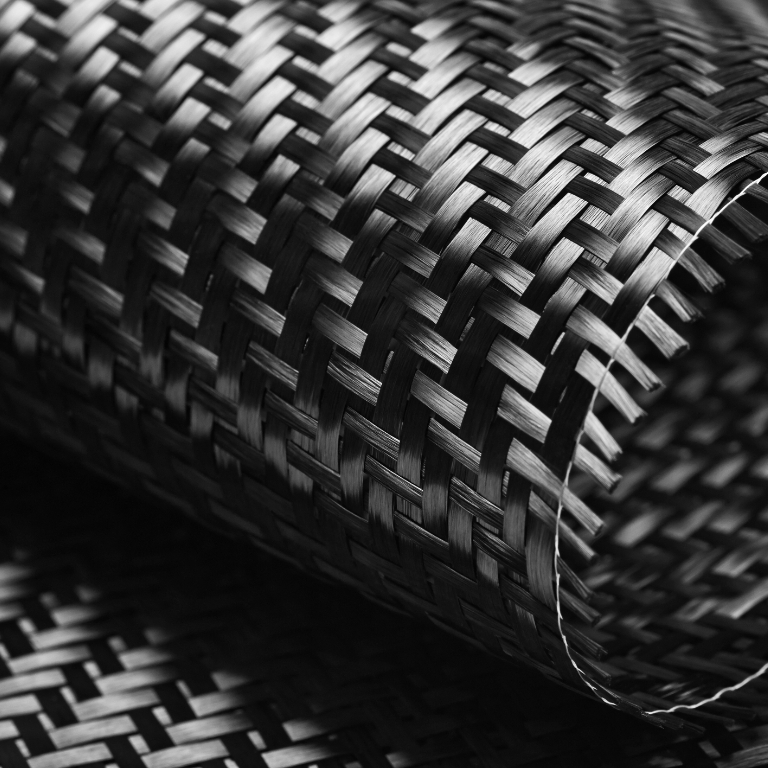
Sizing is a fraction of a percent of a carbon fiber's weight and a large fraction of how it behaves. The film former in that size decides whether tow chops cleanly or fuzzes, whether a bundle feeds or clogs, and whether the fiber-matrix interface transfers load or delaminates.
What the size is doing
Carbon filaments run a few microns in diameter, and a tow carries thousands of them. Sizing is applied on the fiber line after surface treatment, usually at a fraction of a percent up to a few percent by weight, higher for chopped products. The film former forms a continuous film over the filaments and does three jobs at once: protects them from abrasion in winding, weaving, and conveying; consolidates the tow into a bundle that can be handled as one thing; and puts a resin-compatible surface between the carbon and the matrix so the cured composite transfers load into the fiber.
Because those three jobs pull in different directions, there is no single carbon fiber sizing.
First: the matrix
Compatibility with the matrix resin is the decision everything else follows. For epoxy systems, prepreg, filament winding, pultrusion, and infusion, epoxy film formers are the default, and the epoxide equivalent weight is the lever: low-EEW grades built on liquid epoxy resin give a soft film and fast solubility in the matrix, while high molecular weight grades give a tougher, more protective film.
For thermoplastic matrices, the question is what survives the melt. Higher molecular weight epoxy film formers are matched to PET, PBT, and polycarbonate. Polyamide 6 takes a different route: polyurethane dispersions built on polycaprolactone polyols, which stay compatible with the polyamide melt. Above those temperatures, at PPS and PEEK processing conditions, standard epoxy sizings degrade. The line carries FILCO 8902 for those conditions, a modified epoxy built for high heat resistance at 57 percent solids, whose dried film loses only 5 percent of its mass at 385 degrees C and needs no curing after drying. If you are compounding or extruding at PEEK or PPS temperatures, ask for FILCO 8902 and we will send the data sheet and a sample for the trial.
Second: Tg, which sets the hand
The film former's glass transition temperature is the practical control over how the sized tow feels and behaves, what the trade calls hand. The carbon fiber range spans roughly minus 20 to plus 40 degrees C in Tg. At the soft end, tow stays flexible: it spools without springback, survives textile handling, and chops cleanly. At the stiff end, the bundle is compact and stable, holds its form in conveying and dosing, and resists fuzzing under shear. Converters chopping fiber, weavers, and compounders each land at a different point on that ladder. On the carbon fiber polyurethane grades the hand is published as dried-film mechanical data, 0.5 to 21 MPa at 100 percent modulus across twenty-nine grades. Six of them carry a current data sheet and their own page, from FILCO 547 at 2 MPa through D2496, D2596 and D2594 to D2476 at 20 MPa, with FILCO 8000 published for a soft coating with strand integrity, and what that stiffness does on a cutter is covered in sizing, chopping, and blade life in carbon fiber converting.
Working a sizing selection now?
Tell us the fiber, the matrix, the process, and the hand you need. We will recommend a starting grade from the FILCO carbon fiber range and arrange a sample for the trial.
Request a SampleThird: the bath details
Two properties decide whether a film former runs well in a carbon fiber size bath. The first is bath stability. Surface treatment leaves the filament oxidized and charged, and non-ionic waterborne emulsions, the classic default on carbon, stay stable against that surface and against the other bath components. Anionic polyurethane dispersions built with high shear stability also run on carbon, and their charge adds electrostatic dissipation that works against fuzz and fly on chopping and converting lines. The second is particle size, which has to suit filaments a few microns across; carbon fiber grades run fine, starting around 200 nanometers, so the emulsion penetrates the tow and coats filaments evenly rather than sitting between them.
Fourth: heat downstream
Some sized fiber sees real temperature after the size bath: drying ovens, compounding, and downstream cures. Epoxy novolac film formers carry higher functionality than standard epoxies and are the grades to reach for when the size has to hold up under higher-temperature demands. A reactive polyurethane option is also available where the film former should crosslink during downstream processing rather than stay thermoplastic.
Sourcing, and where these grades come from
The FILCO film formers are made by COIM in Italy, a line built over three decades of supplying sizing chemistry to the glass fiber industry and extended to carbon fiber. We supply FILCO from COIM's Offanengo plant to order, arrange samples for line trials, and can bring the manufacturer's technical team into grade selection and, where the catalog does not fit, development work. The full line, including the glass and basalt side and the mat binders, is on the fiber sizing film formers page, and the grade tables sit on the family pages: the carbon fiber film formers, the carbon fiber polyurethanes, epoxy-novolac for high temperature, epoxy for thermoplastic matrices and reactive polyurethane. If your fiber is recycled or you are re-coating converted fiber, the selection changes in ways covered in re-sizing recycled and converted carbon fiber.
Frequently asked
What does sizing do on carbon fiber?
It protects filaments a few microns across from abrasion, holds the tow together so it can be wound, chopped, or woven, and couples the fiber surface to the matrix resin so the composite transfers load into the reinforcement. Typical add-on is a fraction of a percent to a few percent by weight.
Do carbon fiber sizings have to be non-ionic?
Usually, and not always. Surface treatment leaves an oxidized, charged filament surface, and non-ionic waterborne emulsions, the classic default, stay stable against it through the size bath. Anionic polyurethane dispersions built with high shear stability are also published for carbon fiber, and their charge adds electrostatic dissipation for chopping lines.
How does glass transition temperature affect a sized tow?
Tg sets the hand. Low-Tg grades give a soft, flexible tow that chops cleanly and spools well. High-Tg grades give a stiffer, compact bundle that holds its form. The carbon fiber range spans roughly minus 20 to plus 40 degrees C so the hand can be matched to the process.
Can epoxy-sized carbon fiber go into thermoplastics?
Into some. High molecular weight epoxy grades suit PET, PBT, and polycarbonate, and polycaprolactone-based polyurethane dispersions are matched to polyamide 6. At PPS and PEEK melt temperatures, standard epoxy sizings degrade. The line carries FILCO 8902 for those systems, a modified epoxy at 57 percent solids with no curing needed after drying.
Is there a carbon fiber sizing for PEEK and PPS?
Yes, FILCO 8902. Standard epoxy film formers degrade at PEEK and PPS melt temperatures. FILCO 8902 is a modified epoxy at 57 percent solids whose dried film loses only 5 percent of its mass at 385 degrees C, and it needs no curing after drying. Tell us the matrix, the process, and the temperatures, and we will send the data sheet and a sample.
Selecting a size for your line?
Send the fiber, the matrix, and the process. We will match a film former, arrange a sample, and back the trial with technical support.
View the fiber sizing page