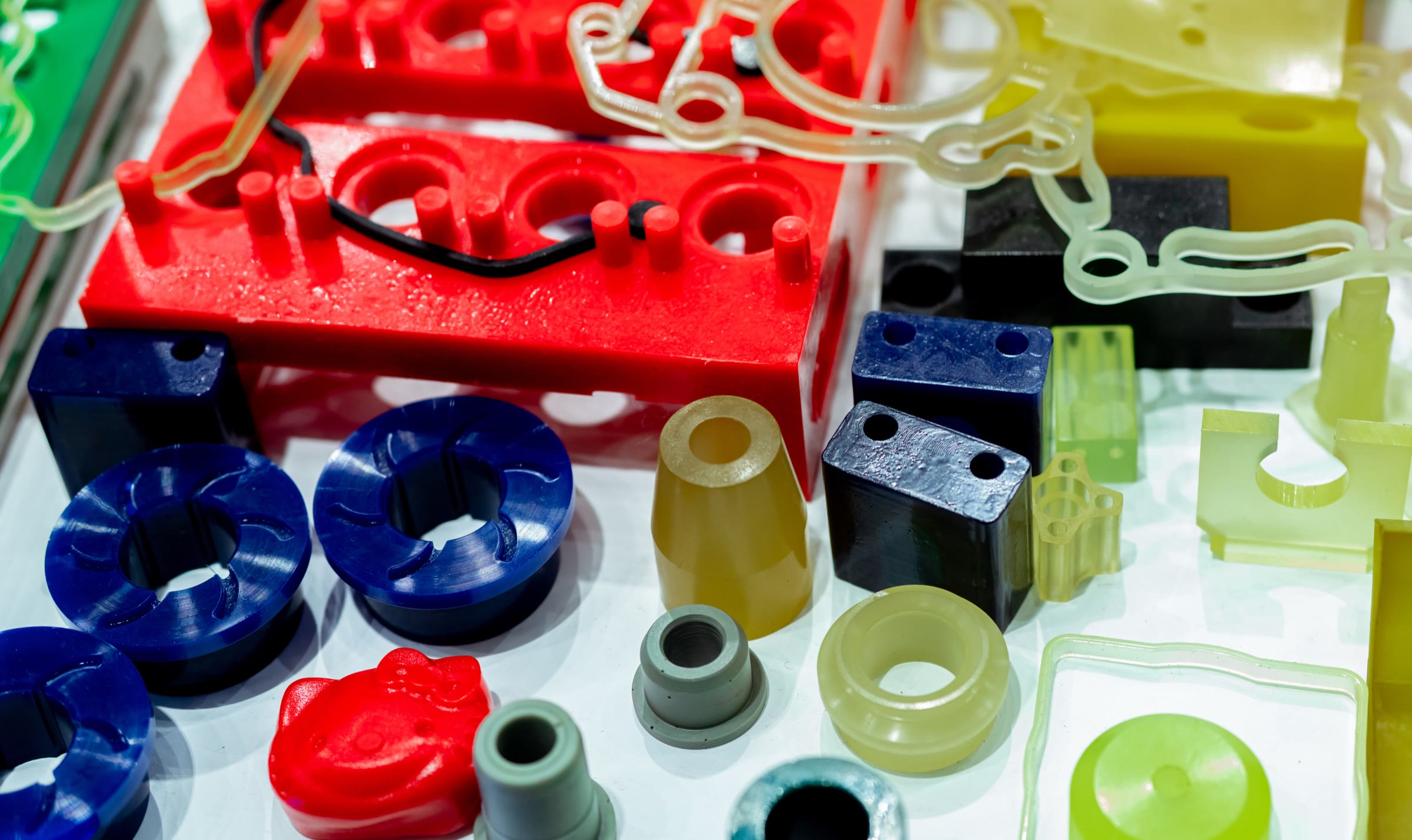
A pigment dispersion is pigment plus the liquid it is dispersed in. In a reactive system that liquid does not evaporate, so it ends up in the cured part. That makes the carrier a formulation decision, and it is the one that determines whether a color will work in a given system.
Four carrier chemistries cover almost all of it: polyether polyol, plasticizer, benzoate ester, and vegetable oil.
The carrier is a formulation ingredient, not packaging
A dispersion is a concentrate you meter in at a few percent, so the carrier is a small fraction of the finished part. It is not zero, though, and in a reactive system a small fraction can matter twice over: once because it occupies volume in the network, and once because it may or may not react into it.
That gives you the selection framework in one question. Does the carrier react with the isocyanate? If it does, account for it in the arithmetic. If it does not, account for it in the physical properties.
Not sure which carrier your system wants?
Tell us the resin, the process, and what the part has to survive. We will recommend a carrier and match the shade into it before you commit to anything.
Request a SamplePolyether polyol: the reactive carrier
A polyether polyol carrier, including polypropylene glycol, carries hydroxyl groups. Those groups are active hydrogen, they behave exactly like the polyol already in your formulation, and they consume isocyanate. That is a feature. The carrier reacts into the network instead of sitting in it as a foreign phase, so it does not migrate and it does not dilute the crosslinked structure.
The cost is arithmetic. Polyol equivalent weight is 56,100 divided by the hydroxyl number. Isocyanate equivalent weight is 4,200 divided by the percent NCO. The isocyanate index is the actual NCO supplied divided by the theoretical NCO required to react with every active hydrogen in the mix, times 100. A polyol-carried colorant enters that equivalents sum like any other polyol:
equivalents contributed = (mass of colorant × its hydroxyl number) ÷ 56,100
Ignore it and the effective index drops below target, which shows up as a part that is soft, under-cured, or tacky. Below roughly 1 part per hundred of a polyol-carried paste the contribution is small enough to ignore. Above that, fold it in. Where that threshold sits relative to normal addition rates is covered in how much colorant to add to cast polyurethane.
The practical consequence for buying: a polyol carrier is only usable if it ships with a stated, controlled hydroxyl number. Without that number on the documentation, the formulator cannot compute the index. Hydroxyl number is determined by ASTM D4274 or ASTM E222 and reported in milligrams of KOH per gram.
Polyol carriers are where the reactive systems go: polyether cast systems, spray-applied polyurethane, and the parts of a foam formulation where the carrier needs to be part of the chemistry rather than a passenger. Whites in particular tend to want the polyol side, because whites carry the highest pigment loading and therefore the most carrier along with them.
Plasticizer: the workhorse
A plasticizer carrier has no active hydrogen. It does not enter the equivalents sum, it consumes no isocyanate, and it needs no index adjustment. That simplicity is why plasticizer-carried dispersions do most of the work in cast polyurethane and effectively all of it in plastisol, where the carrier is itself a PVC plasticizer and disappears into the compound rather than sitting in it as a foreign phase. The plastisol case is set out in full in coloring plastisol for dip molding, rotocast, and coated fabric.
It is also what colors epoxy. An ester plasticizer carries no epoxide and no amine hydrogen, so it takes no part in the amine-epoxy cure. It behaves as a non-reactive diluent: it thins the mix during blending and then stays where it is. Epoxy is not an isocyanate system either, so the hydroxyl and index arithmetic above does not apply at all, which makes carrier selection one question shorter than it is in polyurethane.
We supply color for epoxy systems in production today, across industrial epoxy coatings, epoxy flooring, and epoxy sealants, and our standard dispersions carry an epoxy suitability rating across the line. The product page for that work is liquid color for epoxy systems, and the addition rates, the mix-ratio question, and the guardrail in full are in coloring epoxy systems.
The same guardrail applies as in polyurethane, for the same reason. A non-reactive diluent lowers glass transition temperature and can cut solvent and acid resistance if enough of it is present. At the level a colorant introduces, a few percent of the total formulation at most, that is minor. For immersion service the usual approach is to carry the color through the intermediate coats and finish with a clear high-Tg topcoat.
Our own plasticizer carrier is a phthalate-free terephthalate. Terephthalate is the para isomer, with the two carboxyl groups opposite each other on the ring rather than adjacent, which is what puts it outside the phthalate class.
A plasticizer carrier is not neutral, though. It occupies volume between chains and reduces crosslink density per unit volume. The patent literature on polyurethane elastomers is consistent about the direction: plasticizers give higher flexibility, lower hardness, and lower rebound, which means more energy absorbed, and the products can embrittle over time as the plasticizer migrates out. Bleeding is migration of a plasticizer or wax to the surface to form a film or beads. Bloom is the discoloration or change in surface appearance that migration causes.
At a 1 to 2 percent addition rate that sits below the noise floor of a normal part. At the higher loadings a deep opaque black or a heavily filled shade can require, it may not. The carrier is chosen to suit the system and the loading.
Benzoate and vegetable oil: the specific answers
Benzoate esters go in where solvency and compatibility have to be higher than a general-purpose plasticizer delivers, particularly in systems that are already hard to wet out. Vegetable oil carriers go in where a bio-based, low-volatility, low-odor vehicle is the requirement, or where a customer wants petrochemical plasticizers out of the formulation for reasons that have nothing to do with performance.
Both are non-reactive, so the property caution above applies in the same direction. Neither is a general-purpose substitute for the first two. They are chosen when something specific about the system or the specification asks for them.
Always add the color to the polyol side
Whatever carrier you land on, in a two-component polyurethane the color goes into the polyol side. Three reasons:
The isocyanate side reacts with anything nucleophilic: water, alcohols, amines. Anything carrying hydroxyl or moisture will react with it in the drum instead of in the mold, and you will find out when the drum thickens. The polyol side is the tolerant one, and it is already where the catalysts, chain extenders, surfactants, and pigments live. And the polyol side is usually the larger volume, so a small colorant addition perturbs the ratio less.
The other route is the mix head. On a machine with a color dosing system the dispersion runs as its own metered third stream and never touches either drum, which is also how a line changes shades without a purge.
Changing colorant suppliers is the point at which the carrier gets chosen again rather than inherited. The rest of that process, including what to send when the grade you specified has been discontinued, is in replacing a liquid colorant you can no longer buy.
Running a machine with third-stream dosing?
Metering viscosity is part of the specification, not an afterthought. Tell us the pump and the addition rate and we will formulate the dispersion to meter cleanly at your conditions.
Talk to an ExpertMoisture
Water reacts with isocyanate to form an unstable carbamic acid that decomposes to carbon dioxide and a primary amine. The amine goes on to form urea linkages, and the carbon dioxide shows up as gas. In a foam that is the reaction you are paying for. In a solid casting it is bubbles, pinholes, and porosity in a part that was supposed to be dense.
The stoichiometry makes this worse than it sounds. One water molecule consumes two isocyanate groups, so moisture is not only a defect mechanism, it is an index shift. Polyols are hygroscopic, and so are polyol-carried colorants, which is why a colorant intended for cast polyurethane ships sealed and why "PU grade" means something specific rather than being a marketing word. Water content is measured by Karl Fischer titration. The applicable methods are ASTM D4672 for polyols and ASTM D6869 for plastics.
The same logic applies to contamination. Free amine catalyzes the isocyanate reaction and will move your gel time; acids can inhibit the amine catalysts already in your system. A colorant for a reactive system should be specified free of both.
What the carrier will not fix
Some things are outside what any of these four chemistries can do.
Waterborne systems. All four carriers are non-aqueous. A waterborne coating or adhesive needs a water-based dispersion, which is a different product class.
Thermoplastics outside the polyurethane family. A thermoplastic is colored as a melt, with masterbatch, and our masterbatch line is polyurethane-family only. There is no polyethylene, polypropylene, PET, or ABS concentrate here. The format question is covered in masterbatch vs liquid color.
Slabstock flexible foam. Our foam work is integral skin and RIM. Block foam is a different operation and we do not claim it.
Epoxy is not on this list. It runs on the standard plasticizer-carried dispersions and we supply it today.
What to tell a supplier so the first sample works
Four things, and the carrier follows from them. The resin chemistry, ester or ether. Where in the process the color enters, pre-blended into the polyol or metered at the head. The addition rate you expect to run. And what the part has to survive: outdoor exposure, contact with a mating surface, a hardness target, or a regulatory requirement.
A color reference on its own does not settle it.
Frequently asked
What is the carrier in a pigment dispersion?
The carrier is the liquid the pigment is dispersed in. In a reactive system it does not evaporate, so it stays in the cured part. That makes carrier compatibility with the polymer system the first selection question, ahead of shade.
Should color go into the polyol side or the isocyanate side?
The polyol side. The isocyanate side reacts with anything nucleophilic, including water, alcohols, and amines, so a colorant blended into it can react in the drum rather than in the mold. The polyol side is the tolerant one, it already carries catalysts, chain extenders, and surfactants, and it is usually the larger volume, so a small colorant addition perturbs the ratio less. The alternative is metering the color as a third stream into the mix head.
Does a polyol-carried colorant change my isocyanate index?
Yes. A polyol carrier brings hydroxyl into the formulation and hydroxyl consumes isocyanate. Equivalents contributed equals the mass of colorant times its hydroxyl number divided by 56,100, and the isocyanate charge rises accordingly. Below roughly 1 part per hundred the contribution is usually small enough to ignore. Above that, fold it into the index or the part comes out soft.
Is a plasticizer carrier neutral to part properties?
No. A plasticizer carrier does not react into the network, so it needs no index adjustment, but it occupies volume between chains. Plasticizers in polyurethane elastomers are associated with higher flexibility, lower hardness, and lower rebound, and with migration to the surface over service life. At a 1 to 2 percent addition that is usually below the noise floor. At the higher loadings a deep opaque shade can require, it may not.
Why does a colorant for cast polyurethane have to be dry?
Water reacts with isocyanate to give an unstable carbamic acid that decomposes to carbon dioxide and an amine. In a foam that gas is the point. In a solid casting it is a defect: bubbles, pinholes, and porosity. One water molecule consumes two isocyanate groups, so moisture also shifts the index. Water content is measured by Karl Fischer titration, ASTM D4672 for polyols and ASTM D6869 for plastics.
Which systems do you not supply liquid color for?
Waterborne systems, because these carriers are non-aqueous. Thermoplastics outside the polyurethane family, since our masterbatch line is polyurethane-family only. Slabstock flexible foam, where our evidence is integral skin and RIM rather than block foam. Epoxy is not on that list: we supply color for epoxy systems today.
Can you color epoxy, and which carrier does it use?
Yes. We supply color for industrial epoxy coatings, epoxy flooring, and epoxy sealants. Epoxy runs on the standard phthalate-free terephthalate plasticizer carrier, the same one used for cast polyurethane and plastisol. An ester carries no epoxide and no amine hydrogen, so it takes no part in the amine-epoxy cure and behaves as a non-reactive diluent. Because epoxy is not an isocyanate system, the hydroxyl and index arithmetic that governs a polyol carrier does not apply.
Send us the system, not just the shade
We supply dispersions in low-viscosity plasticizer, polyether polyol, polypropylene glycol, benzoate, and vegetable oil carriers, and we match the color into the system you are actually running. Custom matching is free, samples ship at 0.5 kg, and there is no minimum order. Tell us the resin and the process along with the target and the first sample has a real chance of being the last one.
See liquid color for cast PU