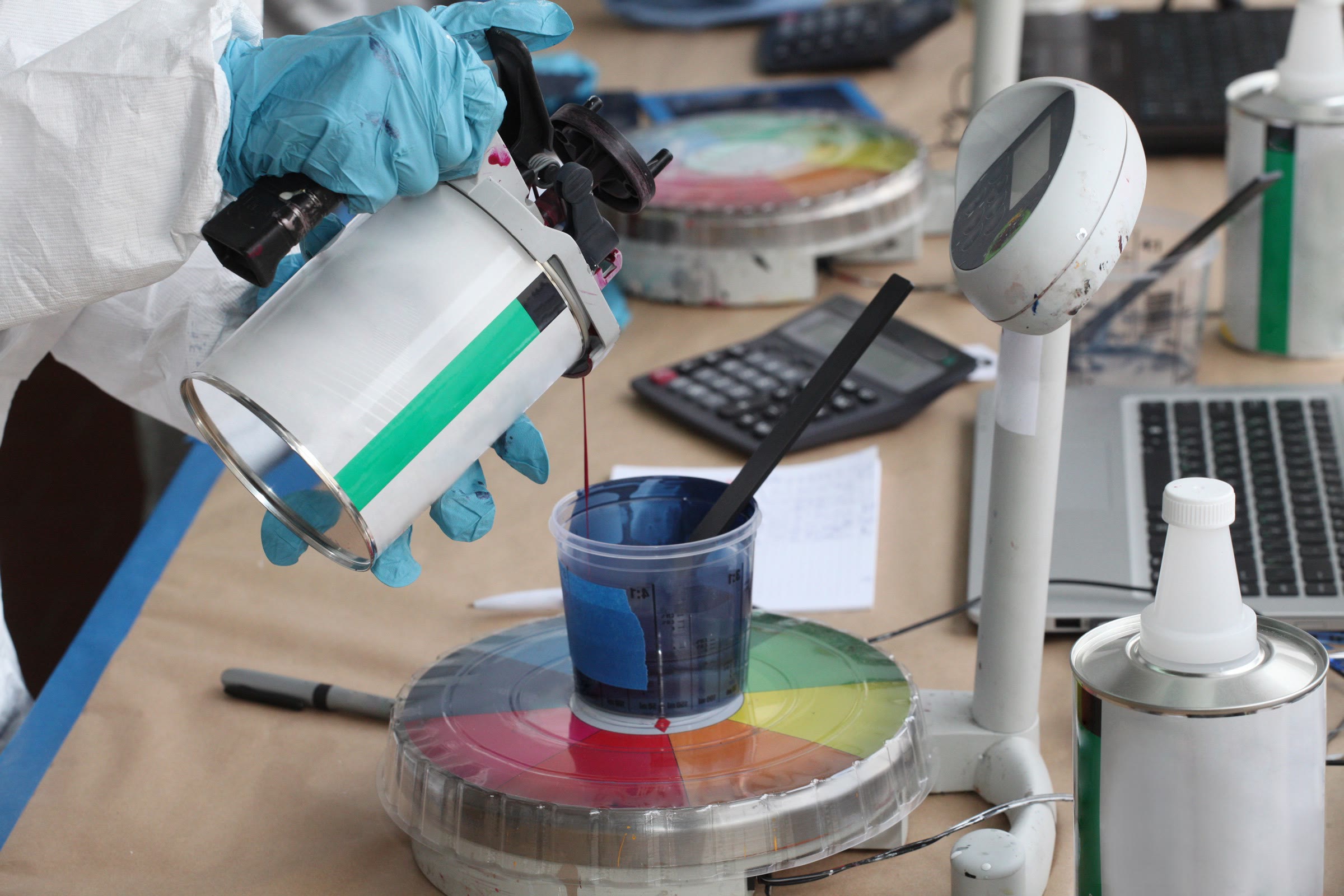
Liquid color for spray polyurethane
Spray polyurethane takes a polyol carrier. Every spray match run here has, and a plasticizer-carried dispersion is the wrong answer to this system.
Spray polyurethane takes a polyol carrier. Every spray match run here has, and a plasticizer-carried dispersion is the wrong answer to this system.
Spray polyurethane runs plural-component through a heated gun with a very short gel time, and it goes down as the finished surface. There is no coat over it to fix a shade.
The carrier is not an open question here. Every spray polyurethane match run at this plant has gone out on a polyol-type carrier, and none has run on a plasticizer. A non-reactive plasticizer carrier sitting in a fast-gelling sprayed network is a liability in both the gun and the film.
The dispersion meters on the resin side of the plural-component set, so the color arrives already in the stream the machine proportions. That keeps the ratio the machine is set to and does not add a third thing to control.
Where spray parts live outdoors, and most of them do, a UV absorber and HALS package goes into the carrier. A sprayed surface takes the full sun load with nothing above it.
| Property | Typical value |
|---|---|
| Form | Liquid pigment dispersion |
| Carrier | Polyether polyol, formulated to the hydroxyl number of the system |
| Metering point | The resin side of the plural-component set |
| Color tolerance | ΔE 1.0 or better, CIELAB against the approved standard, D65 illuminant, 10 degree observer |
| Addition rate | Confirmed on your own system at the sample stage |
| UV package | UV absorber and HALS available in the carrier |
| Match turnaround | About a week on a new match |
| Country of origin | Blended in Hermon, Maine |
Dosage: Set on your own system at the sample stage. Spray systems vary widely in solids and film build and the loading that covers at one build is wrong at another, so we establish it against your formulation and your gun settings.
Typical values from the manufacturer's technical data sheet. They describe the product, they are not a specification. We will send the current TDS and the batch documentation your qualification needs.
Tell us the binder system, the property you are targeting, and the volume you expect. We will confirm the grade, send the documentation, and get a sample of the candidate grade to you.
Where the sprayed surface is the finished surface and the color is often matched to a truck paint.
Color as a service or contents identifier, and a light shade so a defect is visible on inspection.
The MUTCD color set, where the shade is mandated rather than chosen.
The APWA color code for buried lines, read by a crew before a shovel goes in.
Reflectivity and appearance under permanent UV exposure.
Non-skid and wear surfaces that take sun, salt and abrasion together.
It is specified where the formulation needs the carrier this system actually takes, decided before the trial, metered on the resin side, so the machine ratio is unchanged, a UV and HALS package for a surface with nothing above it, regulatory color codes matched to the published standard, ΔE 1.0 or better with the reading on the certificate, and free samples and no minimum to trial one.
Meter into the resin side of the plural-component set. Adding color as a third stream to a plural-component gun means controlling a third ratio, and the resin side already exists.
The carrier is reactive and consumes isocyanate, so it moves the index. Tell us the ratio the machine runs at and the carrier is formulated against it.
Do not carry a plasticizer-carried dispersion into a spray system because it worked in a cast part. The two systems have different tolerance for a non-reactive addition, and a carrier that suited a cast elastomer is a documented reason a spray trial fails.
Judge the shade on a sprayed panel at your own build and your own gun temperature. Film build changes how a sprayed color reads.
Package sizes: Pails and drums, with small trial quantities available. Tell us the volume and the pack and we will confirm.
Storage: Store in the original closed container at room temperature, out of direct sun and away from freezing. Stir before use after a long standstill.
Blended in the United States and supplied as Berry Amendment, REACH, RoHS and California Proposition 65 compliant. Regulatory color codes including MUTCD and the APWA underground utility set are matched to the published standard; name the standard and the chip and we will match it.
Usually not, and it is worth checking before the trial rather than after. Cast systems tolerate a plasticizer carrier; spray polyurethane takes a polyol carrier, and every spray match run at this plant has gone out on one. Carrying a cast-system dispersion into a spray gun is a known reason a trial disappoints.
Into the resin side, ahead of the proportioner. Running it as a third stream means controlling a third ratio on a machine that already has one to hold.
It changes the index, because a reactive carrier consumes isocyanate. Tell us the ratio the machine runs at and the carrier is formulated to the hydroxyl number of the system so the addition is accounted for.
Yes. The MUTCD set for traffic and the APWA underground utility colors are both matched to the published standard, and so are federal standard chips. Name the standard and the chip number and we will work to it.
On a sprayed panel at your own film build and gun temperature. Film build moves a sprayed color noticeably, so a thin lab drawdown will not tell you what the truck will look like.
Yes. We send the Technical Data Sheet (TDS), Safety Data Sheet (SDS), Certificate of Analysis, Berry Amendment statement, Proposition 65 statement, and REACH and RoHS statement on request, in the current revision. Use Request TDS or SDS above and tell us what your qualification review needs.
The other polyol-carried lane, metered on the same side.
Where both carriers are live and the resin decides.
Polyurea sprays alongside these systems and takes the same discipline about the carrier.
The whole color operation, both formats, and how a match is run.
Why a sprayed system takes a polyol carrier.