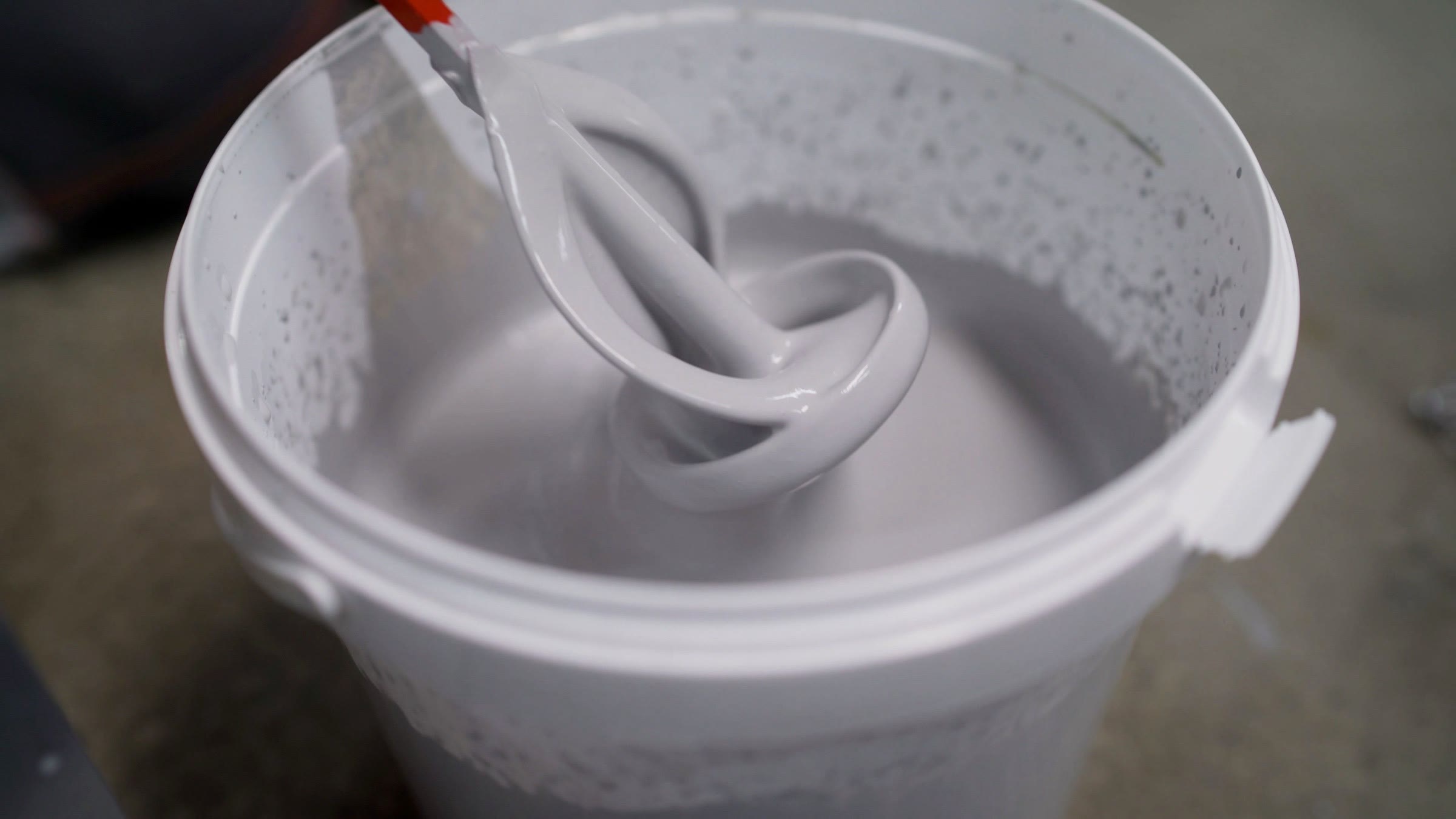
Epoxy takes a liquid pigment dispersion, added at roughly 1 to 5 percent of the total mixed system and blended into one component before the two are combined. The carrier is an ester plasticizer, it takes no part in the cure, and none of the stoichiometry that governs a colorant in polyurethane applies here.
Why an ester carrier is unremarkable in epoxy
A pigment dispersion is pigment plus the liquid it is dispersed in, and in a thermoset that liquid does not evaporate. It ends up in the cured film. So the first question is what the carrier does to the chemistry, not what shade it is.
An epoxy cures when amine hydrogen on the hardener attacks the epoxide ring on the resin. An ester plasticizer carries neither group. It has no epoxide to open and no amine hydrogen to open one with, so it takes no part in that reaction. It behaves as a non-reactive diluent: it thins the mix while you are blending and then stays where it is.
Epoxy is also not an isocyanate system, and that removes a whole layer of arithmetic. In a two-component polyurethane, a polyol-carried colorant brings hydroxyl into the formulation, hydroxyl consumes isocyanate, and above roughly one part per hundred the formulator has to fold the colorant into the isocyanate index or the part comes out soft. There is no equivalent calculation in epoxy. The resin-to-hardener ratio is set by the resin supplier and the colorant does not enter it. That reasoning, in its polyurethane form, is in choosing the carrier for a polyurethane pigment dispersion.
One practical consequence: the same dispersion family colors cast polyurethane, plastisol, and epoxy. A shop running more than one of those holds one color target and one supplier across all of them. The plastisol case is covered in coloring plastisol for dip molding, rotocast, and coated fabric. A system house selling a finished epoxy system under its own name can build a standard color palette on that same carrier.
Coloring an epoxy system?
Send the shade and the system. We match into your own resin rather than a stand-in, and the sample comes back confirmed in the material you sent.
Request a SampleWhich component takes the color
We are not going to give you a universal rule for it, because there is not one that holds across every system.
The two components are not interchangeable for this purpose. The hardener is the reactive, amine-bearing side, and it is usually the smaller volume of the two. Add the same mass of colorant to it and that colorant is a larger fraction of the component, which moves both the shade of that component and its behavior in the pot more than the same addition would move the resin side. A system mixed 2:1 puts three times the proportional load on the hardener as it does on the resin for an identical addition.
The resin supplier is the one who knows where color belongs in their system. They set the mix ratio, they know what is already in each component, and they have seen their product pigmented before. Ask them before you pigment anything.
Then tell us the answer when you send the system. We match into the component that will actually carry the color, and we confirm the shade in the mixed and cured film, not in the wet component, because those two do not read the same.
How much, and what the percentage is a percentage of
Our dispersions run at 1 to 5 percent across the line as a standard band. Blacks sit toward the lower end, roughly 1 to 4 percent, because a carbon black delivers a great deal of color strength per unit of pigment.
State the basis whenever you quote one of those numbers, because a percentage with no basis is not a specification. We mean percent of the total mixed system: resin plus hardener plus colorant. A number quoted on the resin component alone is a different number, and on a 2:1 system it is a substantially different number. The same ambiguity shows up in cast polyurethane and is covered in how much colorant to add to cast polyurethane.
Where you land inside the band depends on the pigment and on how much hide the shade has to deliver. Titanium dioxide, carbon black, and an organic red need very different loadings to reach the same opacity, so a single flat figure across a palette is a planning estimate. Confirm it on a drawdown in your own system.
Need the loading confirmed in your system?
Send the epoxy and the target. We run the drawdown here and come back with the shade and the addition rate that produced it.
Custom color matchingOpacity, and why white is the loading problem
White does the hardest work in the palette. It has to hide the substrate by scattering light, scattering takes pigment volume, and so a white carries the highest loading of anything you will buy.
A tinted shade in a floor or a coating is usually built on a white base and then tinted from there. A light grey is mostly white with a small addition on top. So the loading question for a pale shade is really a question about the white underneath it, and the tint is a rounding error next to it.
A dark hardener pushes the same problem further. If the hardener is amber or brown, the white base has to overcome that color before the finished shade reads correctly, which raises the loading needed to hit a light target. Check the color of both components before agreeing a shade against a chip.
Working the other direction is also possible. Solids can be brought down deliberately to move a shade from opaque toward translucent, which is a real requirement in decorative flooring where some of the substrate is meant to show.
The guardrail
A non-reactive diluent lowers glass transition temperature and can cut solvent and acid resistance if enough of it is present in the film. At the level a colorant introduces, a few percent of the total formulation at most, that is minor and it does not compromise the performance of a floor or an industrial coating.
Pigmenting heavily, or pigmenting a system that already carries a diluent load, puts more of it in the film than a normal addition does. For immersion service the usual approach is to carry the color through the intermediate coats and finish with a clear high-Tg topcoat, which keeps the color where you need to see it and keeps the resistance layer unmodified.
What to send so the first sample works
Four things.
The epoxy system itself, both components, because we match into your material rather than into a substitute. The color reference, which can be a PANTONE code, a RAL number, a Federal Standard 595 chip, a physical part, or a photograph. Which component your resin supplier says the color belongs in. And what the film has to survive, since that decides whether the color goes through the whole build or stops below a clear topcoat.
A shade target on its own does not settle any of the questions above. Sent together, those four usually make the first sample the last one.
Frequently asked
What kind of colorant does epoxy take?
A liquid pigment dispersion: organic and inorganic pigments pre-dispersed in a carrier, metered in and mixed before the two components are combined. The carrier we run for epoxy is a phthalate-free terephthalate plasticizer, the same one that carries our cast polyurethane and plastisol dispersions. An ester carries no epoxide and no amine hydrogen, so it takes no part in the amine-epoxy cure and behaves as a non-reactive diluent.
Does a colorant change the epoxy stoichiometry the way it can in polyurethane?
No, because epoxy is not an isocyanate system. In a two-component polyurethane a polyol-carried colorant brings hydroxyl into the mix, hydroxyl consumes isocyanate, and the formulator has to fold that into the isocyanate index. An epoxy cures by amine hydrogen opening an epoxide ring, and an ester carrier brings neither. The mix ratio of resin to hardener is set by the resin supplier and the colorant does not enter that calculation.
Should the color go into the resin side or the hardener side?
That depends on the system, and the resin supplier is the one who can answer it. The two components are not interchangeable for this purpose. The hardener is the amine-bearing reactive side and it is usually the smaller volume, so the same addition of colorant is a larger fraction of it. Ask your resin supplier where color belongs in their system before you pigment anything, and tell us the answer when you send the system so we can confirm the shade in the component that will actually carry it.
How much colorant does an epoxy system take?
Our dispersions run at 1 to 5 percent across the line as a standard band, with blacks toward the lower end at roughly 1 to 4 percent. State the basis when you quote a number: we mean percent of the total mixed system, resin plus hardener plus colorant, not percent of one component. The right number inside that band depends on the pigment and on how much hide the shade needs, so confirm it on a drawdown.
Why does white take more colorant than a saturated shade?
White has to hide the substrate with scattering alone, and scattering takes volume, so a white carries the highest pigment loading of anything in the palette. A tinted shade in a floor or a coating is usually built on that white base and then tinted, which means the white is doing the loading work and the tint is a small fraction on top of it. A dark hardener pushes the loading further, because the base has to overcome the color the hardener brings before the shade reads correctly.
Will a colorant hurt the chemical resistance of the film?
A non-reactive diluent lowers glass transition temperature and can cut solvent and acid resistance if enough of it is present. At the level a colorant introduces, a few percent of the total formulation at most, that is minor. For immersion service the usual approach is to carry the color through the intermediate coats and finish with a clear high-Tg topcoat.
Send us the system, not just the shade
We supply color for epoxy systems in production today, across industrial epoxy coatings, epoxy flooring, and epoxy sealants, and our standard dispersions carry an epoxy suitability rating across the line. Custom matching is free, samples ship at 0.5 kg, and there is no minimum order. Colors ship in 5 kg, 12.5 kg and 20 kg pails, and in drums and totes.
See liquid color for epoxy systems