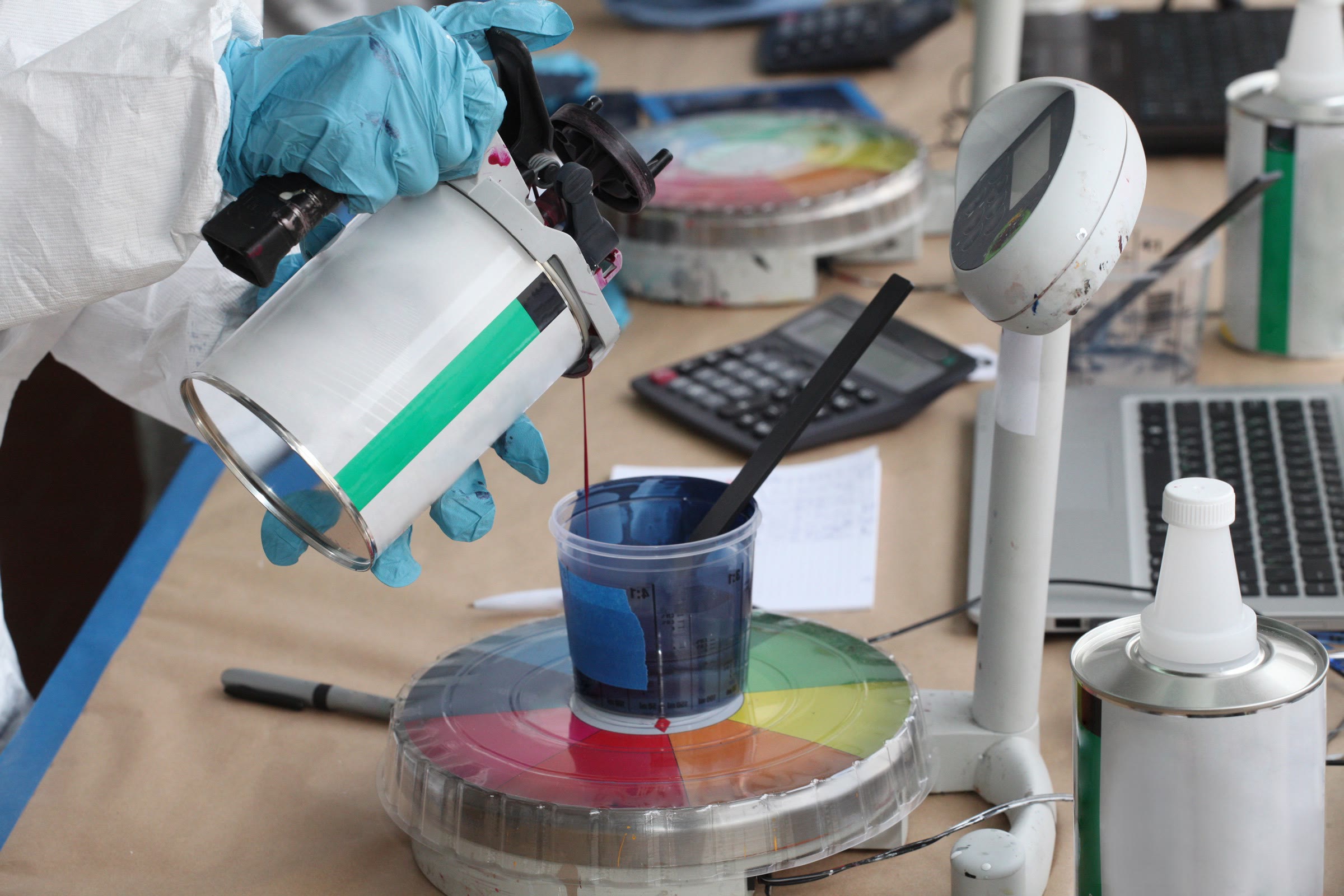
Cast polyurethane takes 1 to 2 percent colorant as a typical figure, with 4 percent as a working maximum, measured on the total system mixture.
Two things move that number. The first is the basis the percentage is quoted on. The second is which pigment is doing the work, since pigments differ widely in tinting strength and hiding power.
Percent of what
The commonly published cast polyurethane figures are on the total system mixture, meaning polyol plus isocyanate plus everything else. Other figures in circulation, including patent language, are on the weight of polyol alone. On a system running near a one-to-one ratio those two bases differ by roughly a factor of two.
Ask which basis a figure uses, and state your own when you pass a number to someone else.
The sourced numbers
The 1 to 2 percent typical and 4 percent maximum figures above are the tightest in open publication for cast polyurethane. They agree with the band across our own product documentation, which runs 1 to 5 percent for standard liquid colors. Our band is wider because it covers pigments of very different strength.
Within that band, our lab's working rule of thumb is roughly one percent for blacks and roughly three percent for chromatic colors. Grades carrying a UV and HALS package run higher, two to six percent, because a meaningful fraction of what you are metering in is stabilizer. Carbon black grades sit around one to four percent. One effect grade in the line runs as low as 0.1 percent.
For flexible PVC plastisol: two percent, a 50 to 1 let-down. For PVC masterbatch: generally one to four percent. Every source expresses these as a percentage or a ratio; none expresses colorant in phr, even though phr is the standard basis in PVC for plasticizers.
Want the number for your own system?
Send the resin and the target shade. We establish the loading on the bench, confirm it in your system, and ship a free 0.5 kg sample with the rate on it.
Request a SampleWhy one percentage cannot cover every color
Pigments differ enormously in tinting strength and hiding power.
Carbon black is the extreme case at one end. It absorbs across the whole visible spectrum, so a small fraction of a percent already reads dark and full black arrives at a loading that would leave most other pigments looking like a tint. Titanium dioxide is the extreme at the other end: white is achieved by scattering, and scattering is inefficient compared with absorption, and a solid opaque white therefore needs a lot of pigment. That is why whites are the loading problem in almost every line, and why whites are the grades most likely to need the polyol carrier, since more pigment means more carrier riding along with it.
Between those two sit the chromatic pigments, and they split again. Inorganic pigments such as the iron oxides are opaque and forgiving. Many organic pigments, particularly the clean bright reds and yellows, are transparent by nature. A transparent organic red will not reach full opacity at any sensible loading on its own. It reaches it with white behind it, which changes the shade, which is why the answer to "how do I get this red more opaque" is usually a reformulation.
A single percentage quoted for all colors averages across pigments that behave differently.
What goes wrong above the band
Physical performance. Higher pigment loads can degrade the physical performance of the cured part. Pigment is solid filler that is not part of the network, and past a point it interferes with the properties you cast a urethane to get.
Cure behavior. Gel time may slow in pre-colored Shore A durometer systems. The usual remedies are adding catalyst to the polyol or coloring immediately before each batch instead of holding pre-colored material. If a soft system started running slow after a color change, that is where to look first.
The index, if your carrier is a polyol. A polyol-carried dispersion brings hydroxyl into the formulation, and hydroxyl consumes isocyanate. Below roughly one part per hundred the contribution is small enough to ignore. Above that, it has to be folded into the isocyanate index or the part comes out soft and under-cured. A plasticizer carrier has no active hydrogen and does not enter that arithmetic at all. Which carrier you are running, and what each one costs you, is covered in choosing the carrier for a polyurethane pigment dispersion.
Where no number exists
For PU foam, TPU, and polyurea there is no defensible universal let-down rate. The rate moves with the system, the density, and what the finished surface has to look like, and it is calculated for the job. Send the system and we will establish it on the bench.
The same goes for a phr figure in PVC. No source expresses colorant that way.
Coloring a system we have not named here?
We match into plastisol, cast urethane, foam, spray polyurethane, and customer-supplied epoxy systems. Send yours and we will match into the actual material rather than a substitute. For epoxy the addition rates and the basis question are set out separately in coloring epoxy systems. The plastisol figures are in coloring plastisol.
Talk to an ExpertFinding your number on the bench
Run a ladder, not a single shot. Take the published starting figure for your system, mix three small batches at that rate, at half again, and at double, and cast a plaque from each. Cut the plaques, because cast color goes all the way through and a cut face tells you what the part will look like after machining. Read them side by side against your standard under one light source, and take the lowest loading that holds the shade, not the one that looks best, because the lowest loading is the one that costs you the least in properties and in money.
Record the basis you used alongside the rate.
Frequently asked
How much colorant do you add to cast polyurethane?
One to two percent of the total system mixture is the typical figure, with four percent as a working maximum. Our own product documentation across the line runs a 1 to 5 percent band, wider because it covers pigments of very different strength. Blacks land near the bottom of that band and chromatic colors near the middle. The number is a starting point for a trial, not a specification.
Is the percentage of the polyol or of the total system?
Ask, every time. The commonly quoted cast polyurethane figures of 1 to 2 percent typical and 4 percent maximum are of the total system mixture. Other published figures, including patent language, are expressed on the weight of polyol alone. On a system running near a one-to-one ratio those two bases differ by roughly a factor of two.
Why can't one percentage cover every color?
Because pigments differ enormously in tinting strength and hiding power. Carbon black hides at a fraction of the loading a titanium dioxide white needs, and a transparent organic red may not reach full opacity at any sensible loading without a white behind it. A single percentage quoted for all colors averages across pigments that behave differently.
What happens if I add more colorant than the recommended range?
Higher pigment loads can degrade the physical performance of the cured part. Gel time may slow in pre-colored Shore A durometer systems, which is usually handled by adding catalyst to the polyol or by coloring immediately before each batch. And if the carrier is a polyol, above roughly 1 part per hundred its hydroxyl contribution has to be folded into the isocyanate index.
What is the colorant addition rate for plastisol and flexible PVC?
Two percent, a 50 to 1 let-down, is the published figure for flexible PVC plastisol. PVC masterbatch is generally quoted at 1 to 4 percent. Every source expresses this as a percentage or a let-down ratio, not as phr, even though phr is standard in PVC for plasticizers.
What is the let-down rate for PU foam, TPU, or polyurea?
There is no universal figure. The rate depends on the system, the density, and what the finished surface has to look like. Send the system and the target and we will establish the rate on the bench.
Get the rate with the color
Every color we match ships with the addition rate it was matched at, on the basis it was measured on. Custom matching is free, samples ship at 0.5 kg, and there is no minimum order. Send the resin system and the target and we will tell you the number for your own system.
See liquid color for cast PU