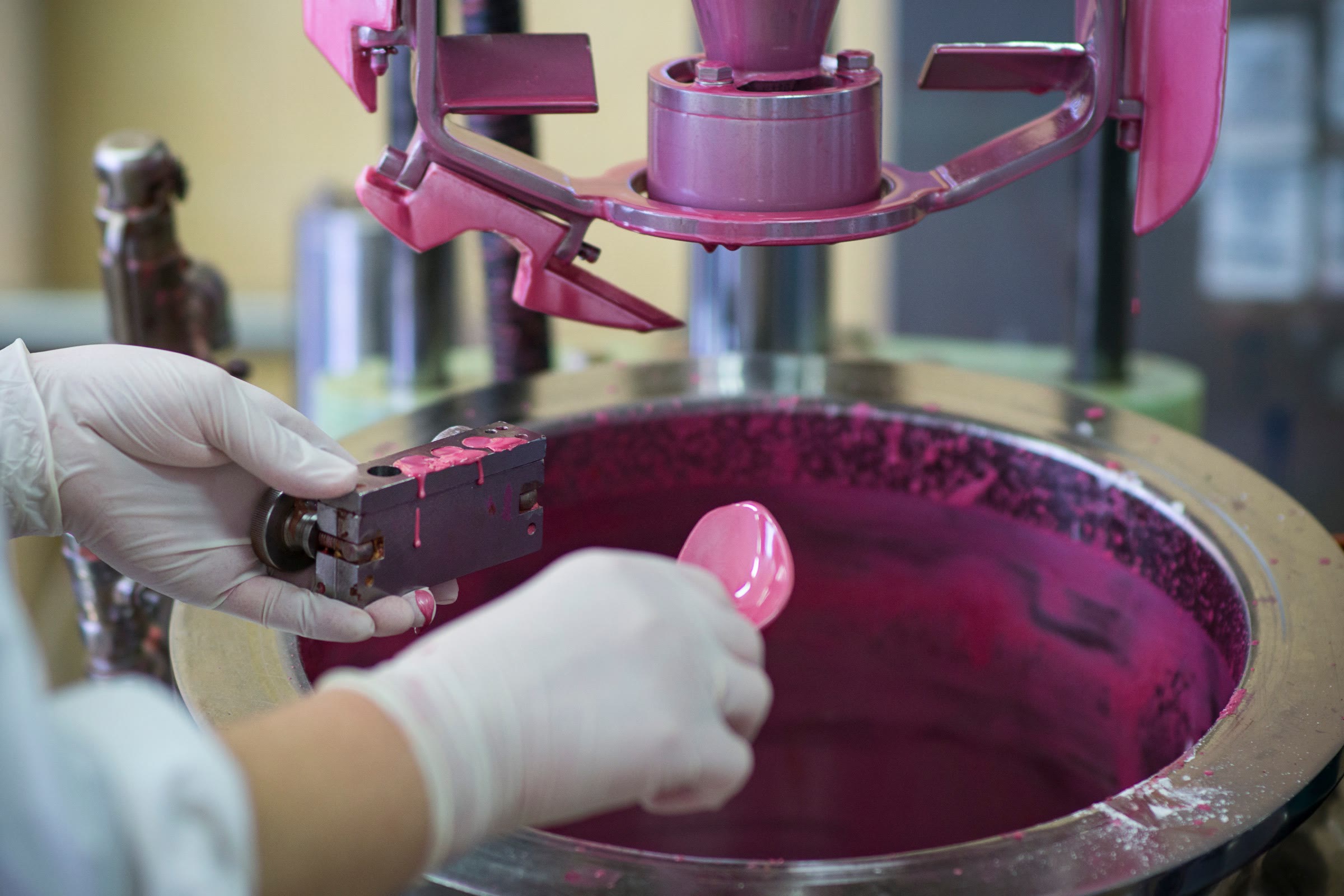
Liquid color for polyurethane foam
Flexible and integral-skin foam, colored on the polyol side. The carrier goes into the reaction, which is what a foam needs.
Flexible and integral-skin foam, colored on the polyol side. The carrier goes into the reaction, which is what a foam needs.
Foam is colored on the polyol side, which makes the carrier choice narrower than it is on a cast system. A polyether polyol carrier is metered into the polyol stream and joins the reaction. It does not sit in the finished foam as an unreacted addition.
Integral-skin foam is where color earns the most. The skin forms in the mold and the part ships as it comes out, so there is no paint step downstream to correct a shade that missed. The color has to be right at the mold or the part is scrap.
Flexible foam converters run the same logic at a different scale. The color identifies density, grade or customer across a cutting floor where a dozen buns look alike from three feet away.
A polyol carrier is reactive and consumes isocyanate, so it moves the index. The carrier is formulated to the hydroxyl number of the system it is going into, and the addition rate is set with that in view. Give us the index you run to.
| Property | Typical value |
|---|---|
| Form | Liquid pigment dispersion |
| Carrier | Polyether polyol, formulated to the hydroxyl number of the system |
| Metering point | The polyol side, ahead of the mix head |
| Color tolerance | ΔE 1.0 or better, CIELAB against the approved standard, D65 illuminant, 10 degree observer |
| Addition rate | Confirmed on your own system at the sample stage |
| Match turnaround | About a week on a new match |
| Country of origin | Blended in Hermon, Maine |
Dosage: Set on your own system at the sample stage. Foam covers a wide range of densities and cell structures and the loading that reads correctly on one is wrong on another, so we establish it against your formulation. A published figure would not travel.
Typical values from the manufacturer's technical data sheet. They describe the product, they are not a specification. We will send the current TDS and the batch documentation your qualification needs.
Tell us the binder system, the property you are targeting, and the volume you expect. We will confirm the grade, send the documentation, and get a sample of the candidate grade to you.
The skin forms in the mold and ships as it comes out, so there is no paint step to correct a miss.
Color as the density, grade or customer identifier across a cutting floor.
Molded-in color to an OEM shade, on a part that never sees paint.
Grade and durometer identification on a part fitted by hand.
Color-coded by protection class or by customer.
It is specified where the formulation needs a reactive carrier that joins the network instead of sitting in it, formulated to the hydroxyl number of your system, not supplied as a generic polyol, metered on the polyol side, where the line already meters, molded-in color on parts that never see a paint step, ΔE 1.0 or better with the reading on the certificate, and free samples and no minimum to trial one.
Meter the dispersion into the polyol stream ahead of the mix head. That is where the line already doses, so nothing new has to be plumbed.
The carrier is reactive and consumes isocyanate, so the index moves. Tell us the index you run to and the carrier and the addition rate are both set against it.
Stir before use after a standstill, then meter. A stirred container gives the shade the drawdown was approved against.
Judge the shade on a molded part from your own tool at your own cure, not on a drawdown. Cell structure and skin formation both change how a foam reads, and neither shows up on a flat panel.
Package sizes: Pails and drums, with small trial quantities available. Tell us the volume and the pack and we will confirm.
Storage: Store in the original closed container at room temperature, out of direct sun and away from freezing. Stir before use after a long standstill.
Blended in the United States and supplied as Berry Amendment, REACH, RoHS and California Proposition 65 compliant. Documentation for a specific requirement is available on request; name the requirement and we will confirm which grades carry it.
Because foam is colored on the polyol side and a polyol carrier goes into the reaction. A plasticizer carrier is a non-reactive addition sitting in a system that is building a network, which is the wrong thing to introduce into a foam. The same reasoning runs the spray polyurethane lane.
We set it on your own system at the sample stage and do not publish a figure. Foam covers a wide range of densities and cell structures and a loading that reads correctly at one density is wrong at another. Send the formulation and the target and we will give you a number that applies to your material.
Yes. A reactive carrier consumes isocyanate, which is why it is formulated to the hydroxyl number of your system and not supplied as a generic polyol. Give us the index and the addition rate is set against it.
Not reliably. Cell structure and skin formation both change how a foam reads, and neither appears on a flat panel. Mold a part on your own tool at your own cure and judge that.
Yes, routinely. It is the cleanest way to remove the substrate variable.
Yes. We send the Technical Data Sheet (TDS), Safety Data Sheet (SDS), Certificate of Analysis, Berry Amendment statement, Proposition 65 statement, and REACH and RoHS statement on request, in the current revision. Use Request TDS or SDS above and tell us what your qualification review needs.
The other polyol-carried lane, where the same carrier logic applies harder.
Where both carriers are live options and the resin decides.
The plasticizer-carried lane, and the system matched most often here.
The whole color operation, both formats, and how a match is run.
Why a foam takes a polyol carrier and what that does to the index.