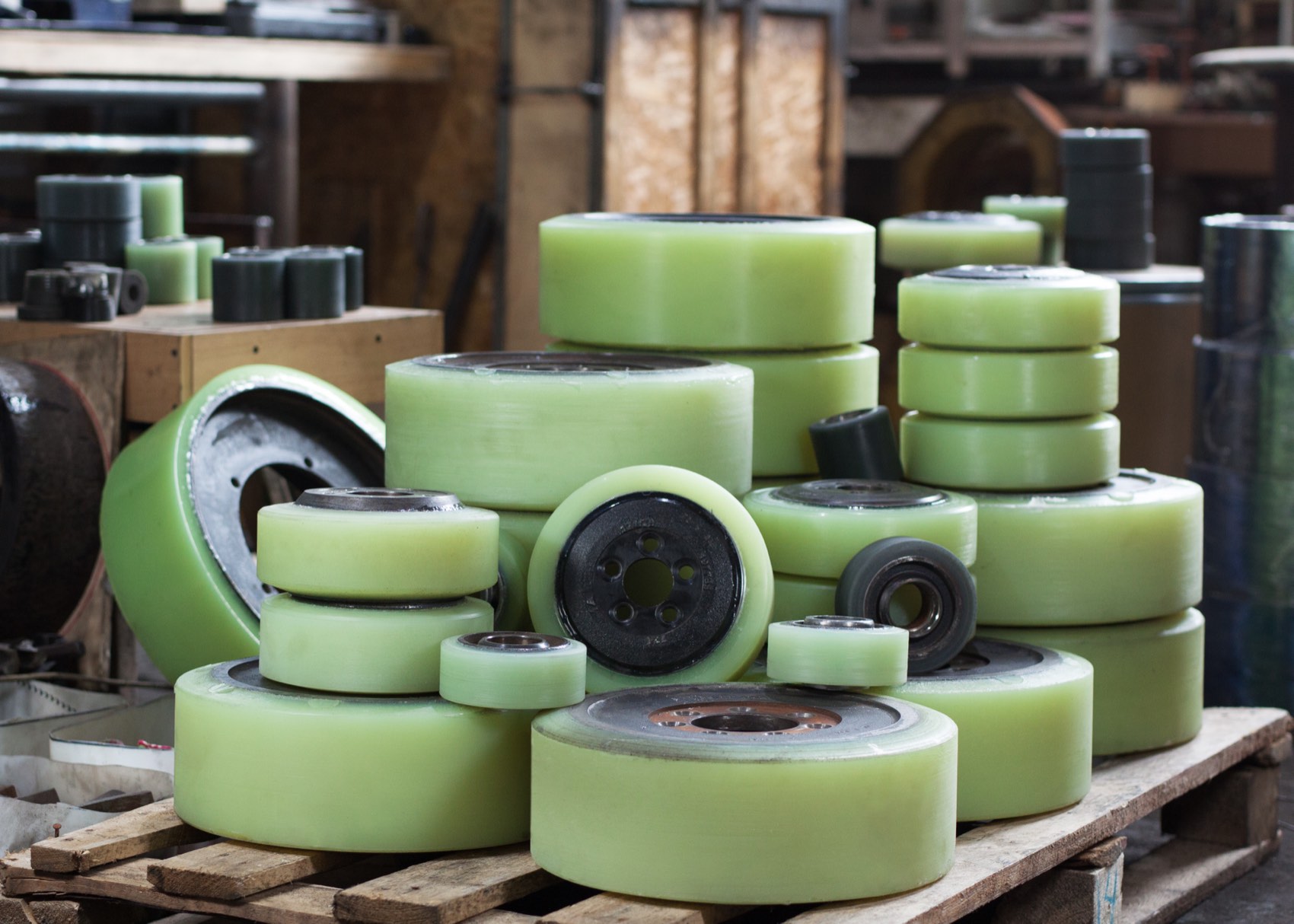
Cast polyurethane is colored while it is still a liquid. A polyol meets an isocyanate, the mix has a short working window, and the part cures to an elastomer. Whatever color goes in has to disperse fully and evenly before the system gels, and it has to do that without changing the reaction. That single constraint is why low-viscosity liquid dispersions are the format that fits cast PU, and why paste and dry pigment fall short.
The mixing window sets the rules
The processing window for a cast system is measured in seconds to minutes, not hours. Inside that window, the colorant has to wet out and distribute through the whole mass. A low-viscosity liquid does this almost as soon as it enters the stream. It carries pigment that is already dispersed, so there is no agglomerate to break down and no thick slug to work in.
A high-viscosity colorant fights the mix. It resists blending into a thin resin, and the result shows up three ways: streaking and swirl in the finished part, shade variation from one part to the next, and, where the colorant is dense enough to throw off local stoichiometry, soft or under-cured spots. They are mixing problems caused by a colorant that does not match the fluid dynamics of the system.
Why viscosity is the variable to watch
Pigment chemistry sets the shade and the lightfastness. Viscosity sets whether the shade lands evenly. A dispersion built for cast PU keeps viscosity low enough to meter and mix while still carrying enough pigment to color at a low addition rate. Dedicated low-viscosity grades push this further for systems that need an easier pour or a tighter metering window, such as fast-gel formulations or precision dosing through a mix head.
The carrier has to belong in the part
A liquid dispersion is pigment in a carrier vehicle, and the carrier ends up in the cured part. So the carrier has to be compatible with the urethane matrix. A carrier matched to the chemistry keeps its effect on tensile strength, elongation, and hardness small. A carrier chosen only for low cost or easy handling can soften the part or migrate over time.
This is why cast PU color is matched by carrier as well as by shade. Plasticizer-based carriers serve a wide range of cast elastomers and flexible systems. Polyether polyol carriers are the reactive route, metered against the polyol side and formulated to the hydroxyl number of the system, for parts where the colorant should react in rather than sit as an inert phase. Where the part lives outdoors, a UV and HALS package in the carrier holds the shade and slows yellowing.
Which of the four carrier chemistries belongs in your system, and what each one does to the cured part, is covered in choosing the carrier for a polyurethane pigment dispersion.
Color does work on the floor
In a cast PU shop, color differentiates hardness grades, marks load ratings, signals compound type, and supports inspection on the line. Because liquid dispersions color the full cross-section, that information survives machining, grinding, and wear. A roller that is reground, a wheel that abrades, and a screen panel that wears all keep their color as material comes off. A surface coating could not do that.
Metering without a pre-blend
Liquid color meters directly into the resin or the mix head, which removes the pre-blending step that paste color needs and lets a line change shades on the fly. For mass coloration, the dispersion blends into the polyol side ahead of the shot. For third-stream dosing, it runs as a separate metered stream into the mix head. Either way, the operation moves between colors quickly and holds them consistently across a run.
Matching the color to the system
A target color behaves differently across resin systems, so a match made for one cast formulation is confirmed in that system, or a representative substitute, before it ships. The inputs that change the formulation are the resin chemistry, the hardness, the addition method, and the exposure the part has to survive. Supply those, and the match accounts for them.
The other half of the specification is the rate you meter it in at, which is set by the pigment rather than by a single house number. The sourced bands are in how much colorant to add to cast polyurethane.
Frequently asked
Why does a thick colorant cause cure problems in cast PU?
A dense, high-viscosity colorant can resist blending into the thin resin and concentrate in pockets. Where it concentrates, it can throw off the local ratio of polyol to isocyanate, which shows up as soft or under-cured spots. A low-viscosity dispersion blends evenly and keeps the reaction uniform.
Does the color go all the way through the part?
Yes. Liquid dispersions color the full cross-section, so parts that are cut, ground, or abraded in service keep their color as material is removed. That is what makes color usable for hardness coding and wear monitoring.
Why is the carrier important?
The carrier ends up in the cured part, so it has to be compatible with the urethane matrix. A carrier matched to the chemistry keeps its effect on the part properties small; a poorly matched carrier can soften the part or migrate over time.
Ready to match a shade
P.A.T. Products produces custom-matched liquid color for cast urethane and PU systems in-house, matched to PANTONE, RAL, Federal Standard 595, or a physical sample. Send a color reference and the resin system, and we will match it, confirm it, and send a sample.
See liquid color for cast PU