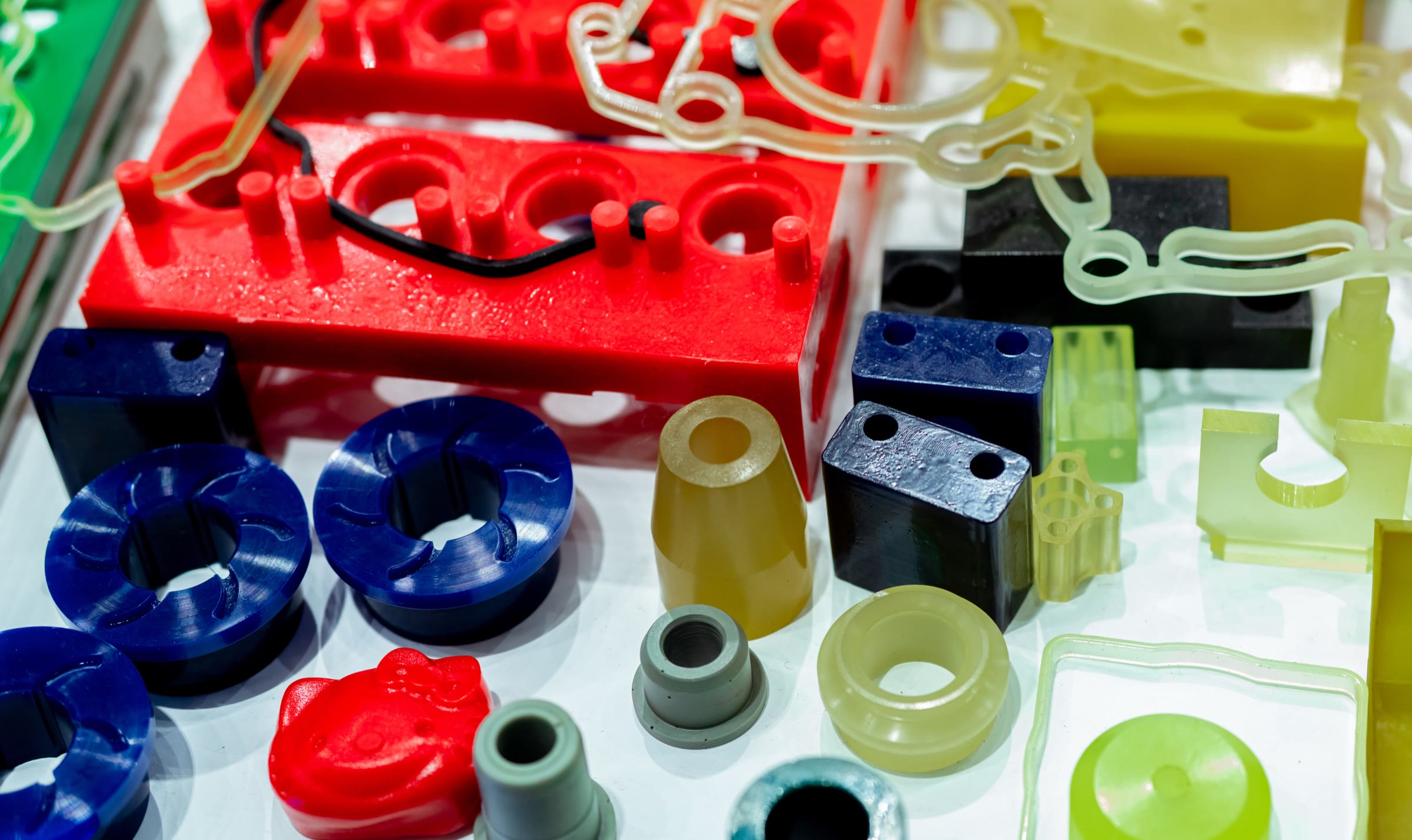
Liquid color for cast urethane
Low-viscosity dispersions that meter into a cast PU system and develop full color before the mix gels. Plasticizer or polyol carrier, matched to your resin and hardness.
Low-viscosity dispersions that meter into a cast PU system and develop full color before the mix gels. Plasticizer or polyol carrier, matched to your resin and hardness.
Cast polyurethane runs as a low-viscosity liquid up to the moment it cures. A polyol meets an isocyanate, the working window is short, and the part sets. A colorant has to disperse fully and evenly inside that window without touching the reaction.
These dispersions are built for that. They pour and meter at low viscosity, integrate into the resin stream quickly, and develop full color before the system gels. A colorant that is too thick fights the mix and shows up as streaking, shade drift part to part, or soft spots where local stoichiometry was disturbed.
The carrier is the real decision. A phthalate-free plasticizer carrier covers cast elastomers across a wide range of parts. A polyether polyol carrier is the reactive route, metered against the polyol side and formulated to the hydroxyl number of the system, and it is what a part goes to when the carrier has to become part of the network instead of sitting in it. Where the part lives in sunlight, a UV and HALS package goes into the carrier.
The color goes through the full cross-section, which matters because cast PU parts get cut, ground, machined and abraded in service. A wheel that wears, a roller that is reground and a screen panel that abrades all hold their color as material is removed.
| Property | Typical value |
|---|---|
| Form | Liquid pigment dispersion |
| Carrier options | Phthalate-free plasticizer, or polyether polyol formulated to the system hydroxyl number |
| Color tolerance | ΔE 1.0 or better, CIELAB against the approved standard, D65 illuminant, 10 degree observer |
| Typical addition rate | 1 to 2 percent, up to 4 percent for a deep shade or full opacity |
| Dosing routes | Third-stream metering into the mix head, or mass coloration blended into the polyol side |
| UV package | UV absorber and HALS available in the carrier for parts in sunlight |
| Match turnaround | About a week on a new match |
| Country of origin | Blended in Hermon, Maine |
Dosage: 1 to 2 percent is the working range on most cast PU, going to 4 percent where a deep shade or full opacity is wanted. The level is confirmed on your own system at the sample stage, since resin, hardness and pigment loading all move it.
Typical values from the manufacturer's technical data sheet. They describe the product, they are not a specification. We will send the current TDS and the batch documentation your qualification needs.
Tell us the binder system, the property you are targeting, and the volume you expect. We will confirm the grade, send the documentation, and get a sample of the candidate grade to you.
Where hardness is color coded by convention and a maintenance crew reads the grade off the part.
Through-color survives the abrasion that removes the surface.
Molded-in color with no paint step downstream to correct a miss.
Color as an identification and tamper-evidence feature.
Pads, guards and edge protection, including the regulatory color codes those carry.
A colored wear layer under a working surface, where the color change is the indicator that the part is spent.
It is specified where the formulation needs low viscosity, so it meters and disperses inside the cure window, carrier matched to the resin instead of one carrier forced across every job, through-color that survives grinding, machining and abrasion, a UV and HALS package where the part lives outdoors, ΔE 1.0 or better with the reading on the certificate, and free samples and no minimum to trial one.
Meter the dispersion as a third stream into the mix head, or blend it into the polyol side ahead of the shot. Either works; the choice is usually whatever the machine already does.
A polyol carrier is reactive and consumes isocyanate, so it moves the index. That is designed for, not ignored: the carrier is formulated to the hydroxyl number of your system and the addition rate is set with it in mind. Tell us the index you run to.
Stir before use. A dispersion that has stood for a long time can settle, and a stirred drum meters to the same shade as the drawdown it was approved against.
Run the shade against your own resin and your own cure schedule before it goes into production. Pigment can read differently against a different polyol, and the drawdown that matters is the one on your material.
Package sizes: Pails and drums, with small trial quantities available. Tell us the volume and the pack and we will confirm.
Storage: Store in the original closed container at room temperature, out of direct sun and away from freezing. Stir before use after a long standstill.
Blended in the United States and supplied as Berry Amendment, REACH, RoHS and California Proposition 65 compliant, which makes it a Berry-compliant component for military and government work. FDA 21 CFR food-contact documentation is available for qualifying grades on request; food-contact color runs on specific carriers, so name the requirement and we will confirm which grades carry it.
A phthalate-free plasticizer carrier is the general answer for cast elastomers and it is the one most parts run on. A polyether polyol carrier is the reactive route, and it is what you want when the carrier should become part of the network rather than sit in it, or when the system is intolerant of a non-reactive addition. Tell us the resin, the hardness and where the part lives and we will name the carrier before anything is blended.
Yes, a reactive carrier consumes isocyanate. That is why it is formulated to the hydroxyl number of your system rather than supplied as a generic polyol. Give us the index you run to and the addition rate is set against it.
1 to 2 percent covers most cast PU, going to 4 percent for a deep shade or full opacity. The number is confirmed on your own system at the sample stage, because resin, hardness and the pigment itself all move it.
ΔE 1.0 or better, measured CIELAB against the approved standard on a spectrophotometer at D65 and a 10 degree observer. The measured reading ships on the certificate of analysis with every batch. Ask any supplier which ΔE formula they are quoting, because ΔE*ab and ΔE2000 are different numbers for the same pair of samples.
Yes, and it is how most of this work arrives. A physical part or a wet sample is a better standard than a code, because it carries the substrate and the finish the eye is actually judging. Send the part and the resin system and we will match into that system.
The match and the sample are free and there is no minimum to try one. What we ask for is the target, the system it has to run in, and enough of a standard to read on a spectrophotometer.
Yes. We send the Technical Data Sheet (TDS), Safety Data Sheet (SDS), Certificate of Analysis, Berry Amendment statement, Proposition 65 statement, and REACH and RoHS statement on request, in the current revision. Use Request TDS or SDS above and tell us what your qualification review needs.
The polyol-carried lane, where a plasticizer carrier is the wrong answer.
Flexible and integral-skin foam, metered on the polyol side.
The plasticizer-carried lane, and the system matched most often here.
The systems where the carrier choice is easiest to get wrong.
Deuteron LE 829 and LE 100 LV for cast rollers and wheels that have to dissipate static.
The full treatment of the system, the carrier decision and dosing.
What viscosity does to dispersion inside the cure window.
Plasticizer against polyol, including what a polyol carrier does to the index.
The addition rate question, worked through.