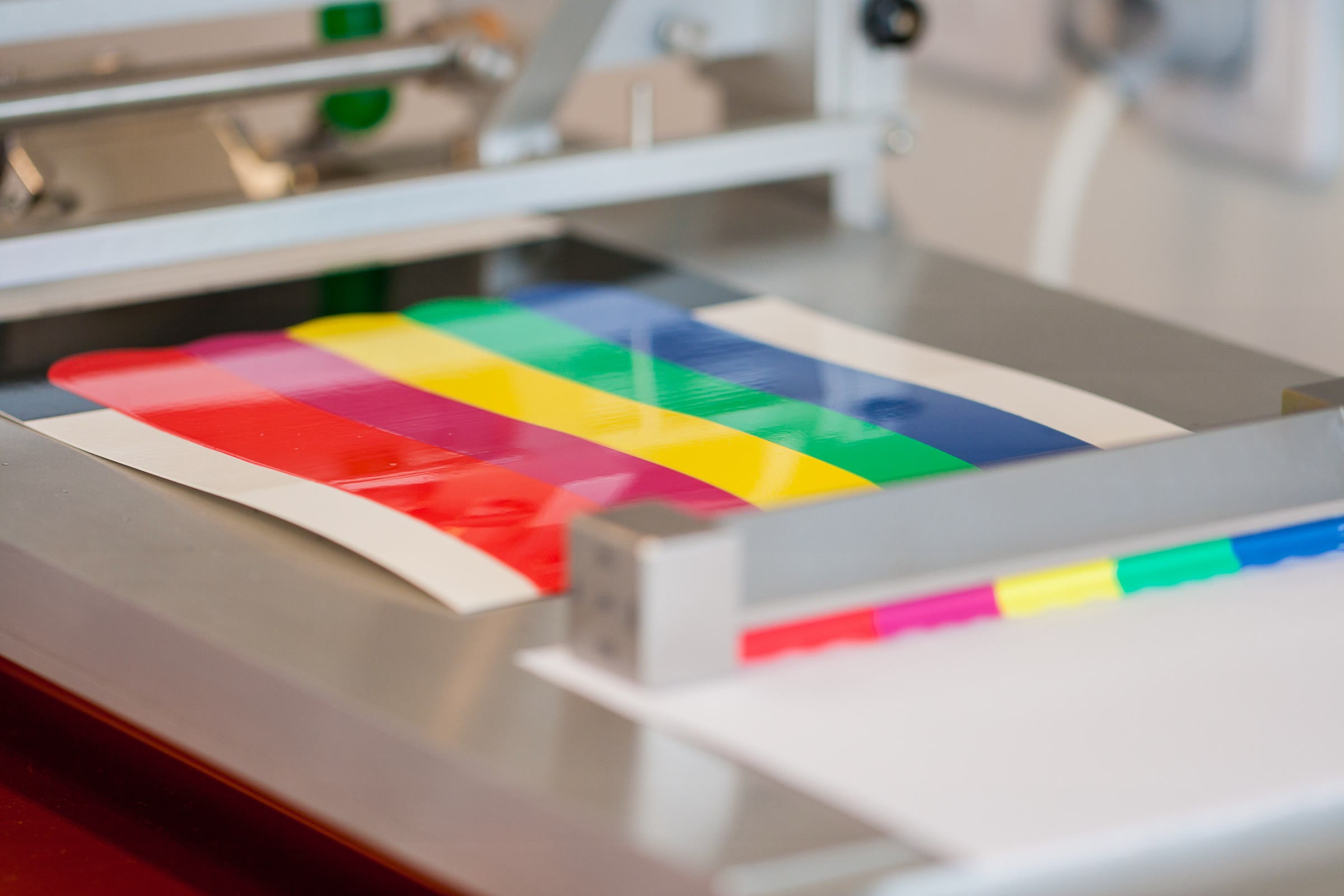
Plastisol takes a pigment dispersion in a plasticizer carrier, let down at about 2 percent of the compound, roughly a 50 to 1 ratio. The carrier is the same class of material the compound is already built on, so it needs no separate accounting.
Why the carrier is native here
Plastisol is PVC resin suspended in plasticizer. The resin particles sit dispersed until heat drives solvation and the mass fuses into a solid.
A dispersion for plastisol is pigment ground into that same plasticizer, so it introduces no foreign phase and needs no compatibilizing. In cast polyurethane the same plasticizer carrier is a non-reactive addition that shows up in hardness and rebound. In epoxy it is a diluent that takes no part in the amine-epoxy cure and slightly lowers glass transition temperature.
So tell your colorant supplier which plasticizer your compound runs on.
Running a plastisol compound?
Send the shade and the compound. We match into your own plastisol rather than a stand-in, on a carrier chosen to suit the plasticizer you already run.
Request a SampleHow much, and what the percentage is of
The published figure for flexible PVC plastisol is about 2 percent, a 50 to 1 let-down, measured on the compound and not on the resin alone. State the basis whenever you quote a loading, because a percentage with no basis is not a specification.
Titanium dioxide, carbon black and an organic red need very different loadings to reach the same opacity, so a single flat number across a palette is a planning estimate. Confirm it on a drawdown in your own compound. The same discipline applies in cast polyurethane: see how much colorant to add to cast polyurethane.
Fusion is a pigment-selection question
Plastisol gets its properties from heat. The compound has to reach fusion temperature and hold there, which puts the pigment on the critical path.
Organic pigments have real temperature limits, and some sit close to a fusion schedule. Diarylide yellows release 3,3-dichlorobenzidine above 200 degrees C, a decomposition threshold and not a fading one. Send the fusion temperature and the dwell with the shade target and the pigment is selected against them.
The dispersion has to leave your rheology alone
Plastisol viscosity is a process variable. Dip thickness, pickup on a rotocast tool and coating weight all move with it, and a shop that has tuned a compound to run at a given viscosity does not want a colorant retuning it.
The dispersion should meter at your conditions, and low-viscosity and pourable trims exist for shops running metering pumps. Tell us the pump, the addition rate, and where in the process the color enters.
Need the loading confirmed in your compound?
Send the plastisol and the target. We run the drawdown here and come back with the shade, the addition rate that produced it, and the viscosity it was measured at.
Custom color matchingPlastisol color and plastisol ink are different products
Searching for plastisol color returns screen-printing content, because screen-printing plastisol ink is the largest consumer use of the word.
Screen-printing plastisol is a finished ink, sold ready to print and formulated to sit on the surface of a fabric. A pigment dispersion is a concentrate: you let it down into your own compound at a couple of percent, and the color runs through the whole part.
Advice written for the ink covers cure temperature, dye migration onto polyester and squeegee technique. None of it transfers to fusion schedule, viscosity, carrier plasticizer and hide.
Phthalates
Our color runs on a phthalate-free terephthalate plasticizer: the para isomer of the phthalate ring, with the two carboxyl groups opposite each other instead of adjacent. That geometry is what the restricted-substance lists are drawn around. Flexible PVC is where phthalate scrutiny lands hardest, so the carrier question comes up on this line more than on any other.
What to send so the first sample works
- The compound itself, so we match into your material and not a substitute.
- The color reference: a PANTONE code, a RAL number, a Federal Standard 595 chip, a molded part, or a photograph.
- The plasticizer the compound runs on, so the carrier suits it.
- The fusion temperature and dwell, so the pigment is selected against your process.
A shade target on its own leaves three of those four open.
Frequently asked
What kind of colorant does plastisol take?
A liquid pigment dispersion in a plasticizer carrier, let down into the compound before fusion. Plastisol is PVC resin suspended in plasticizer, so a plasticizer-carried dispersion is native to the formulation.
How much dispersion does plastisol take?
About 2 percent of the compound, roughly a 50 to 1 let-down, is the published figure for flexible PVC plastisol. State the basis when you quote it. Where you land inside that depends on the pigment and the hide the shade needs, so confirm it on a drawdown in your own compound.
Does the colorant change my plastisol viscosity?
It can, and that is why viscosity belongs in the specification. Dip thickness, rotocast pickup and coating weight all move with compound viscosity. Low-viscosity and pourable trims exist for metering-pump shops. Tell us the pump and the addition rate and the dispersion is formulated to meter at your conditions.
Will the pigment survive fusion?
That is a pigment-selection question. Organic pigments have real temperature limits: diarylide yellows release 3,3-dichlorobenzidine above 200 degrees C, close enough to a fusion schedule to matter. Send the fusion temperature and dwell with the shade target and the pigment is selected against them.
Is this the same as plastisol screen-printing ink?
No. Screen-printing plastisol is a finished ink formulated to sit on a fabric surface and sold ready to print. A pigment dispersion is a concentrate let down into your own compound so the color runs through the part. They share a name and a resin family and very little else.
Can you match into my own compound?
Yes. Send the plastisol and we match into it. Plastisol is the system we match most often, so the bench has seen compounds like yours before.
Send us the compound
Custom matching is free, samples ship at 0.5 kg, and there is no minimum order. Colors ship in 5 kg, 12.5 kg and 20 kg pails, and in drums and totes.
See liquid color for plastisol