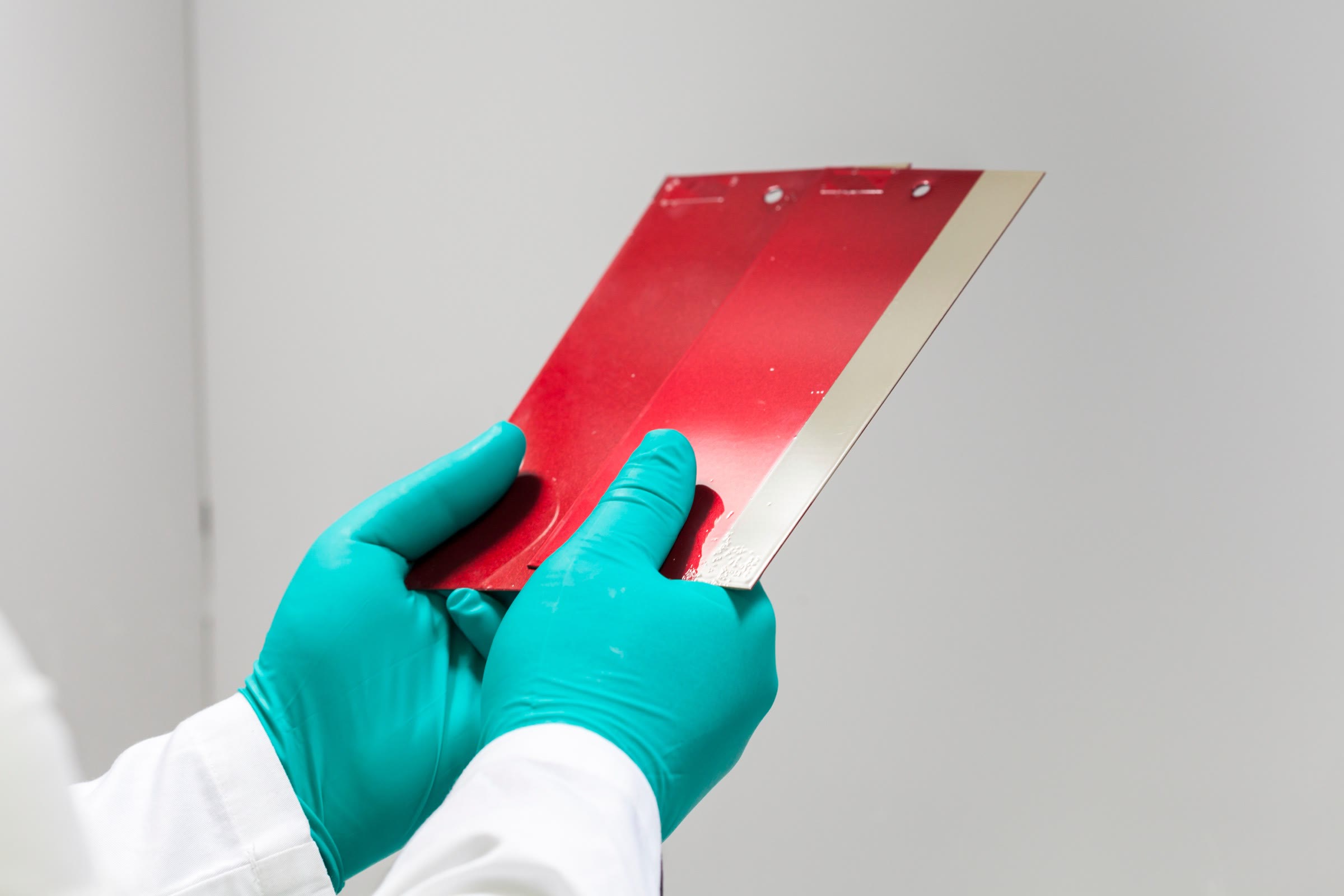
Replacing a discontinued pigment dispersion starts with a physical sample. Send a part in the color you run today, or what is left in the pail, and the shade is read on a spectrophotometer and matched against it. No formula changes hands, and we do not ask for one.
Why the grade name turns up nothing
Liquid colorant lines have consolidated, and the grade-level pages went first. The domain plasticolors.com resolves to a domain-sale page. Deep links into chromaflo.com redirect to a corporate homepage.
The material may still exist inside a larger catalog. What has gone is the page that told you what it was, so the color is now defined by a part in your stockroom and a line on an old purchase order. That is enough to work from.
Have a grade name and nowhere to look it up?
Send it with a part or a sample. We will tell you what we hold on the grade, and match the shade against the material you send.
Request a SampleA formula does not transfer
Two suppliers selling the same shade name are rarely selling the same pigments. Pigment selection, loading, particle size and carrier all vary, and a formula written against one palette lists bases another bench does not hold.
Reverse matching goes the other way. The physical standard is the specification, and the result is measured. That works whether the old supplier is gone, still selling, or on a lead time you cannot live with.
What to send
- A color standard. A molded or cast part, a piece cut from one, or liquid colorant from the old pail. Set some aside before the last drum runs out. More than half the standards we match are physical objects. If nothing is left, a PANTONE, RAL, Sherwin-Williams or Federal Standard 595 code works, and so does a photograph.
- The system it goes into: cast polyurethane, plastisol, polyurethane foam, spray polyurethane, epoxy. Send the material itself when you can, and we match into it instead of a stand-in.
- The process conditions the color has to survive. Fusion temperature and dwell for a plastisol, exotherm and demold time for a cast part, cure schedule for an epoxy. Pigments have real temperature limits.
- The tolerance you hold, and how it gets judged. If your customer inspects against a chip under a specific illuminant, say so.
How the match is confirmed
The target is read on a sphere spectrophotometer, a starter formula is built from stock bases, and a trial is blended and drawn down beside the standard, then measured and corrected until it is inside tolerance. Hermon worksheets carry as many as 36 trials on a hard match.
The specification is ΔE 1.0 or better in CIELAB, D65 illuminant and 10 degree observer. We have never issued a certificate that missed it.
Part thickness, gloss, opacity and the substrate all move the measurement, so the match is confirmed in your own material.
Second-sourcing a color you already buy?
Same process, no discontinuation required. Send the material you run today and we match to it, so a shade can move suppliers without being re-specified.
Custom color matchingThe carrier gets chosen again
A replacement is the point to pick the carrier for the system instead of inheriting whatever the old grade used. The consequences in the part are set out in choosing the carrier for a polyurethane pigment dispersion.
A polyether polyol carrier carries hydroxyl and enters the isocyanate index above roughly 1.0 pph. A plasticizer carrier is non-reactive and stays out of the index, and it is native to a plastisol compound. Spray polyurethane runs on a low-viscosity diluent carrier, because the equipment sets the viscosity limit.
Our color runs on a phthalate-free terephthalate plasticizer: the para isomer of the phthalate ring, with the two carboxyl groups opposite each other instead of adjacent. That geometry is what the restricted-substance lists are drawn around.
What comes back with the batch
Every batch is measured against the approved standard and ships with a certificate of analysis carrying the ΔE, the method, and a Brookfield viscosity taken on an RVF viscometer, spindle 4, 20 rpm, 20 degrees C. Matching, QC and certificate issue all happen at the same bench in the same building as the mixing, in Hermon, Maine.
Most matches come back inside a week, effectively all inside two. Custom matching is free, samples ship at 0.5 kg, and there is no minimum order. Colors ship in 5 kg, 12.5 kg and 20 kg pails, and in drums and totes.
Cross-references
Send a legacy grade name and we will tell you what we hold on it. Cross-references are available on request and are not published as a chart, because a grade name alone does not define a shade closely enough to promise a match against it.
Frequently asked
Can you match a liquid colorant that has been discontinued?
Yes. Reverse matching from a physical sample is routine work here. Send a part in the color you run today, or what is left in the pail, and tell us the system it goes into.
Do you need the old supplier's formula?
No, and we do not ask for it. The match is made against the physical standard. A formula from another supplier lists their bases and their carrier, and neither transfers to a different palette.
What if I have nothing left of the old colorant?
Send a finished part, a piece cut from one, or a PANTONE, RAL or Federal Standard 595 code. All of those are matched in production. About one standard in twenty arrives as a photograph or a color pulled off a web page, and those are matched too.
Will the replacement drop into my process unchanged?
The color is matched to your standard, and the carrier and addition rate are picked for your system. Confirm both on a trial before you commit a production run. Tell us the addition method and the equipment and the dispersion is formulated to meter at your conditions.
How long does a replacement match take?
Most matches come back inside a week, effectively all inside two. Custom matching is free, samples ship at 0.5 kg, and there is no minimum order.
Do you have a cross-reference for legacy grade names?
Cross-references are available on request. Send the grade name and we will tell you what we hold on it. We do not publish a name-to-name chart, because a grade name alone does not define a shade closely enough to promise a match. The sample does.
Send the part
Put a part, a piece of one, or the last of the old colorant in a box with the system it runs in and the tolerance you hold. We match into your material, confirm it on a drawdown, and ship a free sample.
See liquid color and pigment dispersions