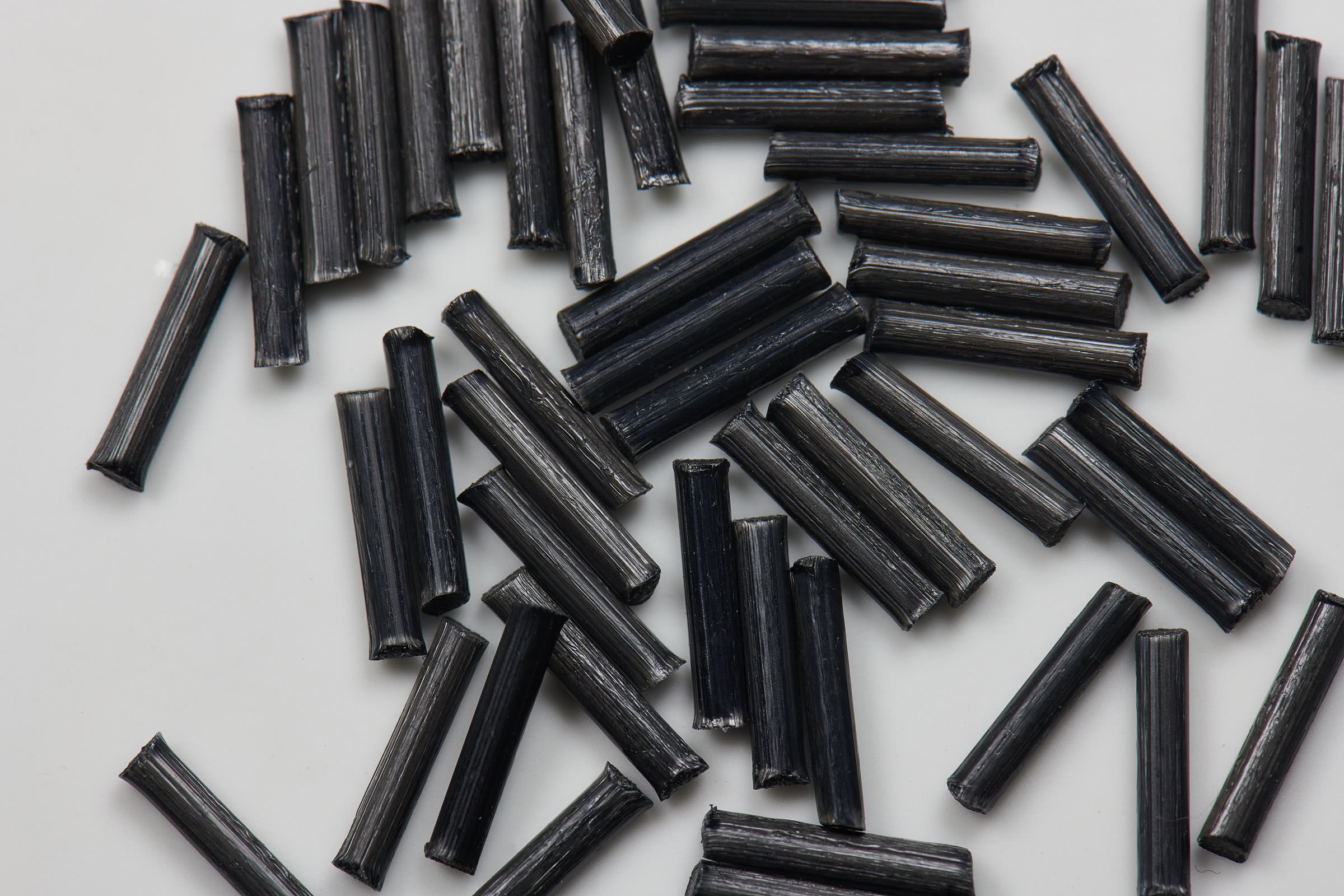
FILCO epoxy film formers for thermoplastics
High molecular weight epoxy dispersions for glass in PET, PBT and polycarbonate. Tough film, improved fiber integrity, and a zero VOC grade.
High molecular weight epoxy dispersions for glass in PET, PBT and polycarbonate. Tough film, improved fiber integrity, and a zero VOC grade.
Glass going into a thermoplastic compound faces a mechanical problem rather than a chemical one. The strand meets a twin screw extruder, and the screw is trying to break it. Fiber length in the finished pellet is what carries the mechanical properties, so the sizing exists to keep the bundle together long enough to survive compounding.
COIM builds this family from high molecular weight epoxy dispersions and names two properties: high shear stability and a tough film that improves fiber integrity. High molecular weight is the reason. Where the direct roving epoxies run 200 g/eq for the fastest possible release, these run up to 1800 g/eq for a film that holds.
Five grades are published, sorted by matrix. FILCO 313, 394 and 8002 are for PET and PBT. FILCO 7875 is the polycarbonate grade at 580 g/eq and a 72 degree F Tg. FILCO 8002 is the one COIM singles out for improved fiber integrity, at the finest particle size in the family at 300 nm.
FILCO 74012 is published as no VOC, at the same 1800 g/eq and 86 degree F Tg as FILCO 394. Where a compounding plant is working to a VOC limit, that is the grade to name.
It is also written as thermoplastic sizing, glass fiber sizing for PET, PBT sizing film former, and polycarbonate sizing.
| Property | Typical value |
|---|---|
| Chemistry | High molecular weight epoxy dispersions |
| Carrier | Water based |
| Epoxy equivalent weight | 580 to 1800 g/eq depending on grade |
| Solids content | 55 to 59 percent depending on grade |
| Average particle size | 300 to 650 nm depending on grade |
| Tg range | 59 to 86 degrees F |
| Film character | Tough, with high shear stability and improved fiber integrity |
| Published grades | 5 |
| Matrix | Thermoplastic |
Typical values from the manufacturer's technical data sheet. They describe the product, they are not a specification. We will send the current TDS and the batch documentation your qualification needs.
Tell us the binder system, the property you are targeting, and the volume you expect. We will confirm the grade, send the documentation, and get a sample of the candidate grade to you.
| Grade | Solids | Av. particle size | Tg | EEW | Main features |
|---|---|---|---|---|---|
| FILCO 313 | 59 percent | 650 nm | 86 degrees F | 660 g/eq | For PET and PBT |
| FILCO 394 | 55 percent | 600 nm | 86 degrees F | 1800 g/eq | For PET and PBT |
| FILCO 74012 | 55 percent | 500 nm | 86 degrees F | 1800 g/eq | No VOC |
| FILCO 7875 | 55 percent | 400 nm | 72 degrees F | 580 g/eq | For polycarbonate |
| FILCO 8002 | 55 percent | 300 nm | 59 degrees F | 900 g/eq | For PET and PBT, improved fiber integrity |
Values are the manufacturer's published typical figures. Ask for the current technical data sheet on any grade and we will send it with the matching safety data sheet.
Electrical connectors, housings and under-hood parts, where retained fiber length carries the strength.
FILCO 7875, the grade COIM publishes for PC.
FILCO 8002, published for improved fiber integrity at the finest particle size in the family.
FILCO 74012, published as no VOC at the same EEW and Tg as FILCO 394.
It is specified where the formulation needs high shear stability, so the bundle survives the twin screw, tough film that improves retained fiber length in the pellet, a matched polycarbonate grade in FILCO 7875, and a no VOC option in FILCO 74012.
Applied at the forming line in a sizing bath. For thermoplastic work the sizing has to be matched to the polymer, because the coupling chemistry that works in PET is not what polycarbonate wants.
Judge these on retained fiber length in the finished pellet, not on how the strand looks before compounding. That is the number the mechanical properties follow.
Tell us the polymer, the glass loading and the compounding line. Grade selection across five grades and three polymers is a technical conversation and we run it with COIM.
Package sizes: Made to order in the pack size the line needs. Tell us the volume and we will confirm..
Storage: Store in the original sealed container, protected from frost and from direct sun. Freezing destroys a water based dispersion permanently. Confirm the shelf life on the current data sheet for your grade.
Read the safety data sheet before handling. We supply the current SDS with every grade.
Because the job is holding the bundle together through a twin screw extruder. Long chains give a tough film with high shear stability. The direct roving epoxies do the opposite, running 200 g/eq so the film releases as fast as possible into a thermoset bath.
FILCO 7875, at 580 g/eq, 55 percent solids and a 72 degree F Tg. It is the only grade COIM publishes for PC in this family, and PET or PBT grades are not a substitute for it.
FILCO 8002 is the grade COIM publishes for improved fiber integrity. It carries the finest average particle size in the family at 300 nm. Tell us the screw configuration and glass loading and we will take it to COIM's technical group with the trial.
FILCO 74012 is published as no VOC. It matches FILCO 394 on EEW at 1800 g/eq and on Tg at 86 degrees F, so it is a like-for-like swap on those two properties.
Yes. Tell us the polymer, the glass loading and the compounding line and we will send the current technical data sheet with the matching safety data sheet, and arrange sample material.
Yes. We send the Technical Data Sheet (TDS) and Safety Data Sheet (SDS) on request, in the manufacturer's current revision. Use Request TDS or SDS above and tell us what your qualification review needs.
The high temperature epoxies, where service temperature is the specification.
The other thermoplastic route, including the PA6 and PBT grades.
Where temperature and hydrolysis resistance both have to increase.
What a film former does in a sizing, and how the chemistries divide.
The selection logic, worked through on the carbon side.