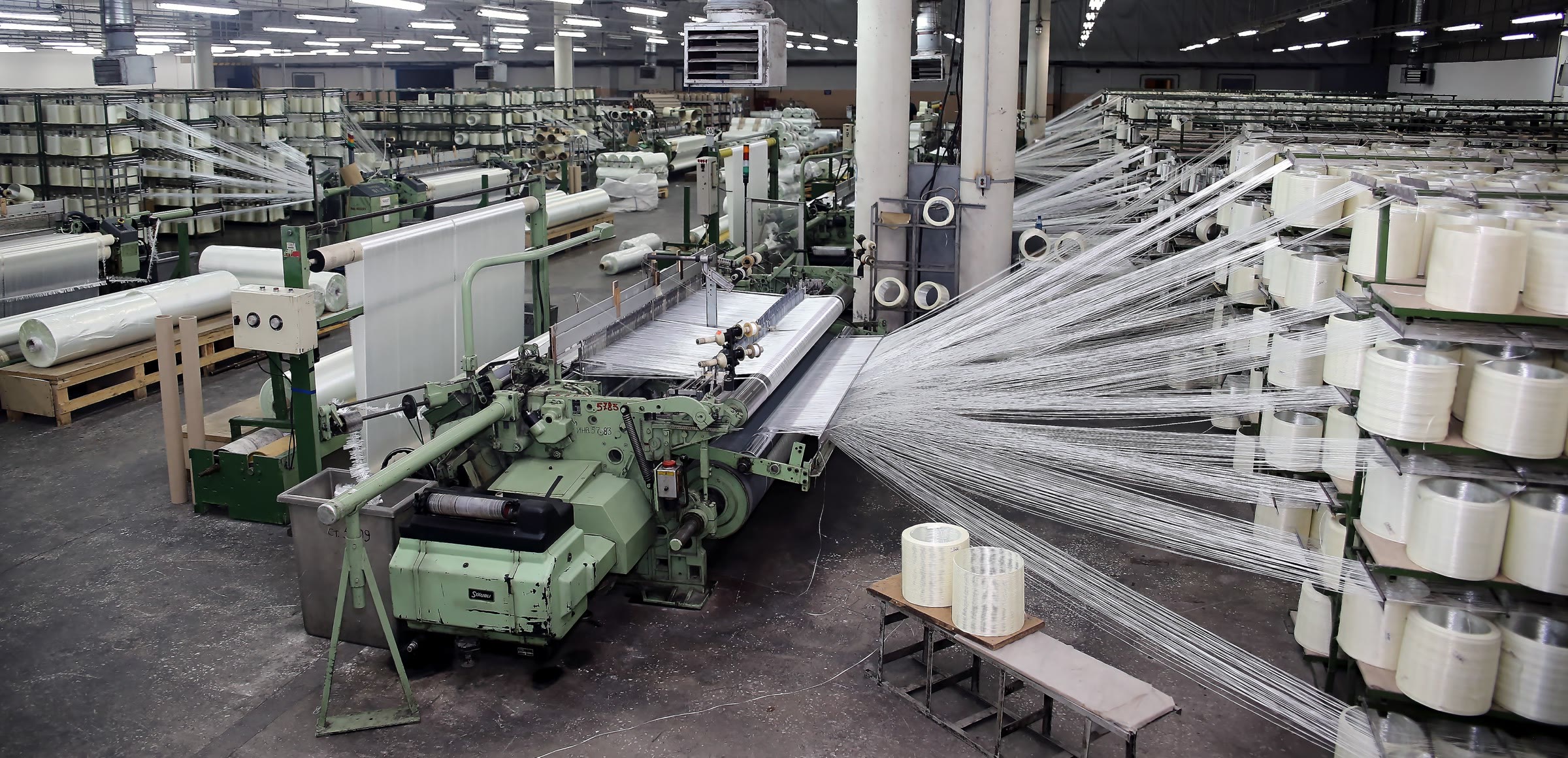
FILCO film formers for woven roving
Two grades for roving that goes to the loom. Good flexibility so the strand takes the weave without breaking, and quick styrene solubility once the fabric is wet out.
Two grades for roving that goes to the loom. Good flexibility so the strand takes the weave without breaking, and quick styrene solubility once the fabric is wet out.
Roving destined for the loom has a different problem from roving that gets chopped. It has to bend, repeatedly and sharply, over the heald and through the reed, without the strand splitting or the filaments breaking. Flexibility is the specification.
COIM publishes two properties for this family: good flexibility and quick styrene solubility.
Two grades are published. FILCO 352 is the bisphenolic polyester at 40 percent solids in partially anionic dispersion, and it is shared with the panel roving family. FILCO 355 is the epoxy ester at 43 percent solids in non-ionic dispersion, with an EEW of 3000, which is the highest in the whole FILCO range.
A 3000 g/eq epoxy ester is a long chain, which is what makes the FILCO 355 film flexible.
It is also written as woven roving sizing, weaving sizing, and glass fiber sizing film former.
| Property | Typical value |
|---|---|
| Chemistry | Unsaturated polyester in partially anionic dispersion, and epoxy ester in non-ionic dispersion |
| Carrier | Water based |
| Solids content | 40 to 43 percent |
| Average particle size | 300 to 600 nm |
| Tg range | 48 to 55 degrees F |
| Film character | Good flexibility, with quick styrene solubility |
| Published grades | 2 |
| Matrix | Thermoset |
Typical values from the manufacturer's technical data sheet. They describe the product, they are not a specification. We will send the current TDS and the batch documentation your qualification needs.
Tell us the binder system, the property you are targeting, and the volume you expect. We will confirm the grade, send the documentation, and get a sample of the candidate grade to you.
| Grade | Solids | Av. particle size | Tg | Main features |
|---|---|---|---|---|
| FILCO 352 | 40 percent | 300 nm | 48 degrees F | Bisphenolic polyester |
| FILCO 355 | 43 percent | 600 nm | 55 degrees F | Epoxy ester, EEW 3000 g/eq |
Values are the manufacturer's published typical figures. Ask for the current technical data sheet on any grade and we will send it with the matching safety data sheet.
Heavy glass fabric for marine, tank and industrial laminates, where the roving is woven before it meets resin.
Where strand flexibility through the heald and reed decides how much breakage the loom produces.
Woven roving laid into a polyester matrix, where quick styrene solubility gives the wet-out.
It is specified where the formulation needs flexibility through the loom, which is what keeps strand breakage down, quick styrene solubility once the fabric meets resin, a very long chain epoxy ester option in FILCO 355 at 3000 g/eq, and FILCO 352 shared with the panel roving family, which simplifies a plant running both.
Applied at the forming line in a sizing bath. On weaving work the sizing has to be judged on the loom, because breakage rate is the number that matters and it does not show up in a bench test.
FILCO 352 runs in partially anionic dispersion and FILCO 355 in non-ionic. That difference matters to bath compatibility if you are blending with other components, so name the full size formulation when you ask.
This is the smallest published family in the range. If neither grade fits, the question goes to COIM's technical group, not to a substitute from another family.
Package sizes: Made to order in the pack size the line needs. Tell us the volume and we will confirm..
Storage: Store in the original sealed container, protected from frost and from direct sun. Freezing destroys a water based dispersion permanently. Confirm the shelf life on the current data sheet for your grade.
Read the safety data sheet before handling. We supply the current SDS with every grade.
The strand bends sharply and repeatedly through the heald and the reed. A stiff film splits the strand and breaks filaments, and the breakage rate on the loom is what decides whether the sizing works. Flexibility is the first property COIM lists for this family.
EEW tracks chain length. A 3000 g/eq epoxy ester is a long chain, and long chains give a flexible film. The 200 g/eq direct roving grades are short chains, which give a soft film that dissolves fast.
Yes, the same grade published for two applications. On panel roving COIM notes it is to be used with plasticizer; here it is published on its own for weaving. Tell us the application and we will confirm the full specification.
Then the question goes to COIM's technical group. Tell us the loom, the fabric weight and the matrix.
Yes. Tell us the process, the matrix resin and the fiber and we will send the current technical data sheet with the matching safety data sheet, and arrange sample material.
Yes. We send the Technical Data Sheet (TDS) and Safety Data Sheet (SDS) on request, in the manufacturer's current revision. Use Request TDS or SDS above and tell us what your qualification review needs.
Shares FILCO 352, with translucency as the target.
The other quick styrene solubility family, for chopped roving.
Where abrasion over guides is the constraint instead of bending.
What a film former does in a sizing, and how the chemistries divide.
The selection logic, worked through on the carbon side.