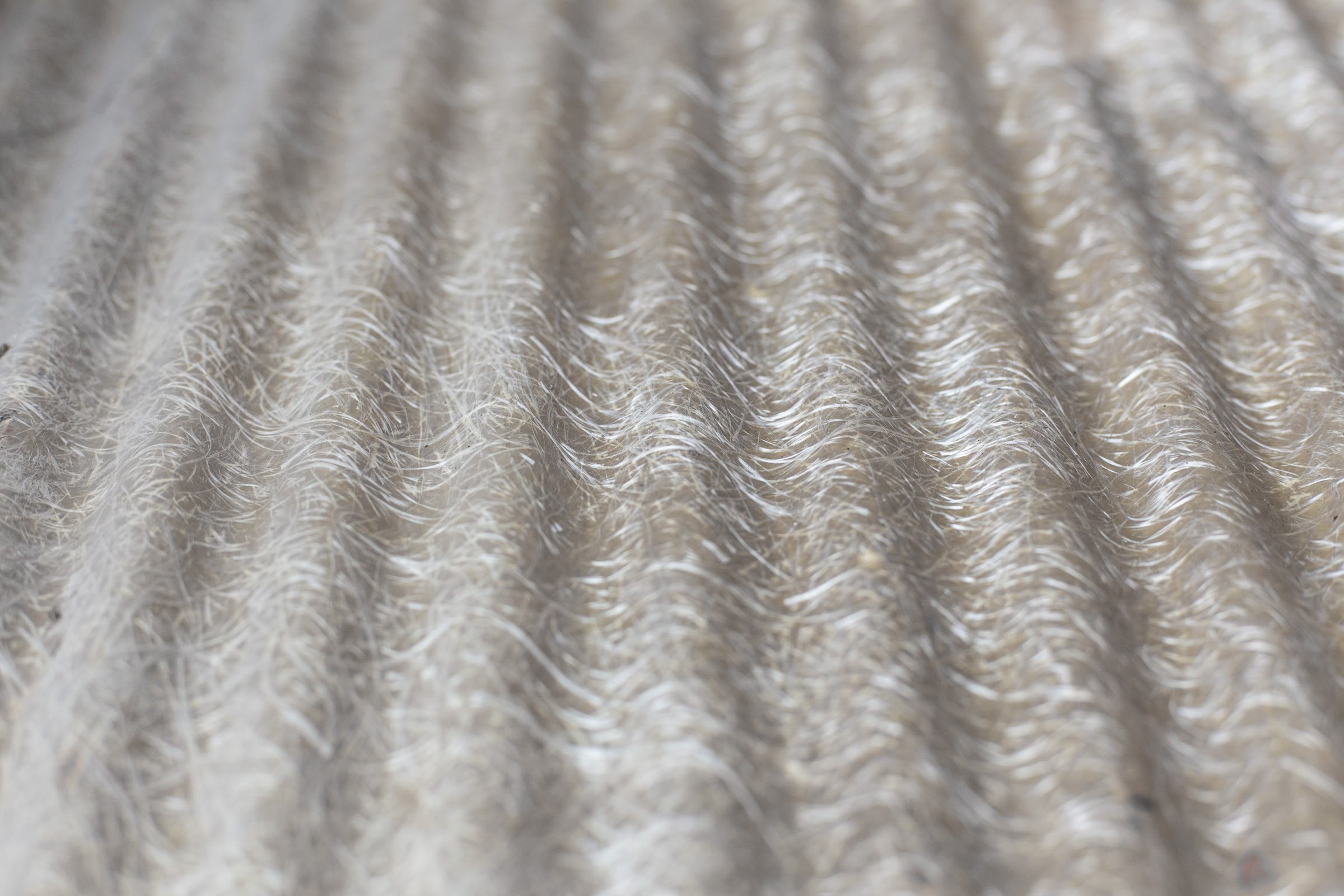
FILCO film formers for panel roving
Soft films, quick styrene solubility and high translucency, for corrugated and flat composite panel. Eight grades including two plasticizers and a very high refractive index option.
Soft films, quick styrene solubility and high translucency, for corrugated and flat composite panel. Eight grades including two plasticizers and a very high refractive index option.
Translucent composite panel is the one glass fiber application where the customer looks through the part. Every interface between fiber and resin scatters light, so if the refractive index of the cured film does not sit close to the resin and the glass, the panel goes cloudy and the fiber pattern shows.
COIM specifies soft films, quick styrene solubility, quick impregnation and high translucency, and it is the only FILCO family where an optical property is named as a design target.
Eight grades are published, across three roles. FILCO 339, 362, 7900 and 8001 are the epoxy ester resins. FILCO 362 is the one COIM singles out for a film with very high refractive index. FILCO 7900 is published as the higher Tg version of 339, at the same 46 percent solids and the same 2000 g/eq.
FILCO 354N and 352 are the bisphenolic polyesters, and COIM's note on both is that they are to be used with plasticizer. FILCO 368 and 470 are those plasticizers, saturated polyesters at 60 and 80 percent solids. 470 is self-emulsifying. Ordering a bisphenolic polyester here without the plasticizer is an incomplete specification.
It is also written as panel roving sizing, translucent panel film former, epoxy ester dispersion, and glass fiber sizing film former.
| Property | Typical value |
|---|---|
| Chemistry | Epoxy ester resins and bisphenolic polyesters, plus two saturated polyester plasticizers |
| Carrier | Water based, non ionic |
| Solids content | 40 to 80 percent depending on grade |
| Average particle size | 300 to 1000 nm on the resins |
| EEW range | 530 to 2000 g/eq on the epoxy ester grades |
| Optical target | High translucency, with FILCO 362 giving a very high refractive index film |
| Published grades | 8, of which 2 are plasticizers rather than film formers |
| Matrix | Thermoset |
Typical values from the manufacturer's technical data sheet. They describe the product, they are not a specification. We will send the current TDS and the batch documentation your qualification needs.
Tell us the binder system, the property you are targeting, and the volume you expect. We will confirm the grade, send the documentation, and get a sample of the candidate grade to you.
| Grade | Solids | Av. particle size | Tg | EEW | Main features |
|---|---|---|---|---|---|
| FILCO 339 | 46 percent | 1000 nm | 43 degrees F | 2000 g/eq | Epoxy ester resin |
| FILCO 362 | 40 percent | 350 nm | 50 degrees F | 530 g/eq | Epoxy ester resin, film with very high refractive index |
| FILCO 7900 | 46 percent | 500 nm | 50 degrees F | 2000 g/eq | Higher Tg version of FILCO 339 |
| FILCO 8001 | 40 percent | 400 nm | 50 degrees F | 600 g/eq | Easy impregnation |
| FILCO 354N | 47 percent | 400 nm | 55 degrees F | Not applicable | Bisphenolic polyester, to be used with plasticizer |
| FILCO 352 | 40 percent | 300 nm | 48 degrees F | Not applicable | Bisphenolic polyester, to be used with plasticizer |
| FILCO 368 | 60 percent | 400 nm | Minus 40 degrees F | Not applicable | Plasticizer, saturated polyester |
| FILCO 470 | 80 percent | Not applicable | Minus 11 degrees F | Not applicable | Plasticizer, bisphenolic saturated polyester, self-emulsifying |
Values are the manufacturer's published typical figures. Ask for the current technical data sheet on any grade and we will send it with the matching safety data sheet.
Roofing and daylighting sheet, where the panel is judged on clarity as much as on strength.
Truck and trailer sidewall, RV panel and similar sheet, where surface uniformity carries the appearance.
FILCO 362, the grade COIM publishes for a very high refractive index film.
FILCO 7900, published as the higher Tg version of FILCO 339.
It is specified where the formulation needs high translucency named as a design target, a very high refractive index film in FILCO 362, quick impregnation and quick styrene solubility, and two matched plasticizers in the same family, one of them self-emulsifying.
Applied at the forming line in a sizing bath. On panel work the optical result is set by the whole system, so the resin, the glass and the film former have to be matched together rather than swapped one at a time.
FILCO 354N and 352 are published for use with a plasticizer. FILCO 368 and 470 are the plasticizers in this family. Specify the pair, and tell us the ratio you are running or ask us to take the question to COIM.
FILCO 470 is self-emulsifying at 80 percent solids, which changes how it is added to the bath compared with 368.
Package sizes: Made to order in the pack size the line needs. Tell us the volume and we will confirm..
Storage: Store in the original sealed container, protected from frost and from direct sun. Freezing destroys a water based dispersion permanently. Confirm the shelf life on the current data sheet for your grade.
Read the safety data sheet before handling. We supply the current SDS with every grade.
Because the customer looks through the part. Light scatters at every fiber-to-resin interface, and the size film sits right at that interface. If its refractive index is far from the resin and the glass, the panel clouds and the fiber pattern shows through. FILCO 362 is the grade COIM publishes for a very high refractive index film.
COIM publishes both as bisphenolic polyesters to be used with plasticizer, and names FILCO 368 and 470 in the same table. Specifying either without the plasticizer is an incomplete specification. Tell us which one you are running and we will confirm the pairing.
7900 is the higher Tg version, 50 degrees F against 43. Solids are the same at 46 percent and EEW is the same at 2000 g/eq. The particle size differs, 500 nm against 1000 nm.
FILCO 8001 is the grade COIM names for easy impregnation, at 40 percent solids, 400 nm and 600 g/eq. If wet-out is the constraint on your line, start there.
Yes. Tell us the process, the matrix resin and the fiber and we will send the current technical data sheet with the matching safety data sheet, and arrange sample material.
Yes. We send the Technical Data Sheet (TDS) and Safety Data Sheet (SDS) on request, in the manufacturer's current revision. Use Request TDS or SDS above and tell us what your qualification review needs.
Shares FILCO 352, with flexibility as the target instead of translucency.
Shares FILCO 354N, published there for the spray-up application.
Where surface appearance is the target and styrene solubility is slow.
What a film former does in a sizing, and how the chemistries divide.
The selection logic, worked through on the carbon side.