The short answer
An antistatic additive lowers the electrical resistance of a coating, a plastic or a polyurethane part so that static charge drains instead of building up. The additives on this page are quaternary ammonium compounds (quats), cationic surfactants that reach the antistatic band of 105 to 109 ohms, which is 100 kilohm to 1 gigaohm, at 0.2 to 5 percent addition. They do not reach true conductivity below 105 ohms on their own; that takes a conductive filler such as carbon black, carbon nanotubes or metal pigment, and the two are combined in practice.
The Deuteron LE grades are migrating antistats: the same quat active supplied carrier-free (LE 100 LV), cut in butanol for electrostatic spray paints (LE 50), absorbed onto silica as a powder for extrusion and powder coatings (LE 15P), or carried in 1,4-butanediol for polyurethane systems (LE 829). PATstat 313 is P.A.T. Products' own antistatic plasticizer: a cationic antistat carried in a plasticizer, metered into a PVC compound or plastisol, built for resilient and vinyl flooring. Pick by the system first and the form second.
SD means static dissipative, ESD means electrostatic discharge, TDI is toluene diisocyanate, MOCA is the aromatic diamine curative used in hot-cast polyurethane, and BDO is 1,4-butanediol.
How a quaternary ammonium antistat works
A quat is an ammonium salt in which all four hydrogens on the nitrogen are replaced by alkyl groups, so it carries a permanent positive charge. The Deuteron LE family is based on tetraalkylammonium ethyl sulphate (TAAES), a linear quat with a C8 to C18 chain and mainly C12, and on tetraalkylester ammonium methyl sulphate (TAeAMS), a branched, 100 percent biodegradable ester quat with about 70 percent plant-based content.
The effect depends on migration. The molecule is surface active, so a share of it moves to the surface of the film or the part and orients there, hydrophobic tail in the matrix and hydrophilic head at the air interface. The head attracts a very thin water layer from the air, and the ionic additive plus the adsorbed water form the electrolyte that carries the charge. Humidity is therefore a working condition, and a quat-treated surface reads higher resistance in dry air than at 50 percent relative humidity.
Because the additive migrates, Deuteron classes its quats as non-permanent. In service the effect typically lasts for years, and in some systems decades, because the volume of the coating or the part acts as a reservoir that keeps feeding the surface. How long it lasts in a given system has to be checked in that system.
Quats are cationic, so they are compatible with non-ionic and cationic systems. Compatibility with anionic systems is limited, and a simple mixing test shows it: an incompatibility appears as a kick-out. They dissolve or emulsify in water and polar solvents, form stable translucent emulsions in low-polarity systems, and separate over time in mineral oils and greases, where the chemistry is not recommended. Against the other antistatic technologies, quats need a low dosage, process easily, keep clear systems clear and leave light colors alone, and cost the least per treatment. Carbon black, carbon nanotubes and metal powders are permanent and reach true conductivity, and they cost more, dose higher, and take the color and the transparency with them. The quats also wet carbon black and carbon fiber well, so a combination of the two technologies gives a synergistic effect where a resistivity well below 106 ohms is needed or the air is dry.
Grades by system and form
| Grade | Active and carrier | Form | Built for | Dose | Supply |
|---|
| Deuteron LE 100 LV | 100 percent TAAES quat, carrier free | Liquid, approx. 3,500 mPa.s, 25 kg and 200 kg drums, 900 kg IBC | Coatings, PU systems, PVC, UV and EB systems, floor coatings; post-addition to correct a batch; carbon black wetting | 0.2 to 5 percent | US stock |
| Deuteron LE 829 | 85 percent TAAES quat in 1,4-butanediol; hydroxyl value approx. 180 | Liquid, approx. 400 mPa.s, 25 kg hobbock, 200 kg barrel | Polyurethane compounds, polyester and polyether: foams, ESD shoe soles, PU castings | 2.5 percent in Deuteron's worked example | US stock, small |
| Deuteron LE 50 | 50 percent TAAES quat in 1-butanol; approx. 11.5 percent OH | Liquid, approx. 20 mPa.s, 25 kg and 185 kg drums | Electrostatic spray paints, air-dry and forced-dry primers and topcoats | 0.3 to 4 percent | To order |
| Deuteron LE 15P | 50 percent quat absorbed onto silica | Free-flowing powder, d50 approx. 18 microns, 15 kg fiber drum | Powder coatings, plastics and plastisol, extrusion, 100 percent systems | 1 to 5 percent | To order |
| PATstat 313 | 43 percent cationic antistat in a plasticizer carrier | Clear liquid, approx. 300 mPa.s, 25 kg and 200 kg drums, 1,000 kg totes | Resilient and vinyl flooring: LVT, VCT, sheet, SD tile, in PVC compound or plastisol | Set to the resistance target | Made by P.A.T. Products, supplied across North America |
Deuteron also makes grades we supply to order: LE 80 (80 percent in butanol, for electrostatic spray where a higher concentration suits the process), LE 50 UV (50 percent in DPGDA for 100 percent UV-curable formulations), LE 151 (85 percent in 1,2-ethanediol, for polyurethane applications where a larger increase in hardness is wanted), and the LE 200 and LE 292 ester quats. Tell us the system and we will say which applies.
Have a resistivity target and a system?
Send us the resin or polymer, the solvent or plasticizer package, the humidity the part will live in and the number it has to reach. We will name the grade and the starting dose and ship a sample.
Request a Sample
Cast polyurethane, rollers and the TDI/MOCA question
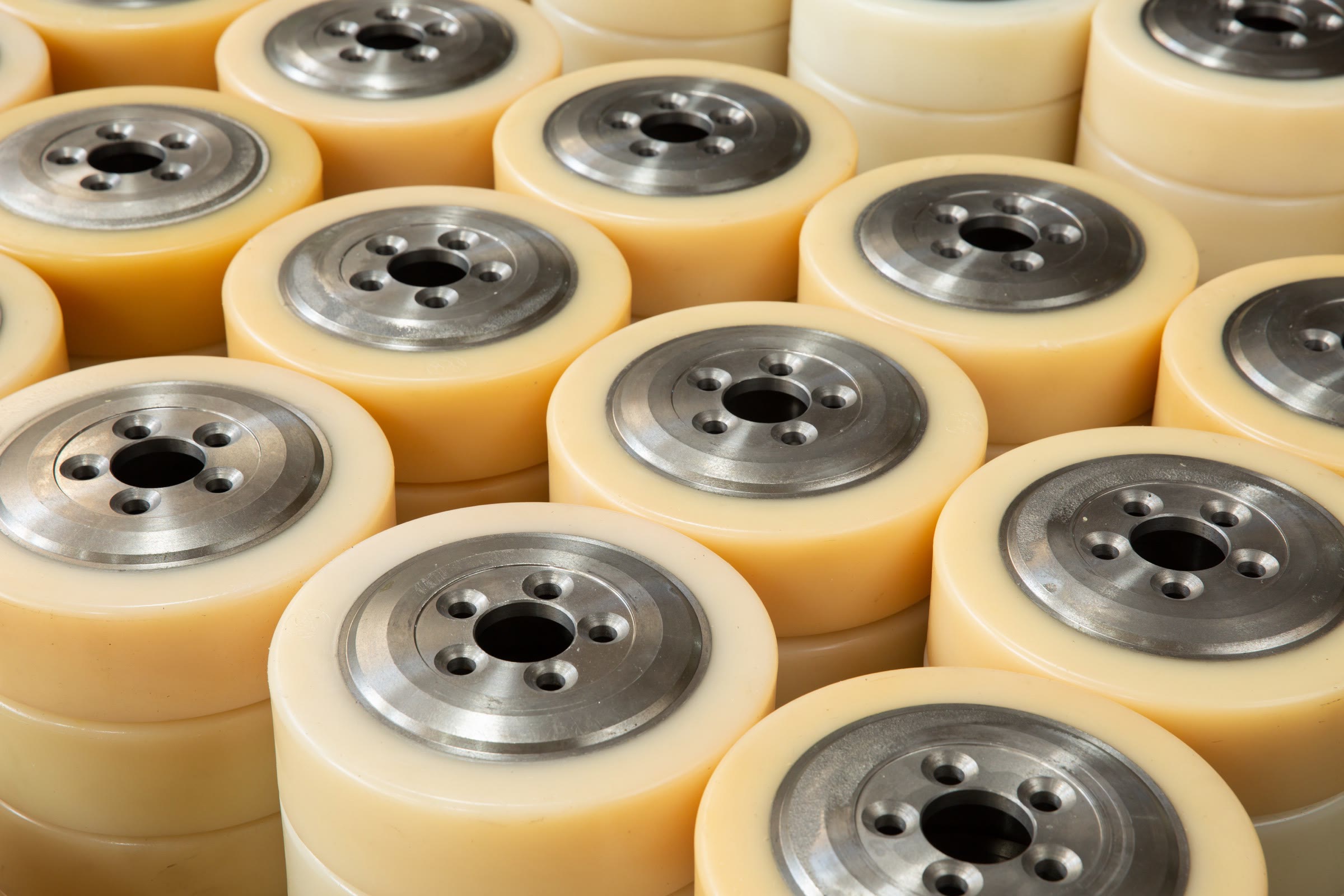
Cast polyurethane rollers, wheels and sleeves for printing, film, paper and web converting build charge as they run, and the charge collects dust and marks the web. The additive route into a cast part is a quat dosed into the polyol or prepolymer side before the pour. Two Deuteron grades fit; they differ in what they bring into the cross-link.
Deuteron LE 829 is 85 percent quat in 1,4-butanediol. In a TDI prepolymer system BDO is a chain extender already, so the carrier is a component the formulation knows, and the additive has a hydroxyl value of approximately 180 that Deuteron says has to be counted to keep the cross-linking right. Deuteron's conductivity agents leaflet lists polyurethane foams and castings among the applications for the LE family and describes LE 829 as suited to polyurethane applications with a moderate increase in overall hardness, against LE 151 in ethanediol where a larger hardness increase is wanted. The LE 829 technical data sheet itself is written for polyurethane foam and antistatic shoe soles, and its worked dose of 2.5 percent giving under 50 megohm is a foam figure. A cast elastomer dose has to be settled on the bench.
Deuteron LE 100 LV is the same quat with no carrier, for a cast system that will not accept an added hydroxyl. It can also be post-added.
The objection a formulator will hear is that a migrating salt in a polyester TDI/MOCA elastomer may move over time or be affected by hydrolysis. Migration is the mechanism, and Deuteron states it: the additive is non-permanent by design and the volume of the part is the reservoir that sustains the surface effect for years. Deuteron has published no hydrolysis data for cast elastomers, and P.A.T. has not run a validated comparison, so a roller shop qualifies the additive the way it qualifies any other change: resistivity on the cured part, again after conditioning at 12 percent relative humidity, and again after the aging the part sees in service. Tell us the prepolymer, the curative and the target, and we will put the system-specific question to Deuteron rather than answer it from a foam data sheet.
ESD footwear, electrostatic spray paints, powder coatings
Antistatic polyurethane soles have to meet the electrical resistance requirement of the footwear standard, EN 344 in the older documents and EN ISO 20345 now, with EN 61340-4-3 giving the antistatic footwear range of 105 to 108 ohms and EN 61340-5-1 the ESD range of 105 to 3.5 x 10⁷ ohms. LE 829 is the grade Deuteron writes that data sheet for: 2.5 percent on a polyester compound at 0.6 g/cm3 gives under 50 megohm.
Electrostatic spray paints need a set resistivity so the atomized paint takes a charge and follows the field to the part. LE 50 and LE 80 are the butanol-cut grades developed for that, thin enough to meter at 20 to 150 mPa.s, and LE 50 carries the lighter hazard label of the two.
Powder coatings, dry plastics compounds and extrusion cannot take a liquid additive, so LE 15P carries the quat on an 18 micron silica. The active is released under shear, which is why it goes in at the extruder or a high-shear stage rather than at the end of a gentle blend.
Where a floor is vinyl, the antistat goes into the compound as an antistatic plasticizer.
PATstat 313, the antistatic plasticizer for vinyl flooring
PATstat 313 is the antistatic additive P.A.T. Products makes for resilient and vinyl flooring. It is a cationic antistat carried in a plasticizer, a clear liquid at 43 percent active and about 300 mPa.s, free of volatile solvents, made to a fixed specification with a certificate of analysis on every lot. It is added in its delivery form at room temperature to the PVC compound, the dry blend or the plastisol, with no pre-heating, no dilution and no masterbatch step, and the dose is set on the line to the resistance target.
Because the carrier is a plasticizer, PATstat 313 blends into flexible PVC the way the rest of the plasticizer package does and stays through the wear layer, so the static control does not walk off with a finish or wait on the weather. It brings a PVC system into the 106 to 109 ohm band, which covers antistatic and static-dissipative flooring and sits at or under the 109 ohm ceiling in ANSI/ESD S20.20. It is an antistatic additive, not a conductivity agent: full conductive flooring at or below 106 ohms normally takes a conductive filler with it.
It goes into luxury vinyl tile and plank, vinyl composition tile, homogeneous and heterogeneous sheet, static-dissipative tile, vinyl-faced access-floor panels and matching wall base, for data centers, electronics assembly, cleanrooms, laboratories, healthcare and control rooms. It ships in 25 kg and 200 kg steel drums and 1,000 kg totes with a 12-month shelf life in the closed container. PATstat 313 is one finished grade; the line is open for a different plasticizer carrier or a different loading against your system. The flooring standards, the tests and the dosing are in antistatic plasticizers for PVC flooring, and the resistance bands are in static-dissipative vs conductive flooring.
Compounding static-control vinyl?
Tell us the floor, the polymer and process, the plasticizer you build on and the standard you design to. We will recommend a starting dose and ship a sample to trial in your compound.
Request a Sample
How to qualify an antistatic additive
Measure the right resistance. Surface resistance with a ring electrode, volume resistance through the specimen with a backplate, and point-to-point resistance across the surface are three different numbers, and the standards that define them are IEC 61340-2-3, IEC 61340-5-1, ESD STM 11.11 and ASTM D257. A flooring specification adds the person to the circuit through ANSI/ESD STM97.1 and STM97.2. Know which one the specification quotes before reading the meter.
Condition twice. Read the sample at 50 percent relative humidity and again at 12 percent, both at 23 degrees C. The dry reading is the honest one for a migrating antistat, because the water film it relies on thins as the air dries.
Allow time. The effect builds as the additive migrates and orients at the surface, so a reading taken an hour after cure understates what the part will do in a week.
Check compatibility before the batch. A quat is cationic; mix it with the resin or the emulsion at the bench and look for a kick-out, and pre-dilute in a compatible solvent if incorporation is slow. In an isocyanate system count the hydroxyl the carrier brings in (approximately 180 for LE 829, about 11.5 percent OH content for LE 50, none for LE 100 LV). Then check what the finished film or part has to keep: color, clarity, gloss, adhesion, recoat, hardness, and for a floor the wear layer. Run a dose ladder across the data sheet range and pick the lowest level that holds the number at 12 percent humidity.
Switching from another antistat
Match on four numbers, not on a name: active content, carrier and its hydroxyl contribution, form and viscosity, and the dose the old formulation ran. A grade that disappears from the market, or one that changes name inside a supplier's range, is replaced by the grade that matches those four in your system, then confirmed on a panel or a cast part. Deuteron LE 947 is an example inside the range: LE 829 is the grade Deuteron supplies in that position now. The method is written out in replacing a discontinued cationic antistat. Cross-references to other suppliers' antistatic additives are available on request.
Pack, stock and lead time
Deuteron LE 100 LV ships from our US warehouse in 25 kg and 200 kg drums and 900 kg IBCs. LE 829 ships from US stock in 25 kg hobbocks. LE 50, LE 15P and the other Deuteron grades are supplied to order from Deuteron in Germany. PATstat 313 is made by P.A.T. Products and supplied across the United States, Canada and Mexico in 25 kg and 200 kg drums and 1,000 kg totes. Samples of the stocked grades ship on request. P.A.T. Products has imported on its own account for 50 years and is C-TPAT validated.
Documentation
Every Deuteron grade has a Technical Data Sheet, a Safety Data Sheet and a Regulatory Information Sheet, plus the Conductivity Agents leaflet. PATstat 313 has a Technical Data Sheet and Safety Data Sheet, a certificate of analysis on each lot, and components that are REACH-registered and listed on TSCA, DSL, AICS, ECL, PICCS, TCSI, NZIoC and IECSC. Every product on this page is classified as dangerous under Regulation (EC) No. 1272/2008 and carries hazard labeling; read the safety data sheet for your region before handling. None is for food-contact use.
Identifiers and composition
| Deuteron LE active | Quaternary ammonium compounds, C12-14 (even-numbered) alkylethyldimethyl, ethylsulphates. CAS 68308-64-5, EC 939-607-9. Tetraalkylammonium ethyl sulphate (TAAES). Cationic. |
|---|
| LE 829 carrier | 1,4-butanediol, CAS 110-63-4, 15 percent |
|---|
| LE 50 carrier | 1-butanol, CAS 71-36-3, approx. 50 percent |
|---|
| LE 15P carrier | Silica, approx. 50 percent, d50 approx. 18 microns |
|---|
| PATstat 313 | Cationic antistat in a plasticizer carrier, 43 percent active. Composition on the safety data sheet. |
|---|
| Also called | Antistatic additive, anti-static agent, antistat, conductivity agent, conductivity promoter, static dissipative additive, ESD additive, quat antistat, cationic antistat, antistatic plasticizer |
|---|
| Producers | Deuteron GmbH, Achim, Germany, antistatic additives since 1980; P.A.T. Products, Inc., Maine, USA |
|---|
Frequently asked questions
Is a quaternary ammonium antistat permanent?
By mechanism, no: it works by migrating to the surface and attracting a water film, and Deuteron classes its quats as non-permanent. In service the effect typically lasts for years because the volume of the coating or part keeps feeding the surface. For a permanent effect independent of humidity, combine the quat with a conductive filler such as carbon black or carbon nanotubes; the quat wets the filler and the two together reach lower resistivity than either alone.
What resistivity can these additives reach?
The antistatic band, 105 to 109 ohms (100 kilohm to 1 gigaohm) under EN ISO 20345, with antistatic footwear at 105 to 108 ohms under EN 61340-4-3 and ESD work at 105 to 3.5 x 10⁷ ohms under EN 61340-5-1. A quat alone bottoms out at about 105 ohms. Where the reading lands inside the band depends on the resin, the pigments, the other additives and the humidity, so confirm it in your own formulation.
Can I use a quat antistat in a cast polyurethane roller cured with MOCA?
Deuteron lists polyurethane castings among the applications for the LE family and supplies LE 829 in 1,4-butanediol for polyurethane systems, with a hydroxyl value of approximately 180 that goes into the stoichiometry. The published dose is a foam figure, and neither Deuteron nor P.A.T. has published cast-elastomer data, so the dose and the long-term behavior are settled by trial on the cured part. LE 100 LV is the carrier-free alternative when no added hydroxyl is acceptable. Tell us the prepolymer and curative and we will put the question to Deuteron for your system.
Is Deuteron LE 829 a replacement for Catafor CA-100?
Formulators who ran Catafor CA-100 ask us this. Both are quaternary ammonium antistats for polyurethane, which is why the question comes up. P.A.T. has not run a validated comparison and Deuteron has not published one, so treat a swap as a trial: match active content, carrier and hydroxyl value, then confirm resistivity on the part. LE 829 is carried in 1,4-butanediol with a hydroxyl value of approximately 180, so it has to be counted in the cross-link. Cross-references are available on request.
What is the difference between an antistatic additive and an antistatic plasticizer?
An antistatic additive is dosed at 0.2 to 5 percent and works by migrating to the surface. An antistatic plasticizer, PATstat 313 here, carries the antistat in a plasticizer so it joins the plasticizer package of a flexible PVC compound and stays distributed through the wear layer. In a vinyl floor the antistatic plasticizer lasts the life of the floor; a surface treatment wears off with the finish.
Why does my floor pass at 50 percent humidity and fail in January?
Because a migrating antistat conducts through a water film it draws from the air, and the film thins as the air dries. The flooring test protocols condition at 12 percent and 50 percent relative humidity for that reason. Build the static control into the compound, read the dry-condition number, and add a conductive filler where the specification has to hold below 106 ohms in dry air.
Can I add the antistat after the batch is made?
Yes, for the liquid grades. LE 100 LV can go in at any point in production or as a post-addition to bring a batch that reads outside specification back onto target. LE 15P needs shear to release the active from its silica carrier, so it goes in at the extruder or a high-shear stage.
Which grades do you stock?
Deuteron LE 100 LV and LE 829 from US stock, in the packs above. LE 50, LE 15P and the other Deuteron grades to order. PATstat 313 is made by P.A.T. Products and supplied across North America. Samples of the stocked grades ship on request.