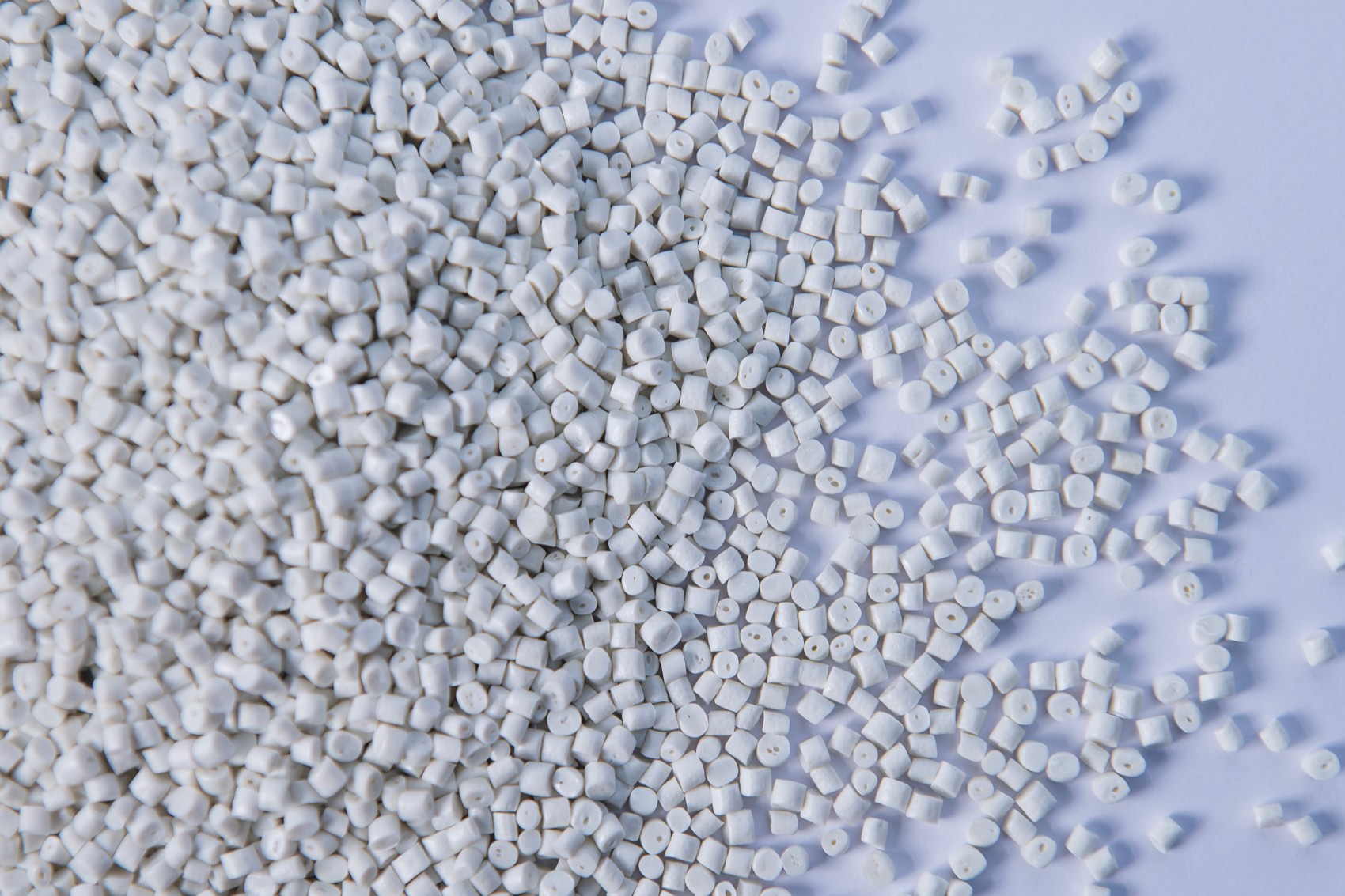
TPU and thermoplastic masterbatch
The solid-carrier format, for a process that melts. Pelletized concentrate that meters with the natural resin at the throat and disperses in the melt.
The solid-carrier format, for a process that melts. Pelletized concentrate that meters with the natural resin at the throat and disperses in the melt.
A process that melts its resin takes a solid colorant. Masterbatch is pigment concentrated on a carrier resin and pelletized, so it meters alongside the natural pellets at the throat and disperses in the melt as the screw does its work.
The carrier resin is the compatibility question, and it is the one worth settling first. A masterbatch carried on a resin that does not belong in your polymer shows up as poor dispersion, streaking, or a mechanical property you did not intend to change. Tell us the polymer and the grade family and the carrier follows.
The same shade is matched across both formats. A part run as a molded thermoplastic and a companion part cast in urethane can be held to the same standard.
| Property | Typical value |
|---|---|
| Form | Pelletized solid concentrate |
| Carrier | A resin selected for compatibility with the polymer being colored |
| Color tolerance | ΔE 1.0 or better, CIELAB against the approved standard, D65 illuminant, 10 degree observer |
| Let-down ratio | Set by pigment loading and the opacity wanted, confirmed at the sample stage |
| Processes | Injection molding, extrusion, blow molding and compounding |
| Match turnaround | About a week on a new match |
| Cross-format matching | The same shade held across masterbatch and liquid dispersion |
Dosage: Set by the concentrate loading and the opacity you need, and confirmed at the sample stage against your polymer and your process. A higher-loaded concentrate lets down further and costs less to run, but it asks more of the screw.
Typical values from the manufacturer's technical data sheet. They describe the product, they are not a specification. We will send the current TDS and the batch documentation your qualification needs.
Tell us the binder system, the property you are targeting, and the volume you expect. We will confirm the grade, send the documentation, and get a sample of the candidate grade to you.
Hose, tube, profile, film and sheet, where the color often identifies the grade.
Molded-in color on a part that never sees paint.
Color added at the compounding step alongside the other additives.
Soles, uppers and midsoles, including the coyote and black defense shades.
Color-coded by circuit, rating or customer convention.
A molded part and a cast part held to one shade across two very different processes.
It is specified where the formulation needs the right format for a process that melts its resin, carrier resin selected for the polymer rather than assumed, the same shade held across masterbatch and liquid dispersion, no liquid handling on a line that is not set up for it, ΔE 1.0 or better with the reading on the certificate, and free samples and no minimum to trial one.
Meter the concentrate with the natural pellets at the throat, or through a gravimetric feeder where the line has one. Dispersion is done by the screw, so screw design and residence time both matter to the result.
Settle the carrier resin before anything else. Compatibility with your polymer is what decides whether the color disperses or streaks, and it is not a detail that can be fixed later by turning the loading up.
Dry the concentrate on the same terms you dry the natural resin. A moisture-sensitive polymer does not stop being moisture sensitive because the pellet is colored.
Judge the shade on a molded or extruded part from your own tool at your own melt temperature. Thickness, gate and cooling all change how a thermoplastic reads.
Package sizes: Bags, boxes and larger packs. Tell us the volume and the pack and we will confirm.
Storage: Store dry in the original sealed container. Treat it with the same moisture discipline as the natural resin it will run with.
Compounded in the United States and supplied REACH, RoHS and California Proposition 65 compliant. Country of origin follows the carrier resin, which may be imported, so masterbatch is not a blanket Berry Amendment claim; our US-made liquid color is the Berry-compliant component. For a thermoplastic part under domestic-content rules, name the requirement and the resin and we will confirm what we can supply.
The process decides. A system that melts its resin, so extrusion, injection molding or compounding, takes a solid concentrate. A system that is liquid until it cures, so cast urethane, plastisol, foam or spray, takes a liquid dispersion. The comparison is worked through on the masterbatch page.
One chosen for compatibility with the polymer you are running. That is the question to settle first, because a carrier that does not belong in your polymer shows up as poor dispersion or streaking and cannot be fixed by raising the loading.
Yes. The standard is the same and the tolerance is the same; the formulation differs because the format does.
It depends on the concentrate loading and the opacity you need, and we set it at the sample stage against your polymer and your process. A higher-loaded concentrate lets down further and costs less per part but asks more of the screw.
Our US-made liquid color qualifies as a Berry Amendment compliant component. Masterbatch is compounded into a carrier resin that may be imported, so its country of origin follows that resin. If your part has to meet domestic-content rules, tell us the requirement and the resin and we will confirm what we can supply.
Yes. We send the Technical Data Sheet (TDS), Safety Data Sheet (SDS), Certificate of Analysis, Country of origin statement, Proposition 65 statement, and REACH and RoHS statement on request, in the current revision. Use Request TDS or SDS above and tell us what your qualification review needs.
The liquid format for the same shade on a cast part.
The liquid format for a dip-molded or rotocast part.
The two formats compared, and how to choose between them.
The selection question on its own.