The short answer
A matting agent is a particle that roughens the surface of a dry film so it scatters light instead of reflecting it. The same additive is called a flatting agent in North American wood and industrial coatings, a dematting or deglossing agent in translated specifications, and a gloss reducer in inks. The products on this page are organic polymethylurea, an aminoplast duromer that Deuteron has made since 1977, and P.A.T. Products has been the United States and Mexico representative for the range. PMU stands for polymethylurea, a urea-methanal thermoset; it is not a polyurethane, a polyurea or a polymer-modified urethane.
Pick the grade by dry film thickness. Deuteron MK at 6.3 microns is the starting point for the majority of coatings. MK-F at 4.6 microns and MK-F6 at 3.5 microns are for thinner films and a smoother, almost waxy feel. MK-F7 at 2.5 microns is for very thin films and inkjet. PMH C is the grade when viscosity is the constraint. The MM 100 and MM 110 dispersions at 0.6 microns are for UV overprint varnishes and inkjet inks, and MM 677 is a water-based, dust-free version of the powders for auto-dosing.
Against silica, polymethylurea takes a slightly higher dosage to reach the same gloss and gives back lower viscosity, a harder and more polish-resistant surface, and a softer feel. The addition-rate and viscosity trade, with the method for costing it per gloss unit, is in PMU vs silica matting agents.
How a matting agent takes gloss down
A smooth surface reflects light in one direction and reads as glossy. A rough one reflects it in every direction and reads as matte. Every matting agent works by building that roughness: as the wet film loses solvent or water and shrinks, the particles that were suspended in it stand up through the surface. The particle size sets the roughness, and the roughness sets the gloss. With one chemistry, the matting effect is proportional to the particle size: coarser particles, rougher surface, lower gloss.
Without volume shrinkage there is no roughness to develop, so in 100 percent UV, solvent-free polyurethane and epoxy, and powder coatings, a particle matting agent on its own is often not enough. In those systems ask us before trialing.
Gloss is read with a reflectometer at 20, 60 or 85 degrees. The 60 degree geometry is the industry standard and covers medium gloss from 10 to 70 units. Above 70 the 20 degree angle separates high gloss finishes, and below 10 the 85 degree angle is the one that still resolves a difference. A specification that only quotes 60 degrees describes a deep matte finish poorly, so a low-gloss project should read both 60 and 85.
Polymethylurea or silica
In Deuteron's own comparison in a solventborne nitrocellulose coating, fumed and surface-modified silica bring 60 degree gloss down faster per percent added than Deuteron MK, and silica costs less per kilogram. If the film is thick and pigmented, feel and polish resistance are not on the specification, and cost per gloss unit is the only criterion, silica is the right answer.
Polymethylurea's influence on viscosity is low, so the formulation keeps its solids and its application window at the dosage a gloss target needs. The particle is a duromer with no melting point, a hardness of about 3.5 Mohs, and about 0.25 percent free hydroxyl groups that can crosslink with an isocyanate binder, which is where the scratch and polish resistance comes from. The finer the grade, the stronger the smoothing, gliding and slip effect at the surface, which is the property soft-touch wood and furniture coatings are specified for. It does not affect catalysts or thickeners, it holds through a 200 degree C bake and briefly through 300, it is non-flammable with no dust explosion tendency, and it is suitable for food-contact applications.
Deuteron's leaflet states that the two chemistries are not directly comparable, that every application should be tested for the material in it, and that combining materials is a route to better overall performance. Its silica-modified PMU compounds are that combination pre-made.
Replacing a silica matting agent?
Send us the system, the dry film thickness and the gloss target. We will name the grade to start the ladder study at and ship a sample from US stock.
Request a Sample
Choosing a grade by film thickness
The pure PMU powders are chemically the same material in five particle size distributions. Matting efficiency rises with particle size, so the coarse grade mattes hardest per percent and the fine grades buy a smoother surface at a higher dosage. Oil absorption, measured to DIN ISO 787/5 in grams of plasticizer per 100 grams, tracks the matting efficiency.
| Grade | Form | dv50 / dv90 (microns) | Oil absorption | Where it fits |
|---|
| Deuteron MK | PMU powder, 10 kg bag | 6.3 / 13.8 | 325 | Medium-fine standard grade. The starting point for the majority of coatings. US stock. |
| Deuteron MK-F | PMU powder, 10 kg bag | 4.6 / 10.6 | 278 | Fine grade for thinner films. Smoother, almost waxy appearance. US stock. |
| Deuteron MK-F6 | PMU powder, 10 kg bag | 3.5 / 6.5 | 251 | Very fine grade for thin films and inks, with the smoothest feel of the three. US stock. |
| Deuteron MK-F7 | PMU powder | 2.5 / 5.0 (dv99 below 10) | 250 | The finest powder grade. Very thin films and inkjet systems, very low friction values. To order. |
| Deuteron PMH C | PMU powder, compact morphology, 15 kg bag | 5.5 / 12.1 | 167 | Lowest viscosity impact of the organic matting agents. Flexible systems, high solids, silky feel and slip. To order. |
| Deuteron MM 677 | PMU dispersion in water, 22 percent, 220 kg drum | 5.5 / 12.1 | n/a | Dust-free, additive-free version of the powders for auto-dosing into waterborne systems. US stock. |
| Deuteron MM 100 | PMU dispersion in DPGDA, 17 percent | 0.6 / 0.8 | n/a | Thin-layer UV coatings, overprint varnishes and inkjet. No wetting agent, so you choose your own. To order. |
| Deuteron MM 110 | PMU dispersion in DPGDA, 25 percent | 0.6 / 0.8 | n/a | Same particle as MM 100 with a dispersant included: higher active content, 220 mPas. Small US stock. |
| Deuteron MM 823 | PMU compounded with PTFE, powder | 6.3 / 17.3 | 288 | Low gloss plus slip and scoring resistance at 1 to 3 percent. Contains PTFE. To order. |
Deuteron also makes system-specific PMU compounds we supply to order: MM 659 (silica-modified, for UV systems with low viscosity impact), MM 669 (wax-modified, a multipurpose UV grade), MM 680 (inorganically modified for two-pack polyurethane), MM 682 and MM 684 (inorganically modified for coil coatings and DIY systems), and the PMH F and PMH M compounds, which combine PMU particle sizes for the smoothest appearance or for higher abrasion resistance. Tell us the system and we will say which one applies.
Soft-touch two-pack polyurethane wood coatings
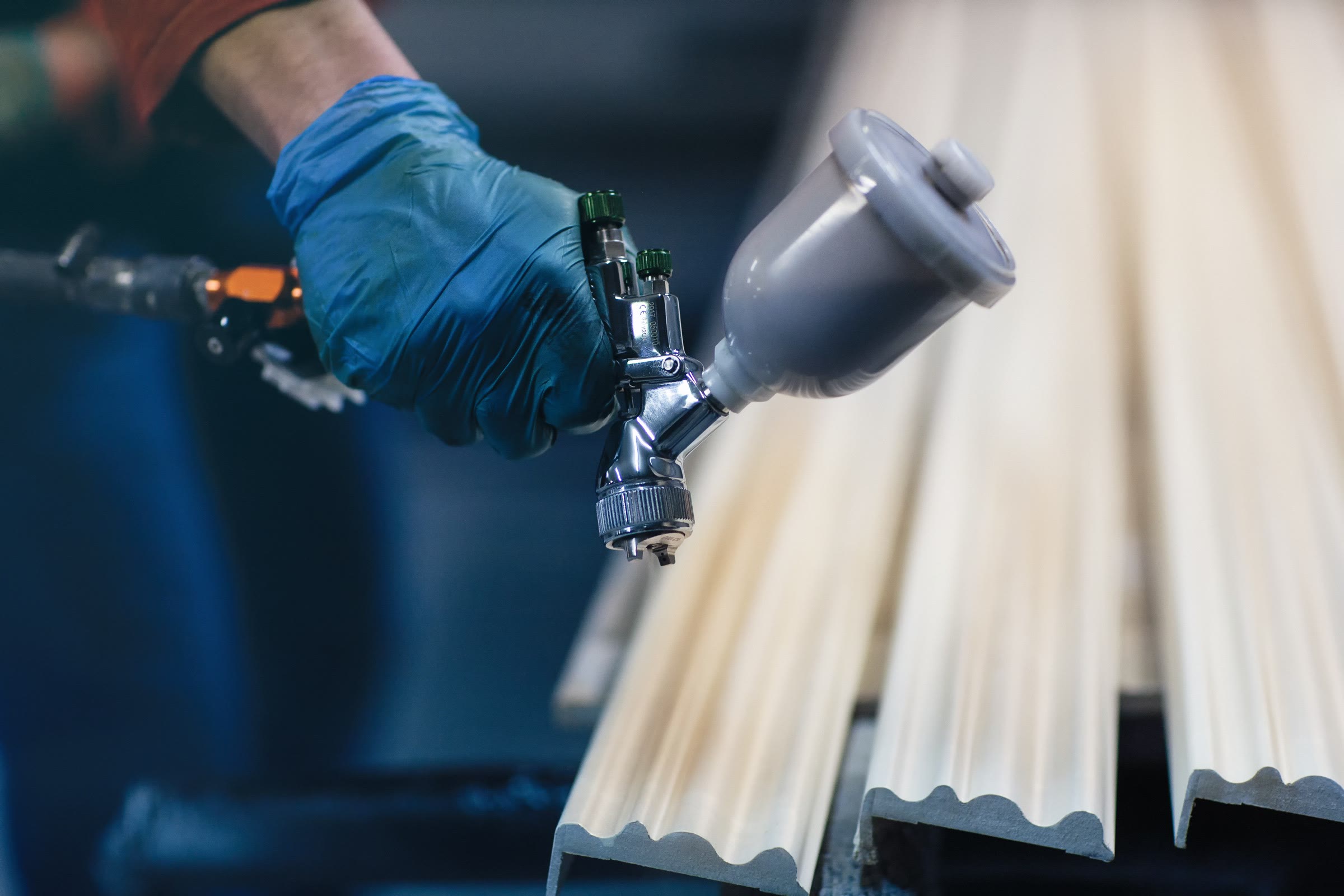
A soft-touch or deep-matte 2K polyurethane wood or furniture coating is the application the fine PMU grades were built for. Deuteron MK-F and MK-F6 give a smoother, almost waxy appearance with the haptics a soft-touch specification asks for, and PMH C gives a silky feel with slip in flexible systems. The PMU particle carries about 0.25 percent free hydroxyl groups, so in a two-pack polyurethane it reacts with the isocyanate and is bonded into the film, which raises scratch and polish resistance on a surface that is handled every day. MM 680 is the inorganically modified PMU compound Deuteron makes specifically for 2K PU systems. Start the ladder at 1 to 15 percent on the binder, read 60 and 85 degree gloss, and burnish the cured panel with a cloth before signing off.
How to qualify a matting agent
Run a ladder, and read it at the gloss you need. The typical range for the PMU powders is 1 to 15 percent, and the level a given system needs depends on the binder, the solids and solvent content, the dry film thickness and the application method, so a ladder study sets it. Read gloss at 60 degrees, and add 85 degrees once you are below 10 units.
Compare candidates at the same gloss, not the same dosage. A matting agent that reaches the target at a lower percent but doubles the viscosity has not saved anything once the solvent, the VOC and the application adjustments are counted. Check the film after it cures: burnish it, scratch it, recoat it and, if the schedule has one, bake it. Check that the dry film thickness on the line matches the panel, because a coarse particle that reads as texture in a 10 micron film disappears in a 40 micron one.
Incorporate with a high-speed dissolver. PMU needs no wetting or dispersing aid, is shear stable in high-shear mixing, and must not go through a bead mill, which grinds away the particle size distribution that produces the matting. Storage is 24 months in dry conditions below 35 degrees C.
Want a starting point for the ladder?
Give us the binder, the solids and the target gloss. We will say which grade and which addition level to start at, from the data sheet and from what the same system has done for other formulators.
Talk to an Expert
Switching from silica or from another PMU supplier
From silica, expect a somewhat higher addition level for the same gloss and a viscosity that is lower than the silica version at that gloss. Rebalance the solvent down before adjusting anything else. If the formulation carried a wax for feel or polish resistance, trial the PMU grade without it first, because the finer PMU grades bring slip and polish resistance of their own. Where a project needs part of silica's efficiency, the silica-modified compounds MM 659 and MM 680 are the halfway house.
From another polymethylurea, match on dv50, dv90 and oil absorption from the data sheets, then confirm on a panel. Cross-references to other suppliers' matting agents are available on request.
Pack, stock and lead time
Deuteron MK, MK-F and MK-F6 come in 10 kg paper bags, PMH C in 15 kg bags, and MM 677 in 220 kg drums. MK, MK-F, MK-F6 and MM 677 ship from our US warehouse. MK-F7, PMH C, the MM dispersions and the MM compounds are supplied to order from Deuteron in Germany. Samples of the stocked grades ship on request. P.A.T. Products has imported on its own account for 50 years and is C-TPAT validated.
Documentation
Every grade has a Technical Data Sheet, a Safety Data Sheet and a Regulatory Information Sheet from Deuteron. Under Regulation (EC) No. 1272/2008 the PMU powders are not classified as dangerous and carry no hazard labeling; the MM 100 and MM 110 dispersions in DPGDA are classified and labeled. PFAS, SVHC and REACH statements are available on request for a qualification review.
Identifiers and composition
| Chemistry | Polymethylurea (PMU), a micronized urea-methanal polycondensate; aminoplast duromer with an amorphous particle structure |
|---|
| CAS number (polymer) | 9011-05-6, listed on the SDS as methylene diamino methyl ether polycondensate, 85 to 90 percent, with water 10 to 15 percent and residual formaldehyde below 0.1 percent |
|---|
| Also called | Matting agent, flatting agent, dematting agent, deglossing agent, gloss reducer, organic matting agent, PMU matting agent, polymethyl urea, urea-formaldehyde matting resin |
|---|
| Appearance | Fine white powder (dispersions: white to yellowish, or grayish for MM 100) |
|---|
| Density | Approx. 1.47 g/cm3 (powders) |
|---|
| Free hydroxyl | Approx. 0.25 to 0.27 percent, crosslinkable with isocyanates |
|---|
| Producer | Deuteron GmbH, Achim, Germany. Family owned since 1977. |
|---|
Frequently asked questions
What is the difference between a matting agent, a flatting agent and a dematting agent?
Nothing in the chemistry. Matting agent, flatting agent, dematting agent, deglossing agent and gloss reducer are regional and industry names for the same class of additive: a particle that roughens the surface of a dry film so it scatters light instead of reflecting it. North American wood and industrial coaters tend to say flatting; ink and European coatings formulators say matting; dematting turns up in translated specifications.
Are these matting agents silica based?
No. They are organic polymethylurea, a micronized urea-methanal duromer with an amorphous particle structure. Deuteron also makes silica-modified PMU compounds (MM 659, MM 680, MM 682, MM 684) for formulators who want part of the efficiency of silica with the viscosity and feel of PMU.
When should I stay with a silica matting agent?
When the film is thick and pigmented, surface feel and polish resistance do not matter, and the lowest cost per gloss unit is the only criterion. Silica reaches a given gloss at a lower addition rate and costs less per kilogram. Polymethylurea needs a slightly higher dosage for the same gloss and repays it with lower viscosity, a harder and more polish-resistant surface, and a softer feel. Run both at the same gloss, not the same dosage, and compare viscosity and burnish.
How much matting agent do I add?
Typically 1 to 15 percent for the PMU powders and 1 to 3 percent for the PTFE-modified MM 823. The right level depends on the binder, solids, solvent content, dry film thickness and application method, so run a ladder study and read gloss at 60 degrees, and at 85 degrees once you are below 10 gloss units.
Which grade for a thin film or a printing ink?
The finer grades. Deuteron MK-F6 at 3.5 microns dv50 and MK-F7 at 2.5 microns keep a thin film smooth, and the MM 100 and MM 110 dispersions at 0.6 microns are built for UV overprint varnishes and inkjet inks. Deuteron MK at 6.3 microns is the starting point for the majority of coatings above about 15 microns dry.
What about PMMA beads, polyurethane beads and waxes?
They are the other organic families. Thermoplastic polymers (polyacrylates such as PMMA, thermoplastic polyurethanes, polyamides and waxes) and duromeric polymers (polyurethane duromers and the aminoplasts, which is where polymethylurea sits). The thermoplastics soften with heat and the waxes add slip and can affect recoating; a duromer has no melting point, which is why PMU holds a 200 degree C bake and why it is used where the finish has to survive polishing. Combinations are common, and we stock Deuteron's micronized waxes alongside the matting agents.
Does polymethylurea contain formaldehyde?
Polymethylurea is a fully reacted urea-methanal polycondensate. The safety data sheet lists the polymer under CAS 9011-05-6 with residual formaldehyde below 0.1 percent. We do not describe the product as formaldehyde-free. The SDS and the regulatory information sheet carry the figures a qualification review needs, and both are available on request.
Can I use a PMU matting agent in a 100 percent solids or powder coating?
With limits. A particle matting agent needs film shrinkage to raise the particles through the surface. In systems without shrinkage, such as 100 percent UV, solvent-free polyurethane or epoxy and powder coatings, the particle-based matting effect is limited and often not sufficient on its own. Tell us the system and we will say whether a PMU grade, a wax, or a combination is worth trialing.
Can I bead mill a PMU matting agent?
No. The particle size distribution is the product. PMU is shear stable in high-speed dissolver mixing and needs no wetting or dispersing aid, but a bead mill grinds the distribution away and the matting effect with it.