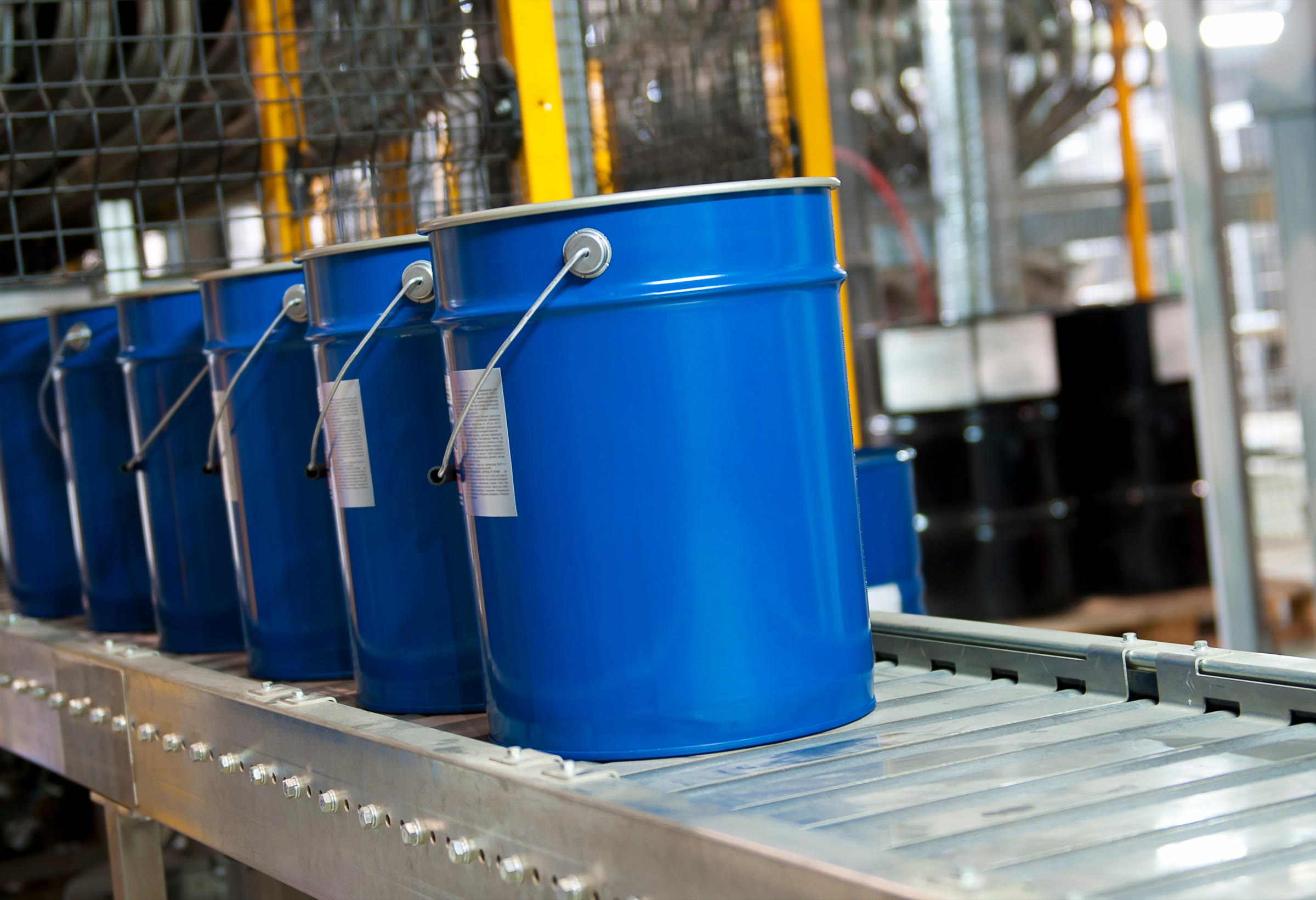
A standard color palette for an epoxy system runs to a black, a white, and a grey range from light to dark, with custom shades matched behind it. P.A.T. Products produces that color as an authorized REPI formulator, at our own plant in Hermon, Maine, and a system house sells it on under its own name.
One color target across epoxy and polyurethane
The same dispersion family colors cast polyurethane, plastisol and epoxy. A house running more than one of those systems holds one color target and one supplier across all of them, and a shade approved once does not have to be approved again when it moves to the next line.
That works because of the carrier. Our color runs on a phthalate-free terephthalate plasticizer: an ester that carries no epoxide and no amine hydrogen, so it takes no part in the amine-epoxy cure and behaves as a non-reactive diluent. Epoxy is not an isocyanate system either, so the hydroxyl and index arithmetic that governs a polyol carrier in polyurethane does not apply. The full version of that reasoning is in coloring epoxy systems, alongside addition rates and the question of which component takes the color.
The same carrier is native to a plastisol compound, and it stays out of the isocyanate index in cast polyurethane. Both of those systems have their own pages: liquid color for plastisol and liquid color for cast urethane.
Running epoxy and polyurethane on two color suppliers?
Send a shade from each line. We match both against the same standard so one target covers the two systems.
Request a SampleWhat sits in the palette
A black, a white, and greys from light to dark cover the shades an industrial epoxy coating, an epoxy floor or an epoxy sealant is specified in most often. The white is the working end of it: white hides the substrate by scattering light, scattering takes pigment volume, and a light grey is mostly white with a small addition on top. Loading a pale shade is a question about the white underneath it.
Everything past that set is matched. A palette gives your customer something to point at without a sample request, and the matching behind it answers the job that does not fit the palette.
Custom matching behind the palette
Send your epoxy system and we match into it rather than into a substitute. Matching into a customer-supplied system is routine work at our bench, and it is the only way to see a shade the way your process will produce it. Film thickness, gloss and opacity all move the measurement.
The standard can be a physical part, a drawdown, what is left in a pail, a PANTONE, RAL, Sherwin-Williams or Federal Standard 595 code, or a hex value. A shade you already sell can be reverse matched from the material itself, which is the same process set out in replacing a liquid colorant you can no longer buy.
The specification is ΔE 1.0 or better in CIELAB, D65 illuminant and 10 degree observer, and we have never issued a certificate that missed it. Custom matching is free, most matches come back inside a week, and samples ship at 0.5 kg.
Have a shade your customers keep asking for?
Send the standard and the epoxy system it goes into. The match comes back confirmed on a drawdown in your own material.
Custom color matchingPack sizes and order size
Color ships in 5 kg, 12.5 kg and 20 kg pails, and in drums and totes. There is no minimum order and one pail is a normal order, so a palette can carry a slow-moving shade without a drum of it sitting in your warehouse. Lead time is about a week on a commercial order, and we ship throughout the United States, Canada and Mexico.
What ships with every batch
Every batch is measured against the approved standard and ships with a certificate carrying the ΔE, the method, and a Brookfield viscosity taken on an RVF viscometer, spindle 4, 20 rpm, 20 degrees C. Technical and Safety Data Sheets go out with every color.
Our liquid color is made in the United States and is Berry Amendment, REACH, RoHS and California Proposition 65 compliant. Tell us what your own qualification process asks for and we will pull the documents.
Matching, mixing, quality control and certificate issue all happen in the same building in Hermon, Maine. No sample goes to an outside lab, so a shade correction, a viscosity question or a pack size is a conversation with the people who make the product.
The guardrail
A non-reactive diluent lowers glass transition temperature and can cut solvent and acid resistance if enough of it is present. At the level a colorant introduces, a few percent of the total formulation at most, that is minor. For immersion service the usual approach is to carry the color through the intermediate coats and finish with a clear high-Tg topcoat.
Tell us what the film has to survive along with the shade. Our standard pigment dispersions carry an epoxy suitability rating across the line, and the rating is the starting point rather than the answer for a specific system.
Selling it under your own name
We produce the color to the standards you approve and ship it in the pack sizes your customers order. What the palette is called on your price list, and how it reaches your customer, are your decisions.
Adding a shade later runs the same route. The standard goes on the same bench, against the same tolerance, and comes back with the same certificate as everything already in the palette.
Frequently asked
Can we sell your color under our own name?
Yes. We produce the color at our plant in Hermon, Maine, to the standards you approve, and ship it in the pack sizes your customers order. What the palette is called and how it reaches your customer are your decisions.
What sits in a standard epoxy palette?
A black, a white, and a grey range running light to dark, with custom shades matched behind it. Tell us what your customers order most often and we will quote that set.
Do we have to commit to a full palette to start?
No. There is no minimum order and one pail is a normal order. Color ships in 5 kg, 12.5 kg and 20 kg pails, and in drums and totes.
Will the same color work in our polyurethane line as well as our epoxy line?
The same dispersion family colors cast polyurethane, plastisol and epoxy, so a house running more than one system holds one color target and one supplier across them. Confirm the loading in each system on a drawdown, because opacity and film thickness differ.
Can you match a shade we already sell?
Yes. Send a part, a drawdown, or what is left in the pail, and the shade is read on a spectrophotometer and matched against it. Custom matching is free and most matches come back inside a week.
What documentation comes with the color?
Technical and Safety Data Sheets with every color, and a certificate with every batch carrying the color measurement and the viscosity conditions it was measured under. Our liquid color is made in the United States and is Berry Amendment, REACH, RoHS and California Proposition 65 compliant.
Start with three shades
Send the shades your customers ask for most and the epoxy system they go into. We match them, confirm each one on a drawdown in your own material, and ship free samples of the set.
See liquid color for epoxy systems