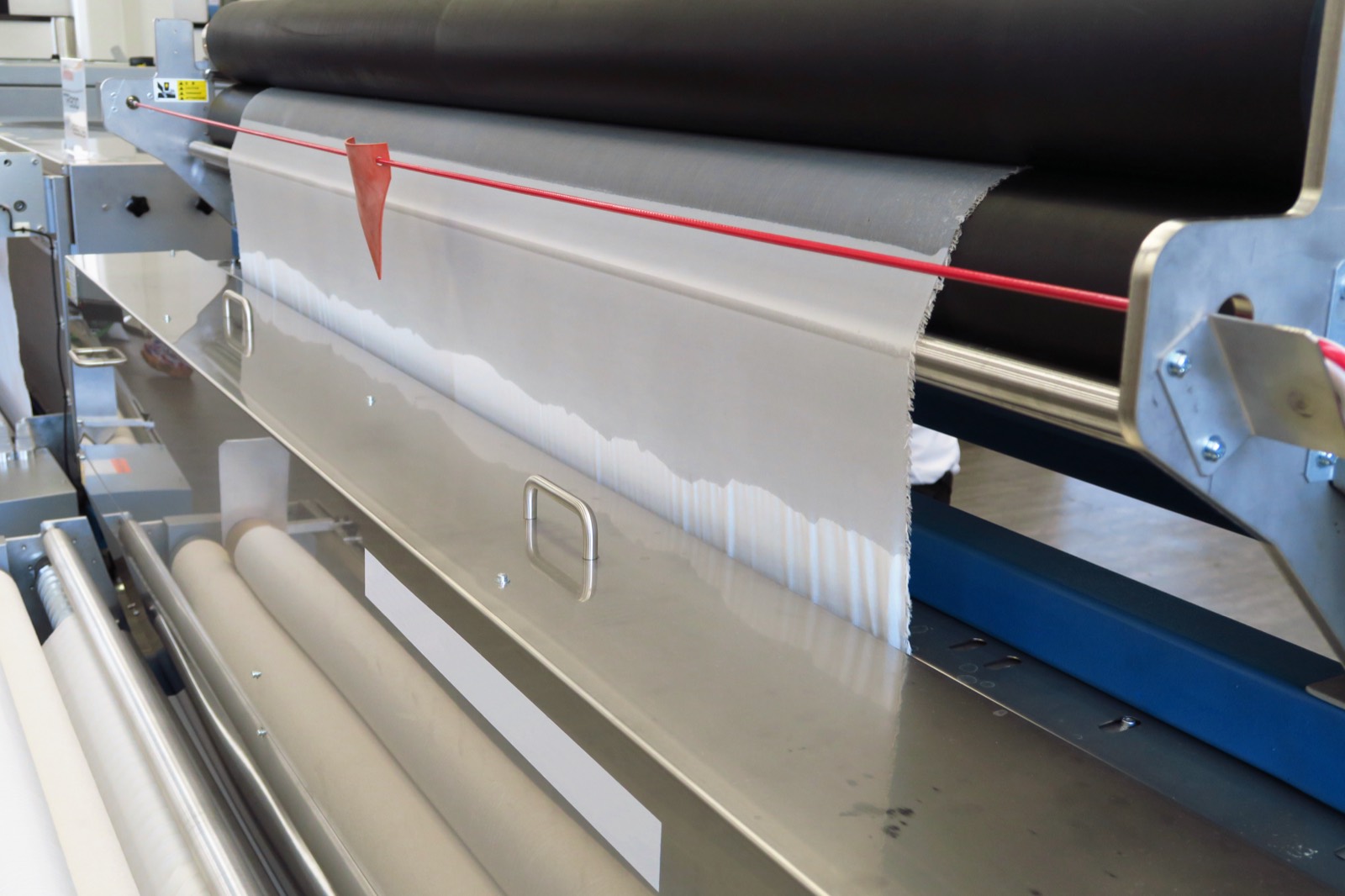
TRAPYLEN primers for films, foils and sheets
Primers for coating polyolefin films, foils and sheets. TPO and FPO on the chlorinated grades, PP and PE on the chlorine free waterborne side. Solvent and waterborne, with matt versions available.
Primers for coating polyolefin films, foils and sheets. TPO and FPO on the chlorinated grades, PP and PE on the chlorine free waterborne side. Solvent and waterborne, with matt versions available.
Polyolefin film takes a coating only after its surface is prepared, and the TRAPYLEN film grades are primers for exactly that step. They ship at application solids, run on a rotogravure station at 0.5 to 5 grams per square meter dry, and leave the film paintable. Typical downstream work is coated TPO film and sheet for interior and exterior parts, decorative foils and laminated structures.
The case splits by carrier and by chlorine. T 4121 and 8000 are toluene solutions and X 8280 is a xylene solution, with 8000 built for FPO film and EPDM and crosslinkable for higher heat and chemical resistance. X 9100 M is chlorine free in xylene. The waterborne grades 9352 W and 9703 W are chlorine free dispersions for TPO film. Matt versions with matting agents are available across the case.
Several grades run as two-component systems with a crosslinker added before application, which raises resistance against chemicals and temperature. The chlorine free TPO primers want a physically pretreated surface, corona to roughly 50 millinewtons per meter, before application.
For PP and PE film the grade is 9500 W. It is a chlorine free waterborne dispersion of an acrylic modified polyolefin with a 120 degree C softening point, the highest Tramaco publishes for a waterborne grade, and its datasheet covers treated and untreated film, so it does not depend on a corona level the way the chlorine free TPO primers do. It is the one grade on this page that is not supplied at application solids: it ships at 30 percent and is diluted to about 10 percent for straight primer use.
Tramaco also makes TRAPUR polyurethane primers for PVC and TPO film, and TRAPUR 209 W is a waterborne polyurethane with stated adhesion on PP. They carry their own page in this catalog, linked below under related products.
| Property | Typical value |
|---|---|
| Chemistry | Modified CPO, EP-modified CPO and chlorine free APO |
| Chlorine content | 2.5 to 26 percent on the CPO grades, zero on the APO grades |
| Forms | Ready-to-use solutions in toluene or xylene and waterborne dispersions |
| Solids content | 6.5 to 12 percent, at application strength as delivered |
| Application rate | 0.5 to 5 g per square meter, calculated on solids |
| Matt versions | Available with matting agents across the case |
| Storage stability | At least 6 months in closed packing at 15 degrees C |
Dosage: 0.5 to 5 grams per square meter calculated on solids, applied as delivered.
Typical values from the manufacturer's technical data sheet. They describe the product, they are not a specification. We will send the current TDS and the batch documentation your qualification needs.
Tell us the binder system, the property you are targeting, and the volume you expect. We will confirm the grade, send the documentation, and get a sample of the candidate grade to you.
| Grade | Chemistry | Chlorine content | Form and carrier | Solids or Mw | What it is for |
|---|---|---|---|---|---|
| T 4121 | EP-modified CPO | 23% | Solution in toluene | 6.5% | Amine-crosslinkable |
| 8000 | Modified CPO | 2.5% | Solution in toluene | 10% | For FPO films and EPDM, crosslinkable |
| X 8280 | CPO | 26% | Solution in xylene | 10% | For TPO films |
| X 9100 M | APO | Chlorine free | Solution in xylene | 12% | For TPO films |
| 9352 W | APO | Chlorine free | Waterborne dispersion | 12% | For TPO films |
| 9703 W | APO | Chlorine free | Waterborne dispersion | 12% | For TPO films |
| 9500 W | Acrylic modified APO | Chlorine free | Waterborne dispersion | 30%, diluted to about 10% as a straight primer | For PP and PE film, treated or untreated. Softening point 120 C, the highest Tramaco publishes for a waterborne grade |
Values are the manufacturer's published typical figures. Ask for the current technical data sheet on any grade and we will send it with the matching safety data sheet.
The core of the case. X 8280, X 9100 M and the waterborne 9352 W and 9703 W leave TPO paintable, and 8000 covers FPO film and EPDM.
9500 W raises the surface energy of polypropylene and polyethylene film so ink, adhesive or coating anchors. Works on treated and untreated film.
Primed film carries print, adhesive or a decorative coat in the following station.
The crosslinkable grades where the coated film faces chemicals or heat.
It is specified where the formulation needs ready to use at delivered solids, no dilution step, chlorine free options in solvent and in water, matt versions available with matting agents, crosslinkable grades for chemical and heat resistance, and runs on a standard rotogravure primer station.
The primers are ready to use and are applied in delivered form, typically by rotogravure with a 60 or 80 point gravure roller. Spraying, dipping and printing also work where the line allows.
Drying runs 30 seconds at 80 degrees C for the solvent grades and 60 seconds at 80 to 100 degrees C for the waterborne grades. TRAPYLEN films form at room temperature once the carrier has evaporated, so temperature and air flow set the real line speed.
The two-component options take their crosslinker before application and hold a pot life of at least 8 hours, so a shift runs on one mix. Crosslinking raises heat and chemical resistance of the coated film.
The chlorine free TPO primers want the film corona treated to a surface tension of about 50 millinewtons per meter before application. Grades containing matting agents need a stir before every use.
9500 W is the exception to the ready-to-use rule. Dilute it from 30 percent to about 10 percent solids for straight primer use, adding coalescing, wetting or rheology additives to the dilution as the line needs. Drying is 60 seconds at 100 degrees C, or 80 degrees C with a longer dwell.
Protect the waterborne grades from frost.
Package sizes: Iron drums of 170 kg for the solvent grades, PE drums of 120 kg for the waterborne grades. Other packing on request..
Storage: At least 6 months in closed original packing at 15 degrees C. Protect the waterborne grades from frost.
Refer to the current safety data sheet for hazard classification and handling. The APO grades are chlorine free per Tramaco's published data.
8000 or X 8280 for a solvent line and 9352 W or 9703 W for a waterborne one. If the specification excludes chlorine, X 9100 M covers the solvent side and the 9352 W and 9703 W dispersions the water side. Send us the film and the coating that follows and we will confirm the candidate before the sample ships.
9500 W. Most grades in the table above are specified for TPO or FPO film, so a PP or PE job is a different selection. 9500 W is chlorine free, waterborne, and its datasheet covers treated and untreated film, with a 120 degree C softening point that holds up when a water-based ink is printed over it. TRAPUR 209 W is the polyurethane alternative where the line wants one. Tell us the film and the ink system and we will confirm the grade before a sample ships.
For the chlorine free TPO primers yes, to a surface tension of about 50 millinewtons per meter. The chlorinated grades are less demanding, and a trial on your film settles it for your line.
Yes. Matt versions with matting agents are available across the case. Stir any grade containing matting agents before every use.
PVC is not polyolefin work. Tramaco's TRAPUR polyurethane primers cover PVC film, and we quote them on request.
Yes. We send the Technical Data Sheet (TDS), Safety Data Sheet (SDS), and Information leaflet for films on request, in the manufacturer's current revision. Use Request TDS or SDS above and tell us what your qualification review needs.
Case one of the range, for coating molded polyolefin parts.
Case three of the range, for solvent-based and UV-curable inks on polyolefin film.
The polyurethane primers for PVC, TPO and TPE film and for plastic parts outside the polyolefin lane.
The polyfunctional aziridine crosslinker behind the two-component options on this page.
The non-chlorinated APO grades, including the waterborne dispersions for polypropylene and polyethylene.
The category page, with the form-by-form selection logic.
Why polyolefins resist bonding and what the chlorinated polyolefin does about it.