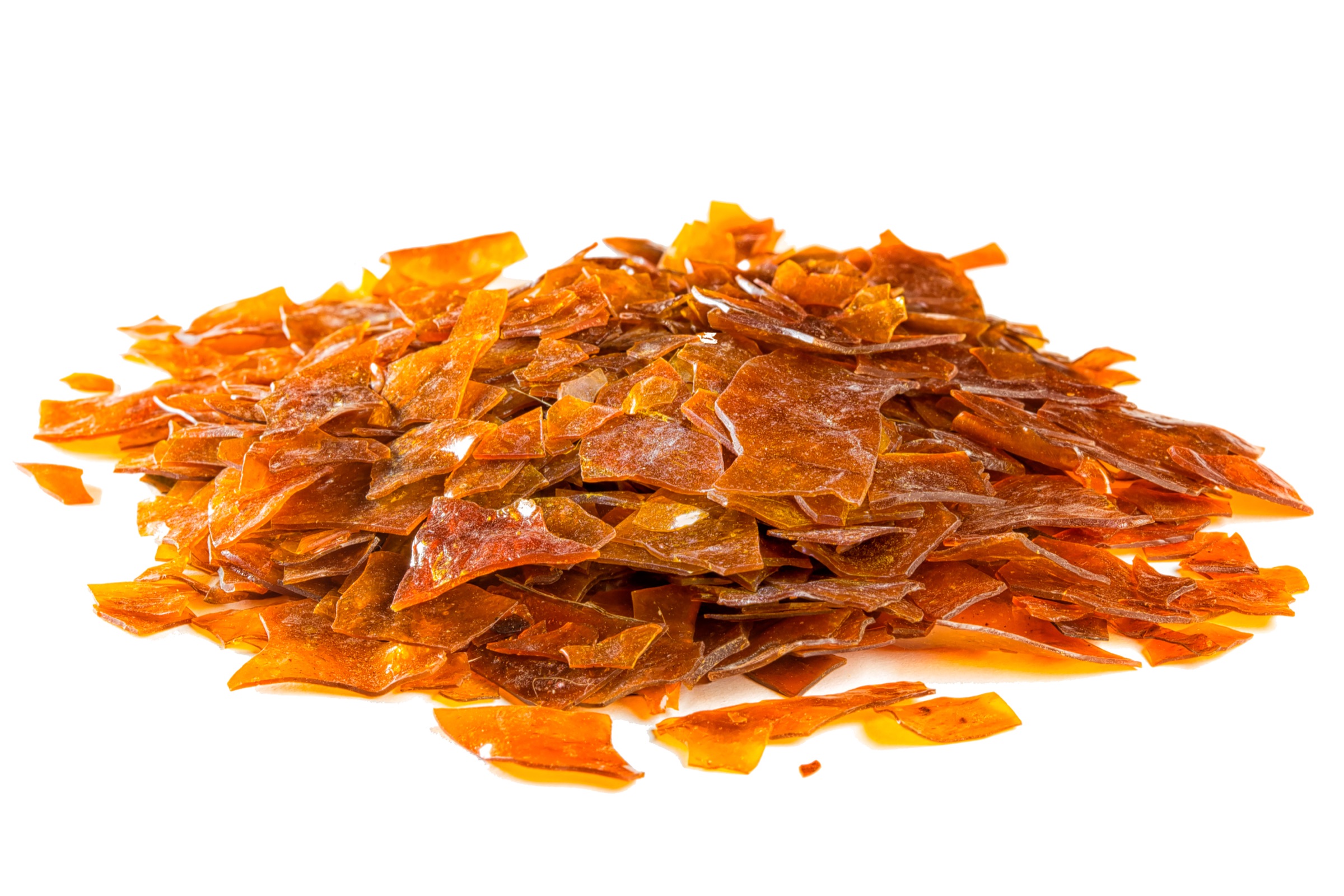
Lemon #1 Flake Shellac
The heat-refined workhorse grade. A light amber wax-containing flake released against a nine-point specification, held in stock in the United States and sold by the bag.
The heat-refined workhorse grade. A light amber wax-containing flake released against a nine-point specification, held in stock in the United States and sold by the bag.
Lemon #1 flake shellac is the light amber, wax-containing grade of shellac, and it is the one most industrial formulations mean when they specify shellac without qualifying it. The resin is secreted by the lac insect on trees in the forests of India and Thailand, then heat refined into flake. It arrives as a pale yellow solid and dissolves in alcohol.
Heat refining is what makes this grade what it is. It leaves the natural shellac wax in, at 2.5 to 5 percent, and that wax is the reason the material yields milky dispersions of medium color shade in solvent rather than a water-clear solution. Films from a wax-containing shellac have a satin gloss rather than a high one, which is the finish a French polisher and a primer formulator both want.
Flow at 57 mm and life at 30 minutes are the flow-plate measurements, and together they describe how far the resin runs and how long it stays fluid before it polymerizes under heat. A bonded abrasive maker reads those two rows first, because they decide how the bond distributes around the grain before it sets.
Acid value at 60 to 75 and saponification value at 185 to 200 fix the ester and free-acid balance, which is what a formulator checks when shellac has to sit in a system alongside another resin or a plasticizer. Melting temperature is 98 to 99 degrees C and ash is held at 0.5 percent.
This is the grade PAT has stocked in the United States longest. It ships by the bag, so a formulator running an intermittent or small requirement does not need an import program to get material.
The CAS Registry Number is 9000-59-3. It is also written as shellac, flake shellac, shellac flake, lemon shellac, lemon #1 flaked shellac, and lac resin.
| Property | Specification |
|---|---|
| Acid value | 60 to 75 |
| Hot alcohol insoluble | 2 percent maximum |
| Loss on drying | 2 percent maximum |
| Flow | 57 mm |
| Life | 30 minutes |
| Saponification value | 185 to 200 |
| Melting temperature | 98 to 99 degrees C |
| Wax content | 2.5 to 5 percent |
| Ash | 0.5 percent |
These are specification limits from the technical data sheet, not typical values. Every batch is released against them and the certificate of analysis reports the measured result. We will send the current TDS and the batch documentation your qualification needs.
Tell us the binder system, the property you are targeting, and the volume you expect. We will confirm the grade, send the documentation, and ship a sample from North American stock.
Shellac seals tannin bleed, smoke and water staining, and knots in resinous timber, and it does it under either a solvent or a water-based topcoat.
The elastic bond in cut-off and finishing wheels. Flow and life are the two rows that decide how the bond sets around the grain.
A hard, fast-setting natural resin used where a joint compound has to grip and stay put.
The traditional padding finish. Wax-containing flake is the grade the technique was built around.
A film former and hardening resin in alcohol-based ink systems.
Bonding built-up mica sheet and segment plate, one of the oldest uses of the resin.
Setting cement for gem cutting, and a repair adhesive in instrument making.
It is specified where the formulation needs adhesion to substrates that give synthetic resins trouble, seals tannin, knots and smoke staining under either solvent or water-based topcoats, dries by solvent evaporation alone, with no cure chemistry to manage, satin gloss against the high gloss of a dewaxed film, A natural resin, held to a nine-point specification lot to lot, and held in United States stock and sold in single-bag quantities.
Shellac dissolves in ethanol and in denatured alcohol. Cuts are usually described in pounds of flake per gallon of alcohol, so a two-pound cut is two pounds of this flake in a gallon. Let the flake dissolve with gentle agitation rather than heat, and strain the solution before use: the natural wax stays dispersed rather than dissolving, which is what gives a waxy shellac its characteristic milky appearance in solvent.
A dissolved shellac has a working life. Esterification continues slowly in solution, so a cut thickens and eventually loses its ability to dry hard. Mix what a job needs, and date the container.
The wax is the reason to check compatibility before topcoating. A wax-containing shellac is the right choice under most primers and finishes, but where a subsequent coat needs to key into a wax-free surface, a dewaxed grade is the one to specify instead.
Handle the dust. Specific gravity is 1.2 and the flake is a solid, but PAT's safety data sheet records that a fine dust cloud of this material in air can cause a dust explosion if ignited. Ground transfer equipment, avoid raising dust, and keep the material away from heat, sparks and open flame. Shellac burns with a clear and almost invisible flame.
Keep it away from strong oxidizing agents. Those are the only materials PAT's safety data sheet lists as incompatible.
Package sizes: 25 kg jute bags..
Storage: Shelf life is more than five years when the material is stored and transported below 20 degrees C, which is 68 degrees F. Higher temperatures accelerate aging of the solid and raise the risk of blocking, where the flake fuses into a mass in the bag. Humidity makes blocking worse. Keep bags cool, dry and out of direct sunlight.
PAT's safety data sheet classifies this material as not hazardous under the OSHA Hazard Communication Standard, 29 CFR 1910.1200, with no label elements required and NFPA and HMIS ratings of zero for health, flammability and instability. It is not regulated for transport by DOT, IMDG or IATA. The substance is listed on the TSCA inventory and on the Canadian DSL, EINECS, ENCS, IECSC, KECL, PICCS and AICS. It contains no chemicals subject to SARA Title III Section 313 reporting. PAT's Statements and Declarations sheet records it as exempt from REACH registration as a substance occurring in nature under Annex V, free of REACH substances of very high concern, free of California Proposition 65 listed substances, and meeting EU RoHS requirements without exemption. Read the safety data sheet before handling.
Lemon #1 is a color and quality designation for heat-refined flake shellac. Lemon describes the light amber shade, and the number distinguishes it from the darker grades further down the color ladder. It is the standard industrial grade and the one most specifications mean when they call for flake shellac without further qualification.
No. This grade is wax containing, at 2.5 to 5 percent natural shellac wax, because it is heat refined rather than solvent refined. The wax is what gives it milky dispersions in solvent and a satin gloss film. If your process needs a wax-free resin, the refined bleached grade is dewaxed to 0.2 percent maximum, and dewaxed and bleached shellac is a different material, not a lighter version of this one.
9000-59-3. It is the same number for every grade of shellac, including the bleached and dewaxed grades, because the refining route changes the material without changing what it is. PAT's technical data sheet and safety data sheet both carry it.
Dissolve the flake in ethanol or denatured alcohol. Cuts are described in pounds of flake per gallon of alcohol, so a two-pound cut is two pounds of this flake per gallon. Use gentle agitation, no heat, and strain the solution before use. Make what the job needs: a shellac solution thickens over months and eventually stops drying hard.
More than five years stored below 20 degrees C, which is 68 degrees F, per PAT's technical data sheet. Heat is what shortens it. Above that the flake ages faster and starts to block, meaning it fuses into a solid mass in the bag, and humidity accelerates it. A blocked bag can often still be dissolved, but it will take longer and the flow and life figures move.
It is held in stock in the United States and ships across the United States, Canada and Mexico. Standard packaging is 25 kg jute bags and we sell by the bag, so you do not need to import a container to run a small or intermittent requirement. Tell us the volume and the lead time you need and we will confirm both with the quote.
PAT's safety data sheet classifies it as not hazardous under the OSHA Hazard Communication Standard and it is not regulated for transport. The handling point that does matter is dust: a fine cloud of shellac dust in air can cause a dust explosion if it is ignited, and the resin burns with an almost invisible flame. Ground your transfer equipment, avoid raising dust, and keep it away from strong oxidizing agents.
Yes. We send the Technical Data Sheet (TDS), Safety Data Sheet (SDS), Certificate of Analysis (COA), and Statements and Declarations on request, in the current revision. Use Request TDS or SDS above and tell us what your qualification review needs.
The dewaxed, low-color grade. A different material, not a lighter version of this one.
Grades, forms and what we hold in stock.
How seedlac forks into flake, dewaxed and bleached, and which one a formulation wants.
The selection question this grade raises, answered on the wax content.
Pack sizes, lead times and what small-lot supply from domestic stock means.
Why shellac seals tannin, knots and smoke where other primers do not.
What flow and life mean for a bonded abrasive.