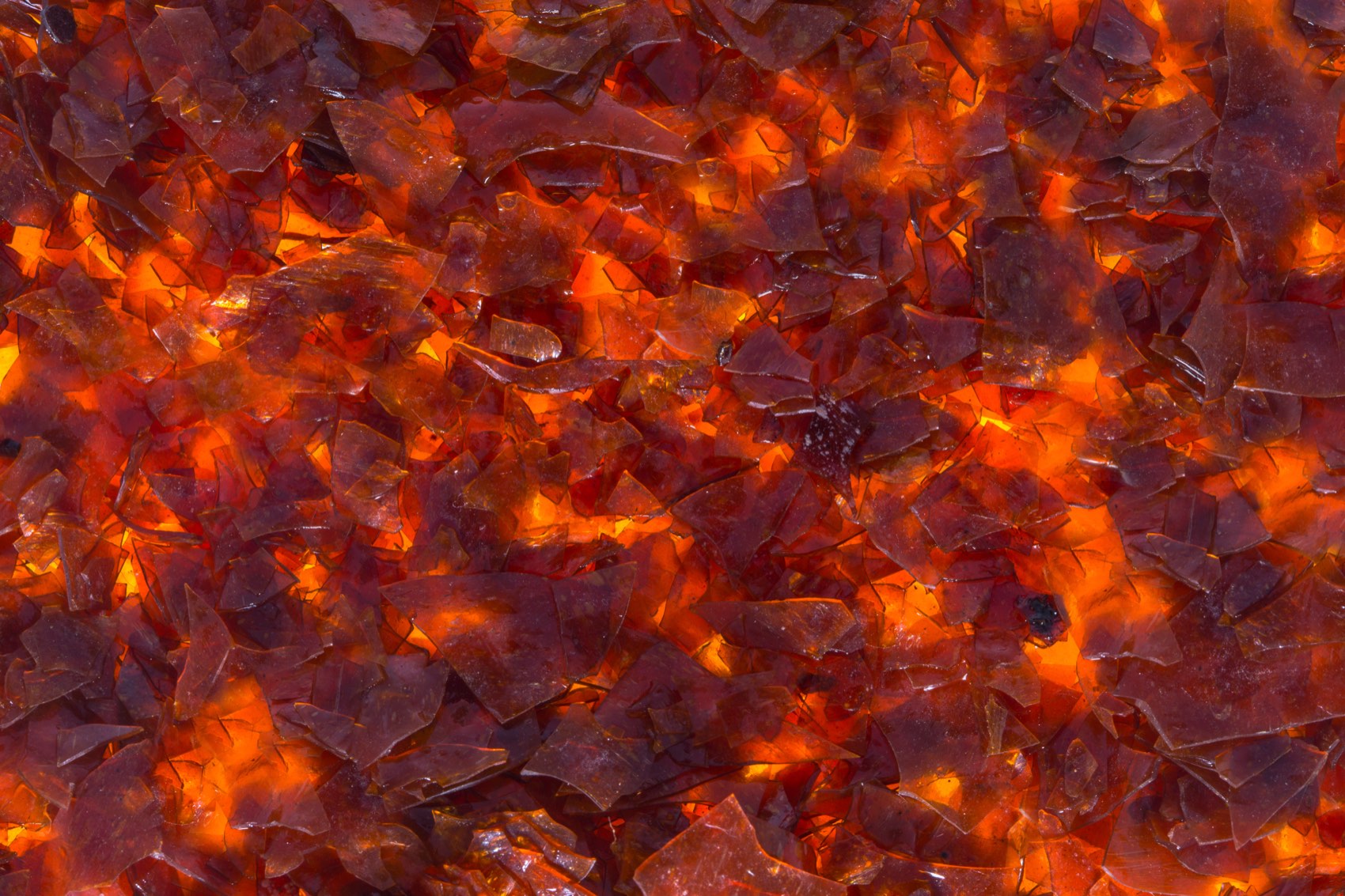
Every grade of shellac on the market starts as the same material: seedlac, the washed and sieved resin that comes off the lac insect. What separates Lemon #1 flake from a dewaxed grade or a bleached grade is the refining route, not the source. The route can be read from the wax content and the color.
From the insect to seedlac
Shellac is a natural resin secreted by the lac insect, Kerria lacca, which colonizes host trees across India and Thailand. The insects coat the twigs in a hard resinous crust. Harvesters scrape that crust off as sticklac, the raw starting material. Sticklac is crushed, washed to remove twig fragments and the red lac dye, and sieved into seedlac: small amber granules. Seedlac is the common intermediate. Every refined grade is made from it, and CAS 9000-59-3 covers shellac in all of those forms.
The three refining routes
Seedlac is refined three ways.
Heat refining: flake
In heat refining, seedlac is melted and filtered, then stretched and broken into thin flakes as it cools. Heat refining keeps the resin's natural wax, around 2.5 to 5 percent, and its natural amber color. Lemon #1 flake is the heat-refined grade. It is the workhorse for most industrial uses: stain-blocking primers, sealants and adhesives, printing inks, wood finishing, and confectioner's glaze production.
Solvent refining: dewaxed
Dewaxing dissolves seedlac in alcohol, chills the solution so the natural wax drops out, and filters it off. The result is a wax-free grade, typically 0.2 percent wax or lower, that dries to a clear film. Dewaxed shellac is specified where natural wax would cloud the film or interfere with adhesion and recoating: clear wood finishes, sanding sealers under other topcoats, and many food and pharmaceutical coatings. Dewaxed shellac is the form recognized as USP-NF Pharmaceutical Glaze. The finishing-side decision between the two forms is worked through in dewaxed vs waxy shellac in wood finishing.
Bleaching: white lac
Bleaching treats the resin with an oxidizing agent to strip the color, producing white or bleached lac. It is used where the amber tint of regular shellac would show, such as light-colored coatings and some pharmaceutical and cosmetic work. Bleached shellac carries residual chlorine from the process and has a shorter shelf life than heat-refined or dewaxed grades, so it is bought closer to the point of use.
Wax content is the diagnostic
Wax content tells you which route a grade came from, and it is a test you can run on any sample.
Around 5 percent wax means a heat-refined, regular grade. Near zero means dewaxed. The trade name on the bag can be inconsistent between suppliers; the wax number is not. When a specification matters, write it against measured wax content, not the grade name.
Request a SampleReading the color: Lemon #1 and IS 16
The grade this section describes is the one we stock: see the full specification for Lemon #1 flake shellac.
The other half of a grade name is color. Shellac runs from pale lemon through orange to deep garnet, set by the resin's origin and how hard it was refined. The Indian Standard IS 16 classifies shellac by a color index and a maximum for hot-alcohol insolubles. Orange and garnet grades sit lower on the color scale and are less common in modern industrial use.
Forms you can buy
Separate from the refining grade, shellac is sold in several physical forms:
- Flake: the dry, heat-refined resin in thin flakes. The form most industrial buyers cut their own solution from.
- Ground or powder: flake milled to a powder for faster dissolving or dry blending.
- Cut (alcohol solution): shellac pre-dissolved in ethanol, sold by pound cut, the pounds of resin per gallon of alcohol. A 2-pound cut is a common ready-to-use finish.
- Aqueous ammoniacal: shellac dissolved in water with ammonia, an alkaline salt solution used where an alcohol carrier is not wanted, including some food-glaze and coating work.
Which grade for which job
| Application | Grade | Form |
|---|---|---|
| Stain-blocking primer / wood sealer | Lemon #1 (heat-refined) | Flake or cut |
| Clear wood finish / French polish | Dewaxed | Flake or cut |
| Printing inks | Lemon #1, low insolubles | Flake or ground |
| Confectioner's glaze / pharma coating | Dewaxed | Cut or aqueous ammoniacal |
| Light-colored coatings | Bleached / white | Cut |
| Abrasive grinding-wheel bond | High-flow Lemon #1 | Flake |
Flow and freshness matter as much as grade for some of these. For how the flow, life, and insolubles numbers on a Certificate of Analysis map to your process, see reading a shellac COA. For the abrasive bond specifically, see shellac bond in precision grinding wheels.
Regulatory status
FDA clears shellac for food-contact coatings under 21 CFR 175.300 and for adhesives under 21 CFR 175.105, and lists it as a diluent in color additive mixtures under 21 CFR 73.1. Direct use as a confectioner's glaze rests on an independent GRAS determination rather than a direct food additive regulation. In the EU it is glazing agent E904. Dewaxed shellac is recognized as USP-NF Pharmaceutical Glaze. It is widely certified kosher and halal, and unbleached (orange) shellac is listed under USDA National Organic Program 205.606 for use in organic processing. Heavy-metals documentation is available for food and pharmaceutical grades.
Common questions
Is dewaxed shellac better than regular shellac?
No; the two grades serve different jobs. Regular heat-refined shellac keeps its natural wax and is the right grade for primers, inks, and most coatings. Dewaxed shellac has the wax removed for a clear film and is specified for clear finishes, pharmaceutical glaze, and many food coatings. The job decides which is correct.
What is the difference between flake and cut shellac?
Flake is the dry resin. Cut shellac is flake already dissolved in alcohol, sold by pound cut. Buyers who want control over concentration and freshness buy flake and cut their own; buyers who want a ready-to-use finish buy cut.
Does bleached shellac expire faster?
Yes. Bleaching leaves residual chlorine and the resin polymerizes faster in storage, so white lac has a shorter shelf life than heat-refined or dewaxed grades. Buy it closer to use and check the production date.
How can I tell which shellac grade I have?
Wax content is the tell. Around 5 percent wax indicates a heat-refined regular grade; near zero indicates a dewaxed grade. Color index and hot-alcohol insolubles, reported on the Certificate of Analysis, place it on the IS 16 grade scale.
Products in this line
The two grades P.A.T. Products holds in stock, one from each of the refining routes above.
| Grade | Refining route | Wax content | What it is specified for |
|---|---|---|---|
| Lemon #1 Flake Shellac | Heat refined | 2.5 to 5% | Stain-blocking primers, grinding wheel bond, sealants, wood finishing and French polish |
| Refined Bleached Shellac | Bleached and dewaxed | 0.2% maximum | Clear coatings and sanding sealers, inks and overprint, pale wood finishing |
Browse the full P.A.T. Products shellac catalog for the specification, handling and documentation on each grade, or tell us the application and we will name the one that fits.
Sourcing shellac from P.A.T. Products
We stock Lemon #1 flake, the heat-refined grade that covers most industrial work, and can arrange dewaxed, bleached, cut, and aqueous grades for applications that need them. Every shipment ships with a Certificate of Analysis from a qualified laboratory, and we are happy to send a sample before you commit to an order.
View Shellac Product Page