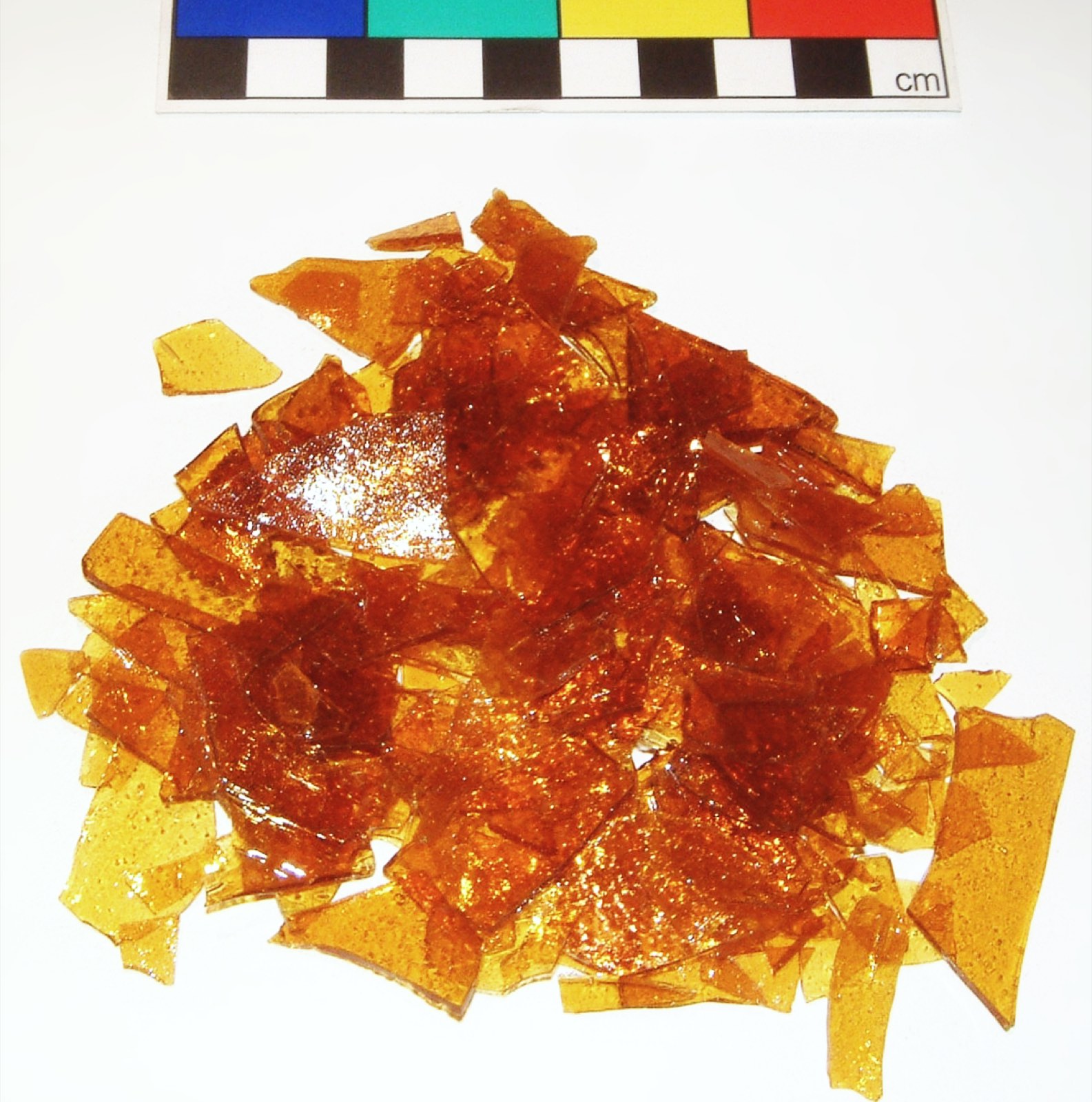
Three numbers appear on every shellac flake COA: flow, polymerization time, and hot alcohol insolubles. If you understand what they're measuring, you can evaluate a supplier, compare incoming lots, and write a specification that actually protects your process.
Flow (ASTM)
Flow measures how far a fixed weight of shellac spreads on a polished metal plate at 150°C, reported in millimeters. A higher number means the shellac flowed farther: it's more fluid, less viscous, and fresher.
Shellac is a natural polyester resin secreted by the lac insect. In storage, it undergoes slow self-polymerization: the resin acid chains cross-link, raising molecular weight and increasing viscosity. The effect is measurable. A lot that tests at 72 mm when it leaves the processing facility may test at 62 mm after six months in warm storage. After a year, depending on temperature and humidity, it can fall below 57 mm. The drop accelerates at higher temperatures.
Standard Lemon #1 flake shellac (CAS 9000-59-3) specifies 57 mm flow. For most industrial uses, standard Lemon #1 is adequate: printing inks, adhesive formulation, stain-kill primers, wood finishing, and confectioner's glaze production. The material flows well enough under process conditions and the degradation rate during a reasonable shelf life isn't a problem.
Abrasive and grinding wheel manufacturing is the exception. The hot-press bonding process requires shellac to flow uniformly around individual abrasive grain at molding temperature. Below a certain threshold, grain wetout is incomplete and bond bridges are inconsistent across the wheel cross-section. That's why the abrasive industry specifies high-flow shellac separately, with a 65 mm minimum. For that application, standard-grade material at 57 mm is the wrong specification.
Grade name tells you the color class and general purity. The per-lot flow value tells you whether that specific material is fresh enough to perform in your process.
Polymerization time / life (ASTM)
Polymerization time (often called "life" on the COA) measures how long shellac remains workable at a fixed elevated temperature before it sets up. It's reported in minutes. The same aging mechanism that drops flow also shortens life: cross-linking makes the resin lock up faster.
Standard Lemon #1 specifies 30 minutes minimum. High-flow grades specify 45 minutes minimum. For most coating and adhesive applications, this parameter is less critical than flow. The process isn't depending on an extended working window at elevated temperature. For hot-press abrasive bonding, it's a hard constraint. The shellac needs time to flow into the grain bed, wet the grain surfaces, and consolidate before cure begins. A lot with 24 minutes of life may fail to complete that process reliably.
Like flow, polymerization time is a freshness proxy. A lot showing 67 minutes on the COA is fresh from the producer. A lot at 28 minutes is either old, poorly stored, or both. When you're evaluating a supplier for the first time, this number tells you something about how they're managing inventory.
Hot alcohol insolubles
This test measures what's left after the shellac is dissolved in hot alcohol: wax, bark fragments, and inorganic debris carried over from raw seedlac processing. The result is reported as a percentage by weight.
Both standard Lemon #1 and the high-flow grade specify 2% maximum. The freshest, most carefully processed lots don't always come with the lowest insolubles.
The practical concern depends on your application. In flexographic ink formulations and pharmaceutical tablet coatings, insoluble particles cause coating defects, filter buildup, and printability issues. Buyers for those applications want the lowest insolubles they can get, tested per lot. In abrasive bonding, the hot-press process is less sensitive to particle contamination. The grain bed itself introduces far more particulate than the shellac, so the relaxed limit is workable.
For confectioner's glaze production and pharmaceutical coating applications, this is also the test category where heavy metals documentation becomes relevant. The Food Chemicals Codex shellac monograph sets arsenic at 1.4 ppm maximum for food-grade shellac. If your process requires heavy metals on the COA, ask your supplier whether that testing is available.
A note on shellac grade names
Multiple shellac grades are sold under different names and the terminology isn't standardized across suppliers. The grades a buyer is most likely to encounter:
Lemon shellac (standard and high-flow): pale yellow, natural wax content of 2.5–5%. The correct input for most industrial applications including confectioner's glaze. This is what P.A.T. Products supplies.
Dewaxed shellac: wax removed by solvent extraction or hot filtration. Used where wax content would cause adhesion, clarity, or compatibility issues. Some pharmaceutical coating specifications and certain food-grade applications require dewaxed grades.
Orange shellac: deeper color, higher resin content, different wax and flow profile. Less common in modern industrial use.
Button lac: unrefined. Rarely relevant to buyers sourcing for manufacturing processes.
For a fuller breakdown of how the refining route sets each grade, see shellac grades and forms.
Request a SampleHow the specs map to applications
| Application | Flow | Life | Insolubles |
|---|---|---|---|
| Confectioner's glaze / pharma coating | Standard adequate | Not critical | Low preferred; heavy metals testing required to the FCC food-grade monograph |
| Printing inks | Standard adequate | Not critical | Critical: lowest available, tested per lot |
| Adhesive formulation | Standard adequate | Process-dependent | Standard adequate |
| Stain-kill primers / wood finishing | Not critical | Not critical | Standard adequate |
| Abrasive bonding (E-bond) | 65 mm min required | 45 min min required | 2% max acceptable |
Abrasive bonding has a dedicated article: Shellac bond in precision grinding wheels: what the flow test measures.
What a useful COA includes
Compare an incoming certificate against the published specification for Lemon #1 flake shellac or refined bleached shellac.
A COA showing "meets specification" next to each parameter tells you the lot passed. It doesn't tell you by how much, or whether you're getting fresh material running at 74 mm or material at the edge of acceptable at 58 mm. For applications where process consistency matters, you want actual measured values per lot, not just pass/fail against the grade spec.
Production date and storage history should be available on request. Shellac degrades during storage and transport.
Third-party laboratory results carry more weight than in-house testing, especially for regulated applications. Our shellac supplier in India uses a qualified third-party laboratory for all COA work. Every lot we ship includes that documentation.

Products in this line
The two grades these certificates come against, each with its published specification.
| Grade | Refining route | Wax content | What it is specified for |
|---|---|---|---|
| Lemon #1 Flake Shellac | Heat refined | 2.5 to 5% | Stain-blocking primers, grinding wheel bond, sealants, wood finishing and French polish |
| Refined Bleached Shellac | Bleached and dewaxed | 0.2% maximum | Clear coatings and sanding sealers, inks and overprint, pale wood finishing |
Browse the full P.A.T. Products shellac catalog for the specification, handling and documentation on each grade, or tell us the application and we will name the one that fits.
Sourcing shellac from P.A.T. Products
We import and distribute Lemon #1 flake shellac from established producers in India. Standard grade is available from North American stock. High-flow grade is available by arrangement for abrasive bonding applications.
Every shipment comes with a COA showing actual lot results for flow, polymerization time, and hot alcohol insolubles, tested by a qualified third-party laboratory. We're happy to provide COAs and samples before you commit to a commercial order.
View Shellac Product Page