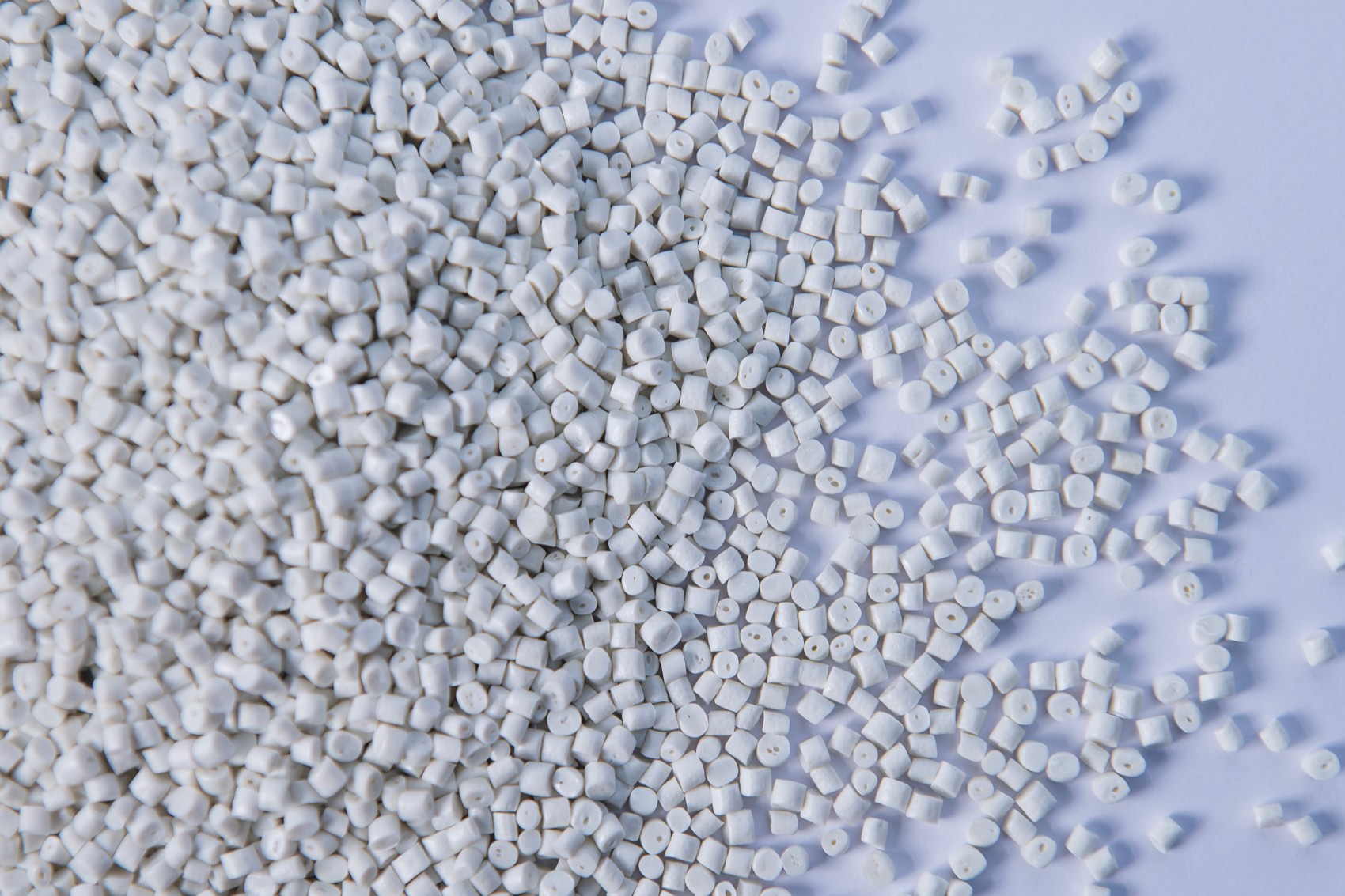
Polyamide is one of the hardest common polymers to plasticize, and the reason is the same thing that makes it strong. The plasticizer class that works in nylon is the sulfonamides.
Why nylon is hard to plasticize
Polyamide chains are tied together by hydrogen bonds between amide groups, and the polymer is semi-crystalline. Those hydrogen bonds are the source of nylon's strength, heat resistance, and chemical resistance, and they are also the barrier. A plasticizer has to be polar enough to compete with amide-to-amide hydrogen bonding and stay dissolved in the amorphous phase. General-purpose ester plasticizers are not; they either fail to mix in or bloom back out.
Nylon does have one plasticizer it picks up on its own: water. Absorbed moisture softens polyamide noticeably, so nylon parts behave differently dry-as-molded than after conditioning. But moisture content follows ambient humidity, so the flexibility it gives is uncontrolled and changes with the weather.
How sulfonamides do it
Sulfonamide plasticizers carry an N-H donor and S=O acceptors, so they hydrogen-bond with the amide groups the same way neighboring nylon chains do. That lets them insert between chains, stay compatible at useful loadings, and hold the amorphous phase open. The result is controlled, formulated flexibility instead of humidity-dependent flexibility.
What that changes in practice:
- Flexibility and elongation. The glass transition drops and the material bends instead of breaking, including at low temperature.
- Processing. Melt viscosity comes down and mold release improves, which matters in monofilament and profile work.
- Water behavior. With the plasticizer supplying the flexibility, the compound depends less on absorbed moisture, and water absorption stays low.
The two liquid grades, and where each goes
N-butyl benzenesulfonamide (NBBS, CAS 3622-84-2) is the workhorse polyamide plasticizer. It is a clear liquid, 99% minimum assay, with viscosity of 150 to 180 mPa·s. It plasticizes nylon broadly and is particularly established in the flexible polyamides, PA11 and PA12, where it supports monofilament, film, tubing-grade compound, and fiber work. The same polarity lets it plasticize polyacetal (POM), polycarbonate, and polysulfone. We stock it as ProFlex 4.
N-ethyl toluenesulfonamide (CAS 1077-56-1 / 80-39-7) is the other liquid, stocked as ProFlex 8: viscosity of 250 to 400 mPa·s, pour point of minus 10 °C. It plasticizes polyamide and cellulosic resins and doubles as a dye solvent and pigment dispersant, so it shows up in textile and thread finishing as well as compounding. Its low solubility in petroleum hydrocarbons carries into the finished material as grease and oil resistance, and it holds FDA food-contact clearances including 21 CFR 175.105 and 176.180.
Running a polyamide flexibility target?
Tell us the polyamide, the loading range you are exploring, and the property you have to hit. Both liquid grades ship from North American stock, samples typically the same business day.
Request a SampleThe two liquid grades have their own pages: ProFlex 8, the N-ethyl toluenesulfonamide, and ProFlex 4, the N-butyl benzenesulfonamide. Both carry the specification and the CAS number.
Formulating notes
Both grades are non-reactive monomeric liquids: they sit in the polymer and do their work physically, so they can be dosed against the flexibility target without consuming functionality. Dosing typically runs by trial against the property window, starting low; more plasticizer means more flexibility and easier flow, traded against modulus and heat deflection. For fiber, monofilament, and film lines, the liquid form meters cleanly into compounding.
If the system is a thermoset rather than a thermoplastic, the selection changes: the reactive ortho/para toluenesulfonamide grade condenses into amino resins and consumes isocyanate in PU systems. That grade and its accounting are covered in the ProFlex 9S article.
Regulatory status
The sulfonamide plasticizer chemistries are not phthalates, are not on the EU REACH SVHC candidate list, and are not restricted under Annex XVII. The N-ethyl toluenesulfonamide grade carries FDA food-contact clearances. TDS, SDS, and application-specific compliance documentation are available on request, and the broader selection logic across chemistries is in non-phthalate plasticizer selection by polymer and application.
Frequently asked
Why can't ordinary plasticizers soften nylon?
Polyamide is held together by strong amide-to-amide hydrogen bonds. A plasticizer has to be polar enough to compete with them and stay dissolved. General-purpose esters are not, so they never mix in or migrate out. Sulfonamides work by hydrogen-bonding with the amide groups.
What do sulfonamide plasticizers change in polyamide?
Flexibility and elongation, low-temperature behavior, melt viscosity, and mold release. The compound also depends less on absorbed moisture for its flexibility, and water absorption stays low.
Which sulfonamide grade goes with which polyamide use?
NBBS for flexible polyamide including PA11 and PA12, monofilament, film, and fiber, plus polyacetal, polycarbonate, and polysulfone. N-ethyl toluenesulfonamide where grease resistance, dye-solvent behavior, or food-contact clearances matter.
Are sulfonamide plasticizers restricted in the EU or US?
No. They are not on the SVHC candidate list, not restricted under Annex XVII, and not phthalates. The N-ethyl toluenesulfonamide grade carries FDA food-contact clearances.
Plasticizing a polyamide?
Send the polymer and the property target. We will recommend a grade, ship a sample from stock, and provide the documentation your qualification needs.
View the sulfonamide plasticizers page