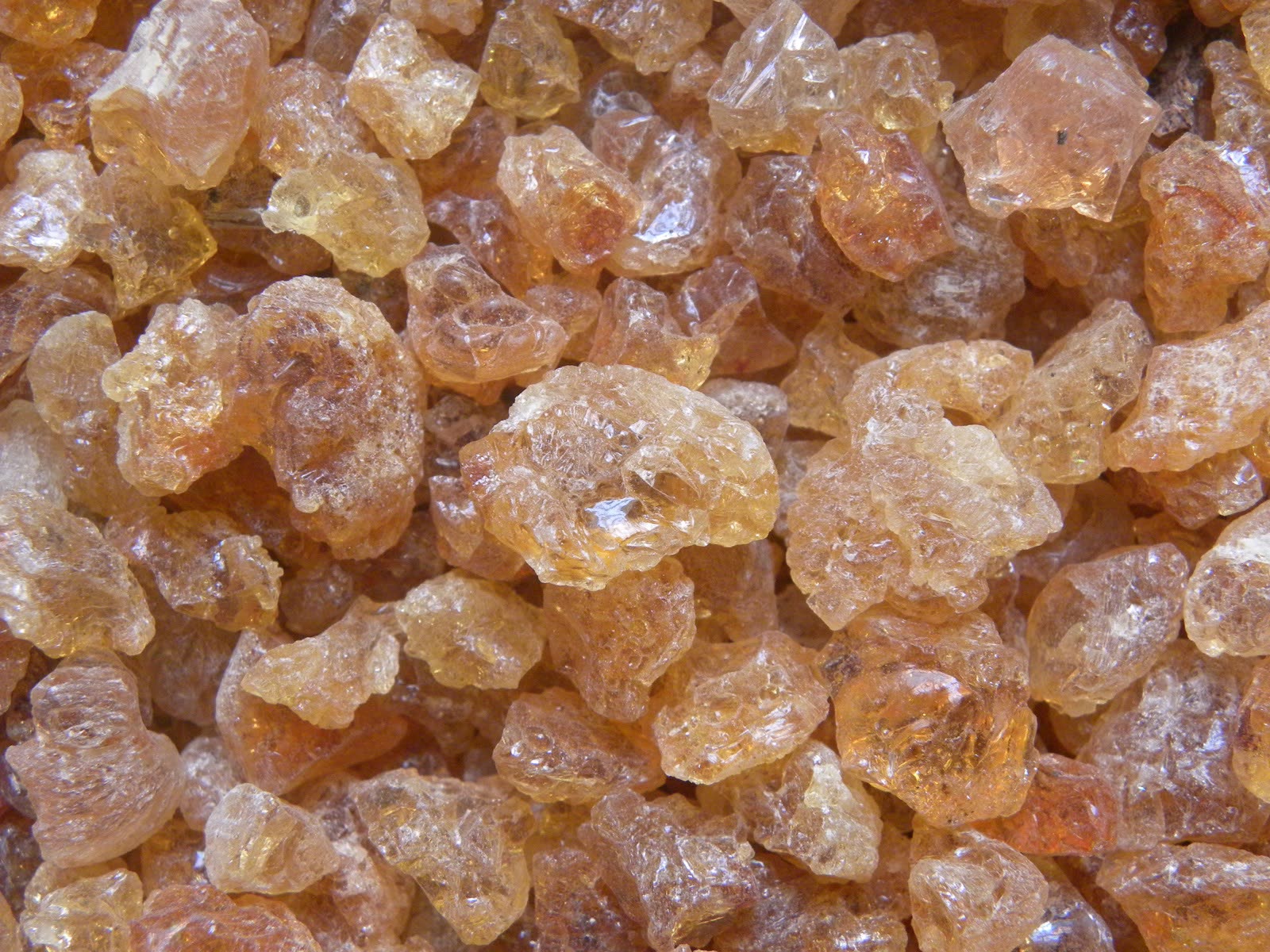
Kibbled gum arabic has to be ground before it will dissolve at working strength. A purified spray-dried powder in agglomerated form does not, and that is the whole substitution: the gum chemistry on the plate stays the same and a piece of equipment comes out of the plant.
What kibbled gum is
Gum arabic is a natural exudate. Kibbled material is that exudate cleaned, sorted and broken into lumps, and nothing more: it has never been taken into solution, so it still carries the bark, sand and other insoluble matter that arrives with the raw crop. Grade names in this form run to things like kibbled number 1 and number 2, and the number describes the sort, not the chemistry.
To use it, a plant grinds it down and then hydrates it, usually with agitation and time. Both steps exist because the material is a hard, glassy solid that dissolves slowly at particle sizes a mill has to produce.
What the grinder actually costs
The mill is the visible part. Behind it sit the things attached to a mill: dust collection, noise, wear parts, a cleaning routine between grades, and a hydration vessel with enough residence time that the make-up step becomes a batch operation, not a metered one.
The mill also leaves the insolubles behind. Bark and sand that came in with the raw gum leave the grinder still insoluble, so they end up on the tank screen, in the filters, and eventually in the circulating solution.
What an instantized powder does instead
Instantized, agglomerated and fast-hydrating all describe the same treatment. Spray-dried gum arabic is a fine powder, and a fine powder thrown into water tends to seal its own surface into a lump with dry material inside it. Agglomeration clusters those dried particles so water penetrates the cluster and wets each particle individually.
The result is a coarse powder specified as fast soluble in cold water, forming a colloidal solution. No mill, no heated hydration vessel, no overnight stand. Both grades we supply into pressroom chemistry, Type 4880 and Type 4915, are built this way.
Purification happens before the powder is packed, not in your tank. The raw gum goes into solution, is clarified, and is dried, so the specification can put a number on what is left: insoluble matter 0.1 percent maximum, acid-insoluble ash 0.5 percent maximum.
The quick test of whether this applies to you
If a mill sits between your gum arabic drums and your make-up tank, the substitution is available to you. If your gum already arrives as a powder, this is a specification comparison, not a process change, and the values to compare are viscosity at 25 percent solids, solution pH, and insoluble matter.
Request a SampleWhat to check when substituting
The gum solids do the same job on the plate either way, so most of the work is confirming that the same solids arrive by a different route.
- Dose on solids, not on pack weight. Loss on drying is specified at 10 percent maximum, and two forms of the same gum can sit at different moisture. Set the addition rate against dry gum and the recipe carries over.
- Viscosity at your working concentration. Types 4880 and 4915 run 60 to 100 mPa·s at 25 percent w/w, measured on a Brookfield LVT with spindle 2 at 60 rpm and 20 °C after 24 hours. If your incoming material was specified on a different concentration or spindle, convert before you compare.
- The pH of the made-up concentrate. A 25 percent solution of these grades sits at pH 4 to 5. Confirm where that lands against your acid and buffer; the gum solution is not neutral.
- Screen and filter load. This is where a purified powder shows up fastest. Watch the tank screen for the first few batches and you will see the difference in what it collects.
- Species, through optical rotation. Dextrorotatory identifies the gum as Acacia seyal on that row, levorotatory as Acacia senegal. Seyal gives a thinner solution than senegal for the same dissolved solids, which matters if you meter a concentrate.
- Preservation. An aqueous polysaccharide solution supports microbial growth whichever form the gum arrived in. A faster make-up step can mean smaller, more frequent batches, which changes the turnover plan more than it changes the preservative.
What does not change
The mechanism on the plate is identical. Gum arabic desensitizes the non-image areas by adsorbing onto the grained aluminum oxide surface and holding a water film there, and it does that on the basis of what the molecule is, not how the powder was dried. How gum arabic desensitizes an offset plate covers that chemistry.
The identity does not change either. Acacia gum and gum acacia name the same material as gum arabic, CAS 9000-01-5, E 414, so a specification written against one of those names reads correctly against the others.
Frequently asked
What is kibbled gum arabic?
Kibbled gum arabic is raw gum broken down into lumps. It is sorted and sized but not taken into solution, so it carries the insoluble matter that comes with a natural exudate and it has to be ground and hydrated before it will go into a make-up tank at working strength.
Why would a plant stop grinding gum arabic?
The grinder is equipment with dust, noise, wear parts, a cleaning routine and a hydration vessel behind it. A purified spray-dried powder in agglomerated form is specified as fast soluble in cold water, so removing the grinder takes the hydration vessel out with it.
Does the formulation have to change when the gum changes?
The gum solids do the same job either way, so the dose is set on a solids basis, not on pack weight. Re-measure solution viscosity at your working concentration, the pH of the made-up concentrate, and how much material the tank screen collects. Those three are where a change shows up first.
Is instantized gum arabic the same as agglomerated?
Yes. Instantized, agglomerated and fast-hydrating all describe the same treatment: the dried particles are clustered so water penetrates the cluster and wets each particle, and the surface does not seal into a lump. The specification wording for Types 4880 and 4915 is purified, agglomerated, fast soluble spray-dried powder with instant properties.
Where to start
P.A.T. Products supplies gum arabic Types 4880 and 4915 into lithographic fountain solutions, plate gums and pressroom chemistry, country of origin Germany, with a specification, an SDS and a Certificate of Analysis per lot. Type 4880 is the grade to open on.
Send the grade you buy today, the annual volume, and how you make the concentrate up. We will tell you which type matches, send a sample against your own make-up procedure, and say plainly where the two specifications differ.
See gum arabic for fountain solutions