Calcium stearate does a different job in nearly every industry that buys it. PVC compounders run it as an acid scavenger and lubricant. Polyolefin producers use it to neutralize catalyst residue. Concrete and masonry plants add it as an integral water repellent. Rubber processors dust uncured stock with it so the stock releases cleanly. Paper mills meter it into coating color for gloss and slip. Grease makers thicken with it. Pharmaceutical and food plants use it as a tablet lubricant and anti-caking agent.
It is one material underneath: the calcium salt of stearic acid, CAS 1592-23-0, a metal soap.
Two properties carry every application
A calcium stearate particle pairs long fatty-acid chains with a calcium center. The fatty chains make it waxy, slippery, and water repellent: they migrate to surfaces and interfaces, lower friction, and shed water. The calcium is a mild base that neutralizes acids. Every use below leans on one of those two properties, and the largest uses lean on both at once.
PVC: stabilizer and lubricant in the same additive
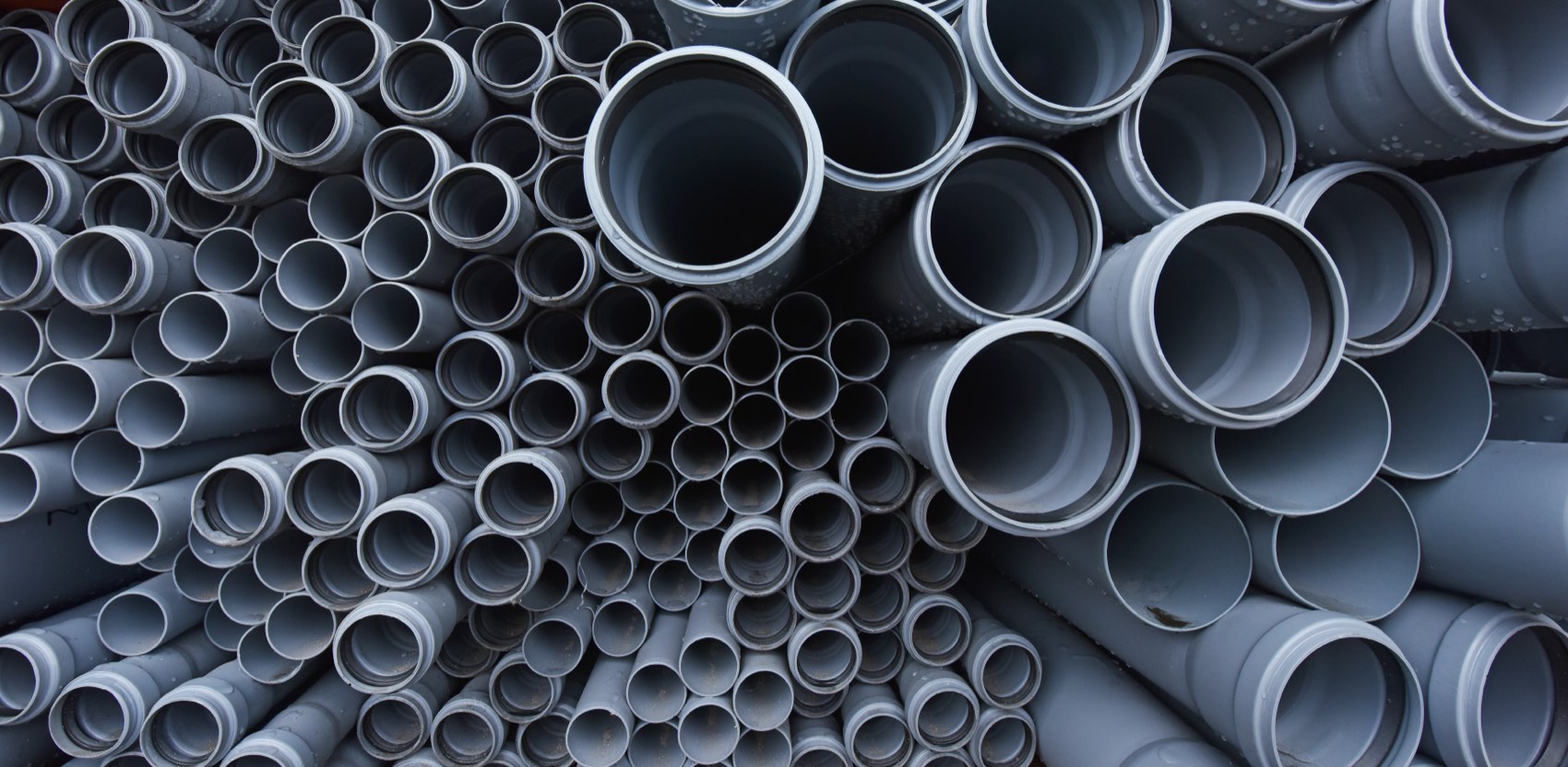
PVC degrades during processing by giving off hydrogen chloride, and the reaction feeds itself: the acid released speeds up further degradation, which shows up as yellowing and eventually charring. Calcium stearate neutralizes that acid as it forms. That is the co-stabilizer role, and it is why calcium stearate sits at the center of the calcium-zinc stabilizer systems that displaced lead and tin across pipe, profile, siding, window, cable, and flooring compounds.
The same molecule lubricates while it stabilizes. Internally it reduces friction between polymer chains and lowers melt viscosity. Externally it migrates to the metal of the extruder and die and releases the melt cleanly. In rigid PVC it also promotes fusion. How much of each effect you get is set by dose and by the rest of the additive package, and that balance is formulation work that belongs on your line. The direction of effect is the portable part: more calcium stearate generally means more lubrication and faster fusion, up to the point where plate-out and haze push back. The full dosing logic, and how the calcium-zinc pair actually works, is in calcium stearate in rigid PVC.
Polyolefins: acid scavenging after the catalyst
Polypropylene and much polyethylene come off Ziegler-Natta catalysts carrying acidic chloride residues. Left in the resin, those residues corrode dies and drag down color. Calcium stearate is the standard acid scavenger dosed at the resin plant to neutralize them, at parts-per-million levels set by the producer's recipe, and it doubles as a lubricant and release aid in the finished resin.
This is the application where the low-ash grade earns its premium, because film clarity and dielectric performance suffer with every part per million of inorganic residue.
Construction: water repellency for concrete, mortar, and board
Mixed into concrete, mortar, or a masonry blend, calcium stearate lines pores and capillaries with a hydrophobic film. Water absorption drops, and with it efflorescence, the white salt bloom that appears when water moves through a block and evaporates off the face. Producers of concrete block, pavers, and dry-mix mortar meter it in as a powder or a dispersion. Gypsum wallboard and fiber-cement plants use it for water resistance and as a release aid that keeps slurry off belts and rolls.
Construction is also the application that asks the least of the grade. The ash and color limits that matter in capacitor film are beside the point in a paver block.
Rubber: release, anti-tack, and dusting
Uncured rubber sticks to itself. Calcium stearate is the standard dusting agent on slabs, sheets, and extruded preforms so stacked stock does not block before cure, and it works as a mold release and processing aid in the press. It is inexpensive, and it is inert enough to stay out of the way of most cure chemistries.
Paper, paints, and inks
Paper mills buy calcium stearate as an aqueous dispersion metered into the coating color. On the coated sheet it acts as a lubricant: gloss comes up in the calender, dusting drops, and the sheet folds without cracking along the coating.
In paints and inks the same particle works as a matting and flatting agent and an anti-settling aid, and powder-coating lines use it for flow and degassing. Where stronger flatting is wanted, formulators often reach for zinc stearate; the two metal soaps split this territory between them.
Grease and dry lubricants
Calcium-soap greases are the original water-resistant greases. The soap structure holds the oil and resists washout, which keeps calcium greases in service wherever equipment runs wet. Calcium stearate also stands alone as a dry lubricant: wire-drawing soaps and metal-forming compounds use it as the solid film between die and metal.
Pharmaceutical and food
In a tablet press calcium stearate is a lubricant, anti-adherent, and glidant: it keeps powder flowing and keeps tablets off the punches. In powdered foods it is an anti-caking and flow agent, food-additive code E470a, generally recognized as safe in the United States. These uses call for the pharmacopeial grades, USP-NF or FCC, with edible-source documentation, rather than the technical grade.
When the spec says low ash
Ash is what remains when a sample of the stearate is burned off: unreacted lime, carbonates, and other inorganic residue from manufacture. A standard technical grade carries more of it. A low ash grade is made and washed to keep it down, and a low ash number usually travels with low free fatty acid and tighter color.
It matters anywhere the residue ends up in the product: clear and high-clarity polyolefin film, biaxially oriented polypropylene, and above all capacitor-grade polypropylene, where dielectric losses track inorganic content. It matters much less in concrete, board, and rubber dusting. The low-ash grade costs more to make, so specify it where the application earns it, and read the ash line on the Certificate of Analysis against your own limit rather than taking the grade name on faith.
Low-ash calcium stearate, in stock
We hold healthy stock of low-ash calcium stearate in our US warehouse, with zinc, magnesium, aluminum, and sodium stearates available alongside it. Samples typically go out the same business day.
View calcium stearateBuying calcium stearate in the United States
Four decisions set the purchase: grade (low-ash technical or USP-NF-FCC), form (standard powder, micronized, granule, or aqueous dispersion), origin (vegetable or animal fat, with kosher and halal documentation where it is needed), and the paperwork your qualification process requires. A Certificate of Analysis for calcium stearate normally reports assay as calcium oxide, free fatty acid, ash, moisture, and fineness. Reading those five numbers against your spec is most of the qualification.
The remaining variable is supply itself. If you buy to a reorder point and the material crosses an ocean to reach you, the lead time is part of the spec. We stock low-ash calcium stearate in our US warehouse in commercial quantity: samples typically go out the same business day, and stock orders ship the next business day.
If you are specifying calcium stearate for the first time, weighing it against zinc or magnesium stearate for the job, or qualifying a second source against the grade you run now, get in touch. Tell us the application and the spec, and we will confirm grade, form, and documentation, and put a sample on its way.
Frequently asked questions
What is low ash calcium stearate?
Low ash calcium stearate is a grade manufactured and washed to minimize inorganic residue, measured as the ash left after a sample is burned off. A low ash number usually travels with low free fatty acid and tight color. It is specified where residue ends up in the product, above all clear polyolefin film, biaxially oriented polypropylene, and capacitor-grade polypropylene, where ash drives haze and dielectric loss.
Is calcium stearate the same as stearic acid?
No. Stearic acid is the free fatty acid; calcium stearate is its calcium salt, made by reacting the acid with lime. They do different jobs. Stearic acid is a cure activator and internal lubricant in rubber and a feedstock elsewhere. Calcium stearate is an acid scavenger, lubricant, release agent, and water repellent.
Why is calcium stearate used in concrete and masonry?
It is an integral water repellent. Mixed into concrete, mortar, or a masonry blend, it lines pores and capillaries with a hydrophobic film, which cuts water absorption and the efflorescence that follows water movement through the block. It is added at the mixer as a powder or an aqueous dispersion.
What does calcium stearate do in grease?
Calcium soaps are the thickener in calcium greases, the original water-resistant greases: the soap structure holds the oil and resists washout in wet service. Calcium stearate also works alone as a dry lubricant, the solid film in wire-drawing soaps and metal-forming compounds.
Does calcium stearate dissolve in water?
No. It is essentially insoluble in water, which is exactly why it works as a water repellent. For waterborne systems such as paper coating color, it is supplied as a ready-made aqueous dispersion rather than dissolved.