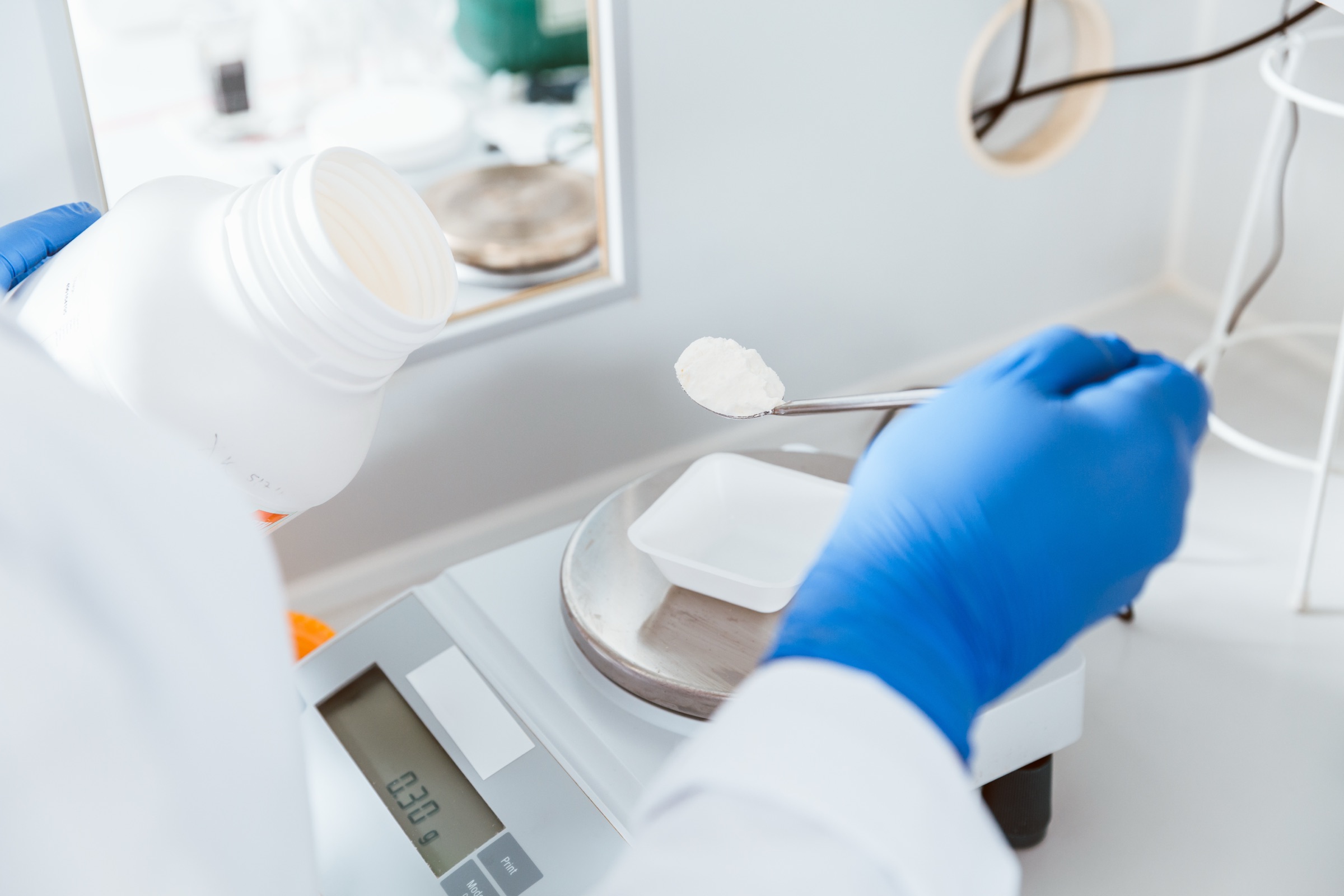
Granular tolyltriazole (TTA) and benzotriazole (BTA) are the most concentrated way to buy the active, and they dissolve poorly in plain water. A formulator building a glycol coolant, a hydraulic fluid or a water-treatment concentrate takes them into a carrier first. There are three carriers: caustic, which turns the azole into its sodium salt; a lower alcohol; or a glycol. Each one sets the strength you can reach, how the concentrate behaves in the cold, and how it ships.
Water alone carries very little
Neutral benzotriazole dissolves to about 20 grams per liter at 25 degrees C, roughly 2 percent, and to about 7 percent at 60 degrees C. Neutral tolyltriazole dissolves to about 4 grams per liter, four to five times less. The methyl group that makes TTA tougher under heat and chlorine also makes it less water-soluble.
| Inhibitor | CAS | Water solubility, neutral form | Melting point |
|---|---|---|---|
| Benzotriazole (BTA) | 95-14-7 | About 20 g/L at 25 °C | About 97 to 100 °C |
| Tolyltriazole (TTA) | 29385-43-1 | About 4 g/L, room temperature | About 76 to 87 °C |
Those numbers are why nobody ships a meaningful azole concentrate in neutral water. The carrier has to change the chemistry or the solvent.
Caustic: converting the azole to its sodium salt
Both azoles are weak acids. Benzotriazole's pKa is 8.37 and the main tolyltriazole isomer sits near 8.5. Above about pH 10, nearly all of the azole is ionized, and the sodium salts dissolve at more than 500 grams per liter for benzotriazole and 625 to 664 grams per liter for tolyltriazole.
Full conversion takes about 0.34 kilograms of sodium hydroxide per kilogram of benzotriazole and about 0.30 kilograms per kilogram of tolyltriazole, on a 100 percent caustic basis. In practice, tolyltriazole concentrates above about 1 percent are held above pH 12. Below that, unconverted azole comes out of solution as fine white solids when the concentrate cools.
The caustic route gives the strongest water-miscible concentrate, and the result is a corrosive liquid rather than an irritant powder. Adding acid to it later releases heat and can throw free azole back out of solution. This is the chemistry behind sodium tolyltriazole 50% and sodium benzotriazole 40%, which arrive already converted. Read their strength on the right basis: 50 percent sodium tolyltriazole is about 43 percent tolyltriazole as the free acid.
Alcohols: high loads, low flash point
Benzotriazole dissolves heavily in the lower alcohols. A 2018 study in the Journal of Chemical & Engineering Data measured saturation from minus 5 to 30 degrees C:
| Solvent | BTA at 25 °C, % of saturated solution | BTA at minus 5 °C |
|---|---|---|
| Methanol | 70.1 | 55.0 |
| Ethanol | 60.1 | 42.8 |
| Isopropanol | 53.6 | 38.5 |
Cold costs a quarter to a third of the capacity, so set the concentration against the coldest place the drum will sit, not the lab bench. For tolyltriazole the published data stop at "more than 100 grams per liter" in alcohol at 21 degrees C. Commercial tolyltriazole concentrates in isopropanol are sold at roughly 35 to 40 percent.
The cost of the alcohol route is the flash point. Methanol, ethanol and isopropanol all flash at roughly 9 to 12 degrees C, so an alcohol concentrate ships and stores as a flammable liquid.
Glycols and glycol ethers: the coolant carrier
Glycol is the natural carrier when the azole is headed for an antifreeze, an inhibited heat-transfer fluid, a glycol-based hydraulic fluid or a de-icer, where tolyltriazole and benzotriazole run at a few tenths of a percent or less of the finished fluid, about 0.1 to 0.2 percent in glycol de-icers and antifreeze. At those use levels the granular dissolves in the glycol with stirring at room temperature, and mild warming speeds it up.
For a concentrate, the data are thin. No peer-reviewed or registration figure has been published for tolyltriazole in ethylene glycol, propylene glycol or diethylene glycol. Tolyltriazole is reported soluble in ethylene glycol, and commercial concentrates in propylene glycol and diethylene glycol are sold at roughly 35 to 40 percent, which shows those loads are workable at room temperature. Run a small batch at your target load and hold it at your lowest storage temperature before committing a production lot.
The glycols themselves flash well above 100 degrees C: propylene glycol at about 101, ethylene glycol at about 111 and diethylene glycol at about 124. Glycol ethers sit lower, about 60 for butyl glycol and 78 for butyl diglycol.
Choosing the route
| Route | What it gives you | What to watch |
|---|---|---|
| Caustic (sodium salt) | The highest water-miscible strength; mixes straight into water-based systems | pH above 12; corrosive; acid contact releases heat and precipitates azole |
| Alcohol | Very high benzotriazole loads; fast to dissolve | Flammable; capacity falls sharply in the cold |
| Glycol | Fits coolants, heat-transfer and hydraulic fluids without adding water | Little published data for tolyltriazole; prove the load at your coldest temperature |
| Buy the sodium-salt liquid | No dissolving step, no caustic handling | Freight on the water; compare strength on a free-acid basis |
Handling the granular
Both granular grades are dusty to handle. They are classed as harmful if swallowed or inhaled and as serious eye irritants, and both carry an aquatic hazard. Once dissolved in caustic, the concentrate takes on the caustic's corrosive classification. The current safety data sheet for each grade governs.
Frequently asked
Does P.A.T. Products sell tolyltriazole pre-dissolved in glycol or alcohol?
No. We supply tolyltriazole granular 99%, benzotriazole fine granular 99%, sodium tolyltriazole 50% and sodium benzotriazole 40%. A glycol or alcohol concentrate is made from the granular grade, and the sodium-salt liquids are the ready-made caustic route.
How soluble is tolyltriazole in water?
Neutral tolyltriazole dissolves to about 4 grams per liter at room temperature, according to its REACH registration data, roughly four to five times less than benzotriazole at about 20 grams per liter at 25 degrees C. Raising the pH above about 10 converts it to the sodium salt, which dissolves at more than 600 grams per liter.
How much tolyltriazole dissolves in propylene glycol?
No peer-reviewed or registration figure has been published for tolyltriazole in propylene glycol, ethylene glycol or diethylene glycol. Commercial tolyltriazole concentrates in propylene glycol and diethylene glycol are sold at roughly 35 to 40 percent, which shows those loads are workable at room temperature. Confirm your own load at the coldest temperature the concentrate will see.
Why does a tolyltriazole concentrate turn cloudy in the cold?
Solubility falls as temperature falls. In alcohols the drop is steep: benzotriazole's saturation in ethanol goes from about 60 percent at 25 degrees C to about 43 percent at minus 5. In caustic concentrates, tolyltriazole that is not fully converted to the sodium salt comes out as fine white solids when the solution cools, which is why concentrates above about 1 percent are run above pH 12.
Is 50% sodium tolyltriazole the same as 50% tolyltriazole?
No. The 50 percent is the sodium salt. Expressed as free tolyltriazole it is about 43 percent, because the sodium adds weight. Compare concentrates on the same basis before comparing price or dose.
What we supply
P.A.T. Products supplies the four forms this article turns on: tolyltriazole granular 99%, benzotriazole fine granular 99%, sodium tolyltriazole 50% and sodium benzotriazole 40%, from North American stock. For choosing between the two inhibitors, see benzotriazole vs tolyltriazole; for solid against liquid feed in water treatment, see choosing between solid and liquid azole feed.
If you are building an azole concentrate, please get in touch and we will send granular or sodium-salt samples.
Sources
Water solubility, pKa, melting points and sodium-salt solubility: REACH registration data as compiled in RIVM report 2025-0051, and the Hazardous Substances Data Bank (PubChem CID 7220). Benzotriazole in alcohols: Luan et al., "Solution Thermodynamics of Benzotriazole in Different Pure Solvents," J. Chem. Eng. Data 2018, 63(5), 1546-1555. Tolyltriazole in alcohol and ethylene glycol, and use levels in glycol fluids: Danish EPA Environmental Project No. 1526 (2013). Concentrate pH practice: US Patent 8,828,273. Dissolving tolyltriazole in water-glycol fluids: US Patent 9,695,380. Flash points: ILO-WHO International Chemical Safety Cards.
See corrosion inhibitors