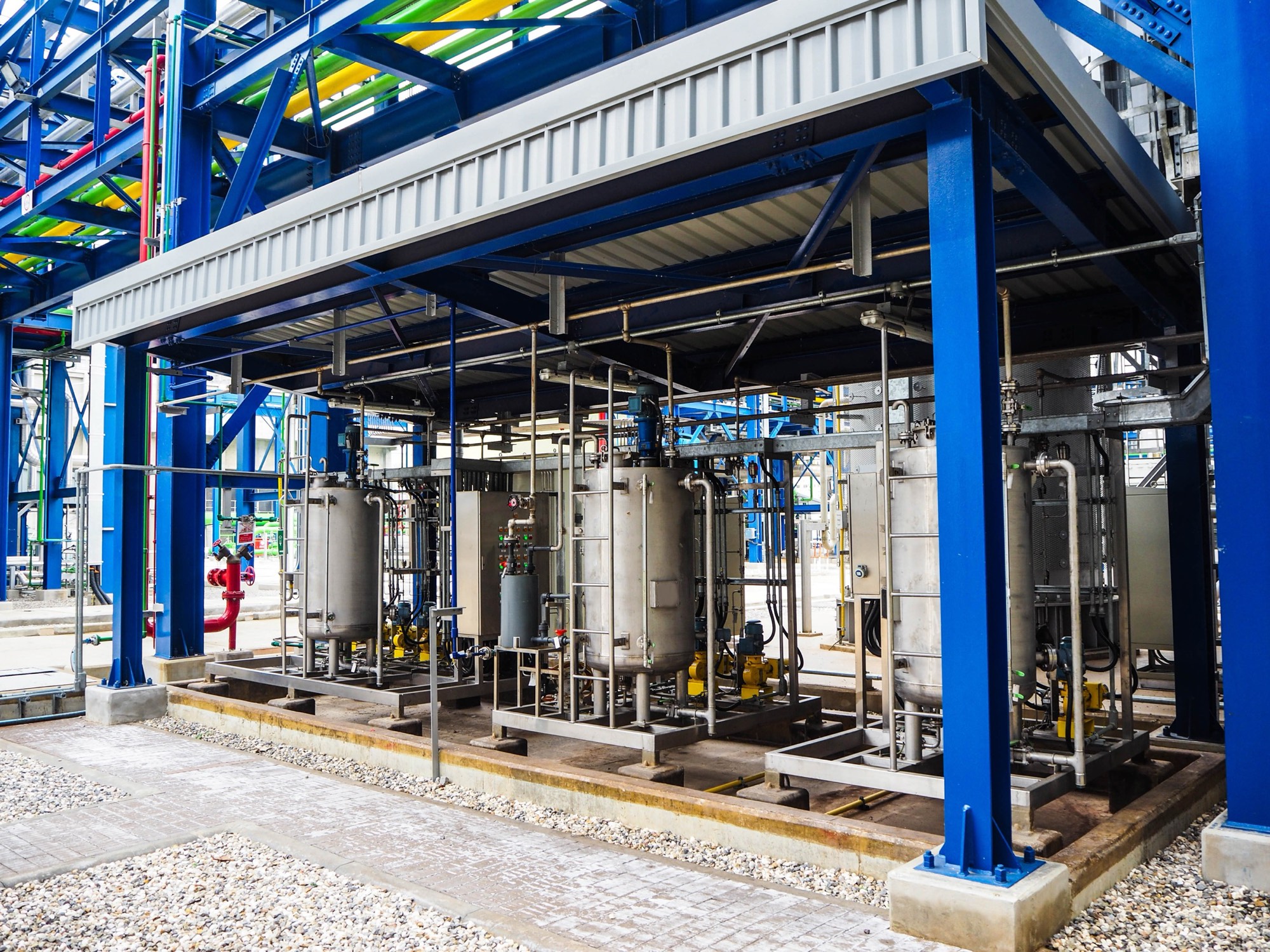
A closed loop has no evaporation, no blowdown, and no daily makeup dragging the chemistry around, so an azole dosed at startup can drift toward zero for years before anyone retests the residual. Benzotriazole dosing in a closed system turns on what depletes the residual, and on the monitoring that keeps the film intact.
Why closed-loop dosing differs from tower dosing
In an open recirculating tower, azole is fed continuously because blowdown and drift constantly remove it; the economics push residuals to the low single-digit parts per million that maintain the film day to day. A closed loop faces the opposite problem: the water stays, so the inhibitor can be carried at a higher concentration once, then maintained. Closed loops typically run azole residuals in the tens of parts per million, a reservoir of protection sized to last between checks rather than between feed pulses.
The mechanism being maintained is the same in both: benzotriazole chemisorbs onto copper and brass and builds the copper-azole film that blocks both dissolution and the galvanic mischief dissolved copper causes downstream on steel and aluminum. The film chemistry is covered in how azole inhibitors protect copper and brass.
Passivation dose, then maintenance residual
At startup, after chemical cleaning, or after any event that strips surfaces, the loop gets a passivation dose, elevated azole held long enough to build the film on bare metal. After that, the maintenance residual only has to keep the film repaired. Programs differ on the exact figures, and the treatment design owns them; the operational rule is that a freshly cleaned or new loop is not protected by its maintenance residual alone, and skipping passivation is how new coils corrode under a "treated" program.
What depletes azole in a loop with no blowdown
- Film formation and repair. The film is made of azole. Every square foot of yellow metal consumed inhibitor building it, and repair keeps consuming at a low rate.
- Fresh metal. Component replacements, new piping, and any active corrosion expose surface that pulls azole from solution.
- Leaks and makeup. Closed loops are rarely perfectly closed. Every gallon of makeup dilutes the residual, and chronic small leaks are the classic cause of slow azole loss.
- Oxidizers. Where a loop is sanitized with an oxidizing biocide, the oxidant degrades azole. Re-dose after oxidant events, and consider tolyltriazole where oxidant exposure is routine.
Monitoring the residual
Azole residuals are directly testable with standard UV-absorbance test methods, and the number belongs on the loop's log next to nitrite or molybdate and glycol concentration. Quarterly is a common cadence for tight loops; anything with known makeup deserves more.
Inhibited glycols include an azole package, but the azole depletes while the glycol persists. Testing the glycol strength and calling the loop protected misses the one component actually guarding the copper.
BTA or TTA for the loop?
In an unchlorinated closed loop, either azole serves and BTA is the common default. Routine oxidant exposure argues for tolyltriazole's better chlorine tolerance. The full comparison: benzotriazole vs tolyltriazole.
Request a SampleSourcing the azole
We supply and stock benzotriazole and tolyltriazole for North American water treatment, in solid and liquid grades, from stock. Formulators blending closed-loop treatment packages and end users maintaining large loops both buy from the same inventory; which physical form fits which operation is covered in choosing between solid and liquid azole feed, and the product detail is on the cooling water corrosion inhibitor page. The grade a loop is usually dosed with is benzotriazole fine granular 99%, and where the loop runs hot or carries an oxidizing biocide it is tolyltriazole granular 99% instead.
Frequently asked
How much benzotriazole does a closed loop need?
Closed loops typically carry azole residuals in the tens of parts per million, above the low single-digit residuals common in open towers, because the water is not replaced and the film has to last. Passivation doses run higher than the maintenance residual. The exact target belongs to the treatment program; the operational discipline is testing and holding it.
Why do closed loops still lose azole if nothing is blown down?
Film formation and repair consume azole, fresh metal surface pulls it from solution, leak makeup dilutes it, and oxidizing biocides degrade it. Loops that never get retested drift below target quietly.
Do glycol loops need an azole?
Yes, when they contain copper or brass. Inhibited glycols include an azole package, but the azole depletes while the glycol persists, so long-lived systems test and re-dose the azole.
Should a closed loop use BTA or TTA?
Either passivates copper and brass; BTA is the common closed-loop default. Routine oxidizing biocide use argues for TTA's better chlorine tolerance.
Feeding azole into a program?
Solid and liquid benzotriazole and tolyltriazole, from North American stock. Tell us the program and the volume and we will quote it.
View corrosion inhibitors